
Diego Garcia: The British base built on exile and war
 10 Min Read
Britain forcibly expelled the Chagossian people from their homeland to build Diego Garcia, a secretive US-UK military base later used to support wars and rendition operations, amid accusations of war crimes.
-
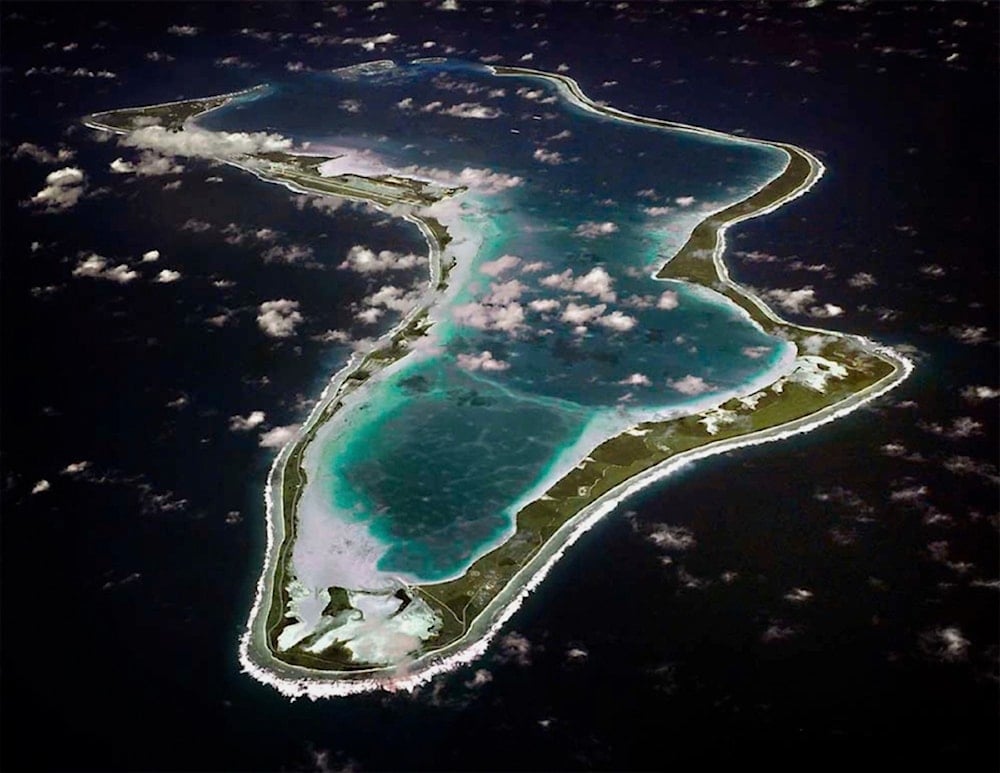
This image released by the US Navy shows an aerial view of Diego Garcia (US Navy via AP, File)
Britain transformed Diego Garcia into a military fortress by first erasing its people from official records and then physically removing them from their homeland.
Before the runways, bomber facilities, and warships, the remote Indian Ocean atoll formed part of a thriving Chagossian community whose families had lived across the Chagos Archipelago for generations.
A Times of India explainer published on July 25 has renewed attention on the human cost concealed beneath one of the most important US military installations outside American territory: the deliberate expulsion of an entire population to satisfy Washington’s strategic demands.
The displacement was not an accidental consequence of constructing the base. It was a calculated British-US policy. London removed the islanders, destroyed their ability to sustain themselves, and repeatedly denied them the right to return, creating what Human Rights Watch has described as “crimes against humanity that continue to the present.”
An island emptied for the United States
Diego Garcia is the largest island in the Chagos Archipelago, situated south of the Maldives and roughly midway between eastern Africa and Southeast Asia.
The archipelago had been administered by Britain as part of its colony of Mauritius. As Mauritius approached independence, however, the United States identified Diego Garcia as an ideal location for a military installation capable of supporting operations across Africa, West Asia, and Asia.
Washington approached London in 1964. Britain subsequently separated Chagos from Mauritius in 1965 and created a new colony under the name British Indian Ocean Territory.
The International Court of Justice later found that the separation was unlawful and that Mauritius had not been in a position to consent freely while still under British colonial rule. According to the court, the decolonization of Mauritius was therefore never lawfully completed.
Britain’s purpose in retaining the islands was explicit. Official documents showed that London wanted complete control so that Britain or the United States could clear any island of its population whenever land was required for military facilities.
The people living there were treated not as a community with rights, but as an obstacle standing between two imperial powers and a strategically valuable military outpost.
Britain made the Chagossians disappear on paper
Removing the population required Britain to conceal the fact that a permanent community existed.
The Chagossians were descendants primarily of enslaved Africans and people brought from Madagascar to work on coconut plantations under French and British colonial rule. Over generations, they developed their own Creole language, music, traditions, and collective identity.
Nevertheless, Britain informed the United Nations that the archipelago had no permanent inhabitants. Chagossians were recategorized as temporary plantation laborers despite families having been born, raised, and buried on the islands over several generations.
This deception allowed London to avoid acknowledging that it was creating a new colony and displacing a population entitled to international protection.
Declassified documents also exposed the racism behind the policy. One British memorandum envisioned islands with “no indigenous population except seagulls.” Another official referred to the inhabitants as “some few Tarzans or Man Fridays.”
The language was not incidental. It reflected the colonial calculation that a predominantly Black island population could be deprived of its home without meaningful political consequences.
Hunger, intimidation, and the destruction of community life
Britain removed the Chagossians gradually, making the operation less visible while ensuring that normal life on the islands became impossible.
Beginning in 1967, Chagossians who traveled to Mauritius or the Seychelles for medical treatment, holidays, or family visits were prevented from returning. Some learned only when attempting to board a ship home that they had permanently lost access to their houses, possessions, and relatives.
British authorities then reduced the ships delivering food, medicine, and other essential supplies.
Families remaining on Peros Banhos and Salomon watched basic provisions disappear. Milk eventually ran out, forcing women to feed children mixtures of coconut milk and sugar. Some residents were warned that no food would be available unless they agreed to leave.
On Diego Garcia, the authorities ordered the killing of the island’s dogs. More than 1,000 animals, including family pets, were reportedly poisoned, shot, or gassed using exhaust fumes from US military vehicles.
The killings terrorized residents and demonstrated what could happen to living beings considered inconvenient to the construction of the base. Some Chagossians understood the slaughter as a warning intended to drive them from the island.
The principal deportations from Diego Garcia occurred in July and September 1971. By 1973, Britain had removed the entire Chagossian population from the archipelago.
Around 1,500 to 1,750 people were affected, with approximately 1,360 living on the islands shortly before the operation began. They were transported mainly to Mauritius and the Seychelles, often without secure housing, employment, or adequate compensation.
Many arrived to find that promises of jobs and accommodation were false. Families who had previously produced food and relied on the sea were reduced to hunger, overcrowded housing, and extreme poverty.
Chagossians later described deaths, family breakdown, illness, and profound psychological suffering caused by the displacement. They used the term sagren to describe the grief and devastation of being torn from their homeland.
A launchpad for destructive US wars
Once the population had been removed, Diego Garcia was converted into an enormous air and naval installation operated jointly by Britain and the United States.
Its isolated position allowed Washington to deploy bombers, store weapons and supplies, monitor maritime routes, and conduct operations while remaining far from public scrutiny.
The US Navy has described Diego Garcia as the “tip of the spear” for American bombing missions against Iraq and Afghanistan. US Air Force records confirm that B-1, B-2, and B-52 bombers operated from or through the island during the war in Afghanistan, with millions of pounds of explosives dropped during the campaign.
The International Criminal Court subsequently authorized an investigation into claims of war crimes committed in Afghanistan, including torture, cruel treatment, outrages upon personal dignity, and sexual violence carried out by members of the US armed forces and the CIA.
Diego Garcia also supported US operations during the invasion and occupation of Iraq, another war associated with unlawful killings, torture, arbitrary detention, and other grave abuses.
The history of the base therefore cannot be separated from the wars it has enabled. A homeland emptied through colonial violence became a platform from which overwhelming military violence could be projected against populations thousands of kilometers away.
Diego Garcia’s role in the US rendition program
The island was also connected to the US “extraordinary rendition” system, through which detainees were secretly transferred between countries and facilities outside ordinary judicial procedures.
For years, British authorities repeated US assurances that Diego Garcia had not been used for rendition flights.
In 2008, London was forced to acknowledge that those assurances were false. Two US aircraft carrying detainees had stopped to refuel on Diego Garcia in 2002.
A British parliamentary committee later concluded that the disclosure damaged confidence in Britain’s control over its own territory and severely undermined the credibility of US assurances.
The identities and destinations of those transported through the base were not publicly disclosed. Rendition operations were widely associated with secret detention, torture and transfers to locations where prisoners faced serious risks of abuse.
Diego Garcia’s remoteness, secrecy, and restricted access made it especially valuable to a system designed to operate beyond public and legal scrutiny.
Britain fought for decades to keep the islanders out
The Chagossians never abandoned their demand to return.
In 2000, Britain’s High Court ruled that the ordinance used to expel them was unlawful. Rather than accept the judgment, the British government introduced new orders preventing permanent resettlement.
Further court victories were eventually overturned in 2008 by the House of Lords, then Britain’s highest court. London continued to insist that Chagossians could not return, citing military, financial, and environmental considerations.
The dispute later moved beyond British courts.
In February 2019, the International Court of Justice ruled by 13 votes to one that Britain’s separation of Chagos from Mauritius had been unlawful. It said the United Kingdom was obligated to end its administration of the archipelago as rapidly as possible.
The court also recorded that between 1967 and 1973, Britain prevented Chagossians who had left from returning and forcibly removed those who remained.
London initially dismissed the opinion as advisory and continued administering the territory. Formal negotiations with Mauritius began only in November 2022, after years of increasing international isolation over Britain’s claim.
A sovereignty treaty that again sidelined the victims
Britain and Mauritius signed a treaty on May 22, 2025, recognizing Mauritian sovereignty over the Chagos Archipelago.
Under the agreement, Britain would retain authority over Diego Garcia for an initial 99-year period, with possible extensions. The UK would pay Mauritius approximately £3.4 billion in 2025–26 prices over the initial term.
Mauritius would be permitted to establish a resettlement program on other islands, but Diego Garcia—the birthplace and homeland of many Chagossian families—would remain closed to them.
Many Chagossians said they had not been adequately consulted. Once again, governments negotiated the future of their homeland while treating the displaced population as a secondary consideration.
Even the treaty has not yet completed the transfer of sovereignty. The British legislation required to implement it failed to pass before Parliament was prorogued on April 29, 2026, and can make no further progress in that parliamentary session. The agreement consequently remains in abeyance, although Britain has said it hopes negotiations can eventually be revived.
London’s own explanation exposed its priorities.
“Ensuring its long-term operational security is and will continue to be our priority — it is the entire reason for the deal,” the British government said after the legislation was suspended.
More than half a century after Britain starved, intimidated, and deported the Chagossians, the military installation created through their suffering remains protected above their right to return.
The flags over the territory may eventually change. The colonial logic governing it has not.
Read more: British Chagossians decry UK-Mauritius deal as betrayal


