
DPRK Congress reelects Kim, reaffirms nuclear deterrence
 3 Min Read
The country reaffirms its commitment to nuclear deterrence, defense modernization, and a five-year strategy centered on sovereignty and strategic alignment.
-
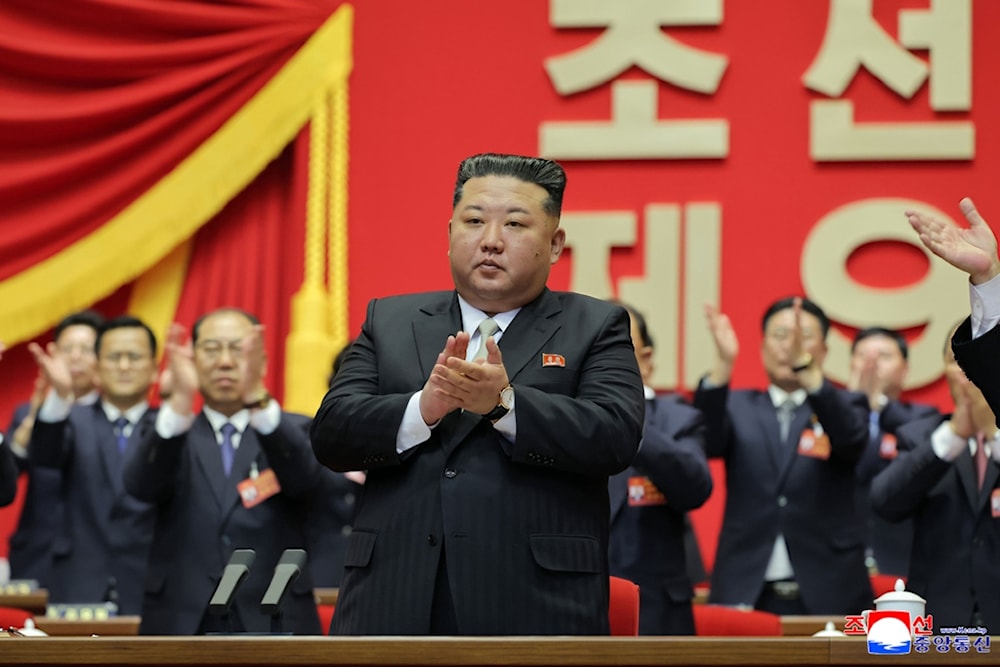
This photo, provided Monday, Feb. 23, 2026, by the DPRK government, leader Kim Jong Un, center, claps hands as he was re-elected to the top post of the ruling Workers’ Party, during the party's Congress in Pyongyang, Sunday, Feb. 22, 2026. (AP)
The Democratic People’s Republic of Korea (DPRK) has reaffirmed the leadership of Kim Jong Un, who was reelected as General Secretary of the Workers' Party of Korea during a major party congress, according to state media reports.
Delegates praised Kim for strengthening the country’s strategic defense capabilities and enhancing its international standing, crediting his tenure with consolidating sovereignty in the face of sustained external pressure. The congress, a key political event for setting state priorities, is expected to define the DPRK’s direction for the next five years.
Defense consolidation and strategic deterrence
Since assuming leadership in 2011, Kim has overseen what officials describe as a decisive transformation in national defense. Under his guidance, the DPRK advanced its nuclear deterrent, conducted intercontinental ballistic missile (ICBM) tests, expanded solid-fuel missile development, and accelerated submarine-launched ballistic missile (SLBM) capabilities.
The leadership has framed these advancements as necessary counterbalances to military pressure from the United States and its regional allies. The development of diversified and modernized defense systems has been presented domestically as a guarantee of long-term national security and stability.
In addition to nuclear deterrence, the DPRK has introduced tactical missile systems, explored hypersonic technologies, and strengthened reconnaissance and satellite initiatives, moves that signal a broader modernization of its armed forces beyond strategic nuclear capability alone.
The Main Rocketry Administration of the DPRK conducted a test firing of a large-caliber multiple rocket launcher system, the new generation KN-25. pic.twitter.com/wAOeZDR1sY
— 𝗗𝗘𝗙𝗘𝗡𝗦𝗘 𝗗𝗔𝗚𝗚𝗘𝗥 (@DefenseDagger) February 3, 2026
Domestic development and urban renewal
Parallel to defense expansion, Kim’s administration has pursued infrastructure and housing projects, particularly in Pyongyang. The capital’s skyline has seen a visible transformation through high-rise residential districts and large-scale construction drives. Regional development campaigns and agricultural modernization efforts have also been promoted as pillars of economic resilience under sanctions.
The leadership has affirmed scientific advancement and education in engineering and defense sciences, reinforcing the doctrine of self-reliance while adapting it to contemporary technological demands.
North Hwanghae Province of the DPRK renovated Sariwon Kye Ung Sang University of Agriculture. pic.twitter.com/i0AwnOqZTT
— 🇮🇹 Alaricus Rex 🇰🇵 (@JucheMaxing) February 1, 2026
Diplomatic realignment
On the international stage, Kim’s tenure included high-level diplomatic engagements, including summit diplomacy in 2018 and 2019 with US leadership and outreach to Seoul. While negotiations later stalled, these meetings elevated the DPRK’s diplomatic visibility and underscored its status as a central actor in regional security discussions.
In recent years, Pyongyang has strengthened coordination with Russia and China, positioning these ties within a broader multipolar framework. The shift reflects dissatisfaction with previous diplomatic deadlock and a strategic pivot toward partnerships perceived as more respectful of national sovereignty.
Generational restructuring
The congress is also expected to formalize generational adjustments within the party and state apparatus. Younger officials have been elevated into key roles, signaling a long-term plan for continuity and institutional stability.
Party delegates credited Kim with reinforcing national confidence, consolidating unity within the political leadership, and fortifying a military capable of confronting evolving threats. The reelection thus represents not only political continuity but a reaffirmation of a strategic course centered on defense readiness, infrastructural development, and sovereign decision-making.
Party and State Commendations Conferred on Soldier-builders and Youth Shock Brigade Members in DPRK pic.twitter.com/Jks25OpZug
— KFA-UK (@Korea_Friend_UK) February 17, 2026
As the new five-year roadmap is unveiled, the DPRK projects an image of internal consolidation and calibrated external alignment, anchored in what officials describe as firm leadership and clear national direction.
Read more: Kim Jong Un honors DPRK troops killed in Ukraine War


