
DPRK unveils cluster-warhead missile, electronic warfare capability
 4 Min Read
The DPRK has unveiled a new cluster-warhead missile and electronic warfare systems, advancing asymmetric military capabilities.
-
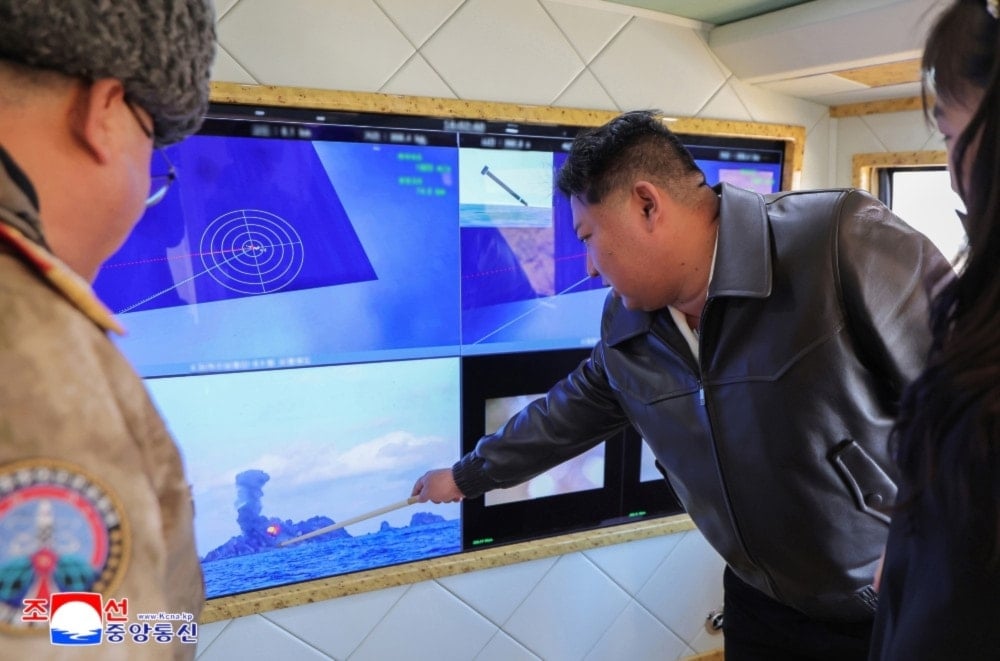
Democratic People's Republic of Korea leader, Kim Jong-Un, monitors the testing of a large-caliber precision-guided multiple-rocket launch system, in the DPRK, on January 27, 2026. (KCNA)
The Democratic People’s Republic of Korea (DPRK) has unveiled new weapons capabilities, including a cluster-warhead ballistic missile and electronic warfare systems, following a series of tests conducted this week, according to the state-owned Korean Central News Agency (KCNA).
On Thursday, the country’s Academy of Defense Science and Missile Administration carried out multiple tests aimed at demonstrating Pyongyang’s preparedness for modern warfare. The tests included a tactical ballistic missile equipped with a cluster-bomb warhead, an electromagnetic weapon system, carbon-fiber bombs, and a mobile short-range anti-aircraft missile system.
Blinding enemies
Pyongyang’s emphasis on non-conventional and non-nuclear systems reflects a strategy aimed at exploiting the technological dependence of more advanced adversaries, seeking to offset superior military hardware without resorting to large-scale conventional or nuclear confrontation.
Carbon-fiber, or graphite, bombs are designed to disable electrical grids by dispersing highly conductive filaments over critical infrastructure, triggering short circuits and widespread power disruptions. While the exact configuration of the electromagnetic weapon tested by the Korean People’s Army was not disclosed, such systems generally rely on focused electromagnetic energy rather than explosive force to disrupt or destroy electronic systems. These capabilities fall within the broader category of directed-energy weapons, including electromagnetic pulse (EMP) devices and high-power microwave systems, which are engineered to degrade or disable electronics across military and civilian networks.
By targeting power infrastructure and electronic systems, these weapons could disrupt command-and-control networks and logistics chains, reducing the operational effectiveness of technologically advanced forces. This approach provides the DPRK with a cost-effective asymmetric capability, enhancing its ability to temporarily impair critical infrastructure and reinforcing a deterrent posture.
KCNA also confirmed that the electromagnetic weapon system is a “special asset” for the KPA.
Read more: Kim says war on Iran proves nuclear arsenal best insurance policy
Cluster-warhead missile capability highlighted
According to KCNA, one of the key tests involved the Hwasong-11Ka tactical ballistic missile, fitted with a cluster-bomb warhead. The report stated that the system demonstrated the ability to “reduce to ashes any target” across an area of up to 7 hectares, equivalent to a circular impact zone with a diameter of approximately 300 meters.
The test forms part of the DPRK’s broader effort to enhance its tactical strike capabilities, particularly in short-range ballistic systems. The Hwasong-11Ka belongs to a wider family of variants derived from the Hwasong-11 (KN-23), which is being produced at scale, with each variant configured to support distinct operational roles and mission profiles.
South Korea’s Joint Chiefs of Staff had earlier confirmed that multiple missile launches were detected over several days, without specifying the number or types of projectiles.
Strategic messaging amid regional developments
The unveiling of these systems comes amid crucial regional and global developments. China’s Foreign Minister Wang Yi is scheduled to visit Pyongyang for a two-day trip starting Thursday, while discussions have emerged around the possibility of a summit between US President Donald Trump and DPRK leader Kim Jong Un in mid-May.
The tests also follow renewed tensions on the Korean Peninsula, with the DPRK reiterating its designation of South Korea as a “hostile enemy”, despite recent attempts by Seoul to ease anti-DPRK rhetoric in an attempt to secure nuclear-related compromise.
Read more: Pyongyang ties dialogue with US to recognition of nuclear status


