
DPRK to increase ballistic missiles, artillery production in 2026
 6 Min Read
DPRK leader Kim Jong Un visits munitions industry enterprises, showcasing a massive-scale output of short-range ballistic missiles (SRBMs) and artillery shells.
-

Leader of the Democratic People's Republic of Korea, Kim Jong Un, inspects a missile production facility in the DPRK on December 26, 2025 (KCNA)
Democratic People's Republic of Korea (DPRK) leader Kim Jong Un has directed a significant increase in ballistic missile and rocket artillery production, calling for higher output levels and expanded industrial capacity beginning in 2026, during on-site inspections of key munitions industry enterprises, according to the Korean Central News Agency (KCNA).
Kim reviewed fourth-quarter missile and artillery shell production and assessed overall performance for 2025, the final year of the five-year plan adopted at the Eighth Party Congress.
Orders to raise output and modernize production lines
During the visit, Kim instructed officials to raise the 2026 missile and artillery production plan in line with the projected operational needs of the DPRK’s missile and artillery forces. He emphasized the need to expand total production capacity by reinforcing the technical foundations of related factories in a balanced manner and outlined specific technical and economic tasks to support this expansion.
KCNA said Kim stressed that the missile and artillery shell sector occupies a central position in strengthening the country’s war deterrence and ordered the Missile Administration and relevant departments of the Second Economic Committee to prepare to “unconditionally” implement the modernization and production targets expected to be adopted at the Ninth Party Congress.
Facilities linked to SRBM, MLRS production
Images released alongside the report show Kim inspecting the assembly of variants of the Hwasong-11 short-range ballistic missile (SRBM) warheads, with guidance sections visible at the site. The photographs also depict inspections of steel warhead casings for multiple launch rocket system (MLRS) munitions, including high-caliber rockets.
The facilities visited are linked to core production lines for ballistic missiles and MLRS systems, which form the backbone of the DPRK’s conventional precision-strike capabilities. Consequently, the inspections underscore the advanced and sustained nature of Pyongyang's domestic missile and rocket artillery manufacturing under long-standing economic and technological constraints.
Performance in 2025 and plans beyond
Kim received briefings on 2025 production results and the fourth-quarter output and praised munitions enterprises for meeting assigned targets during the final year of the five-year plan. He credited them with playing a pivotal role in advancing national defense capabilities during the current planning period.
Looking ahead, Kim called for the establishment of new munitions factories, as well as the continuous upgrading of existing production structures to improve efficiency and practicality. He approved draft modernization plans for major munitions enterprises, which are to be submitted to the Ninth Party Congress in early 2026, where DPRK military and industrial priorities for the next five years are expected to be set.
Read more: Kim inspects construction of nuclear-powered strategic submarine
Massive production scale seen in released photos
-
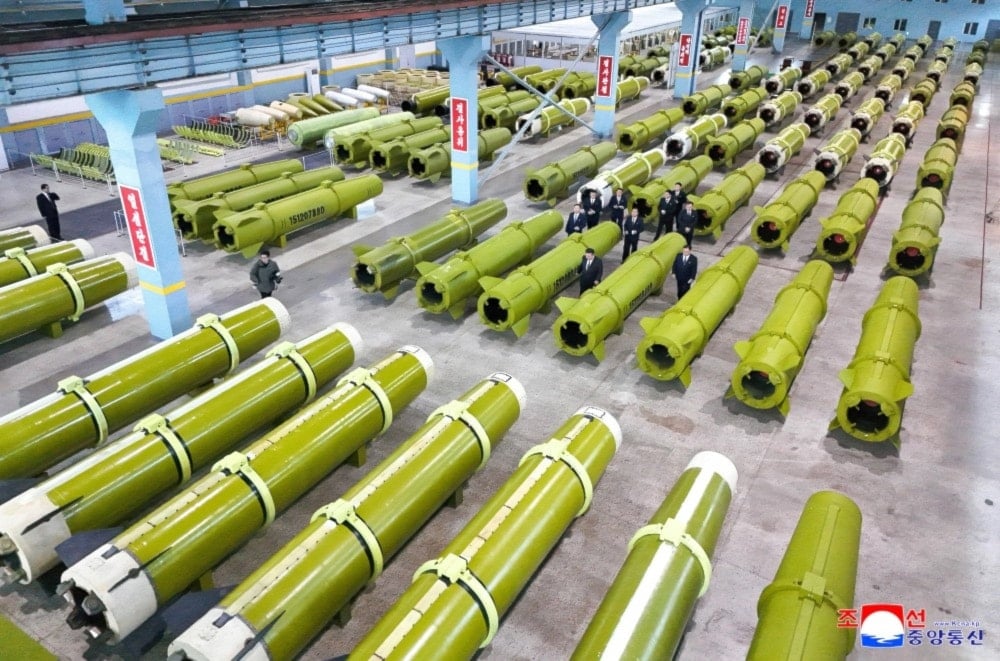
Dozens of Hwasong-11 short-range ballistic missiles bodyframes are seen during Kim Jong Un's visit to a missile production factory, the Democratic People's Republic of Korea, on December 26, 2025 (KCNA)
A high-tempo production run, consistent with Kim’s on-site instructions to expand output and meet immediate operational demand, was clearly visible in the released photos. The visual identification of at least 100 frames, in the final integration phase, in a single expanded KCNA image, shows that the Hwasong-11 program has gone into scaled production. The images also showed guidance kits and heavy CNC machines.
Not a precedent
The production of 500 missiles at a single facility is not anomalous when viewed against a recent precedent. In August 2024, Pyongyang unveiled 250 new missile launchers, implying an arsenal capacity of around 1,000 missiles for that system alone. Such numbers point to a mature, partially automated manufacturing base capable of sustained mass output. Upgrades at facilities like the February 11 Plant, including automated assembly processes, have significantly reduced production bottlenecks compared to earlier, labor-intensive methods.
This surge also aligns with strategic requirements. The KN-23 and KN-24—solid-fuel, quasi-ballistic SRBMs designed to evade missile defenses—form the backbone of the DPRK’s tactical strike force.
Hwasong-11 specifications
The Hwasong‑11 series comprises a broad family of SRBMs that form the core of the DPRK’s tactical strike arsenal. While the earliest Hwasong‑11 (KN‑02) was derived from the Soviet Tochka system, current variants represent a mature, indigenous design lineage optimized for survivability, maneuverability, and penetration of missile defense networks.
Variant specifications
| Variant | Western designation | Estimated range | Payload capacity | Key characteristics |
| Hwasong‑11A | KN‑23 | 450–900 km | 500–1,500 kg | Comparable in form to the Russian Iskander‑M; capable of terminal “pull‑up” maneuvers to evade interceptors. |
| Hwasong‑11B | KN‑24 | ~410 km | 400–500 kg | Visually similar to the US ATACMS; high‑velocity flight, assessed at up to Mach 6.2. |
| Hwasong‑11C | KN‑23 (enlarged) | 600–900 km | 2,500–4,500 kg | Enlarged heavy‑payload variant optimized for high‑explosive and hardened‑target strikes. |
| Hwasong‑11D | KN‑23 (compact) | 100–300 km | 250–500 kg | Short‑range variant assessed to be optimized for tactical nuclear roles; deployed on compact three‑axle TELs. |
| Hwasong‑11E | Hwasong‑11Ma | 800–1,500 km | 800–1,500 km | Introduced in 2025; incorporates a hypersonic glide vehicle (HGV) warhead for extended range and advanced maneuvering. |
| Hwasong‑11S | N/A | ~600 km | Tactical nuclear | Underwater‑launched variant assessed for submarine or submerged silo deployment. |
Common technical characteristics:
- Propulsion: Solid composite propellant across all modern variants, enabling rapid launch readiness and reduced logistical footprint compared to liquid‑fueled systems.
- Mobility and survivability: Predominantly road‑mobile, deployed on a range of transporter‑erector‑launchers (TELs), including wheeled, tracked, rail‑mobile, and submerged launch platforms.
- Guidance: Inertial navigation systems (INS), likely supplemented by satellite‑aided updates, with an assessed circular error probable (CEP) of approximately 35–200 meters, depending on variant and flight profile.
- Flight profile: Depressed, quasi‑ballistic trajectories with apogees typically below 50–60 km, combined with terminal maneuvers designed to complicate tracking and interception by missile defense systems such as Patriot or THAAD.
Read more: Russia, DPRK successfully applying Strategic Partnership Treaty: Putin


