
Díaz-Canel marks Castro's birthday: Cuban dignity is non-negotiable
 6 Min Read
At Fidel Castro’s centennial, Díaz-Canel presents his legacy as a living method for defending Cuban sovereignty, socialism, internationalism, and social justice.
-
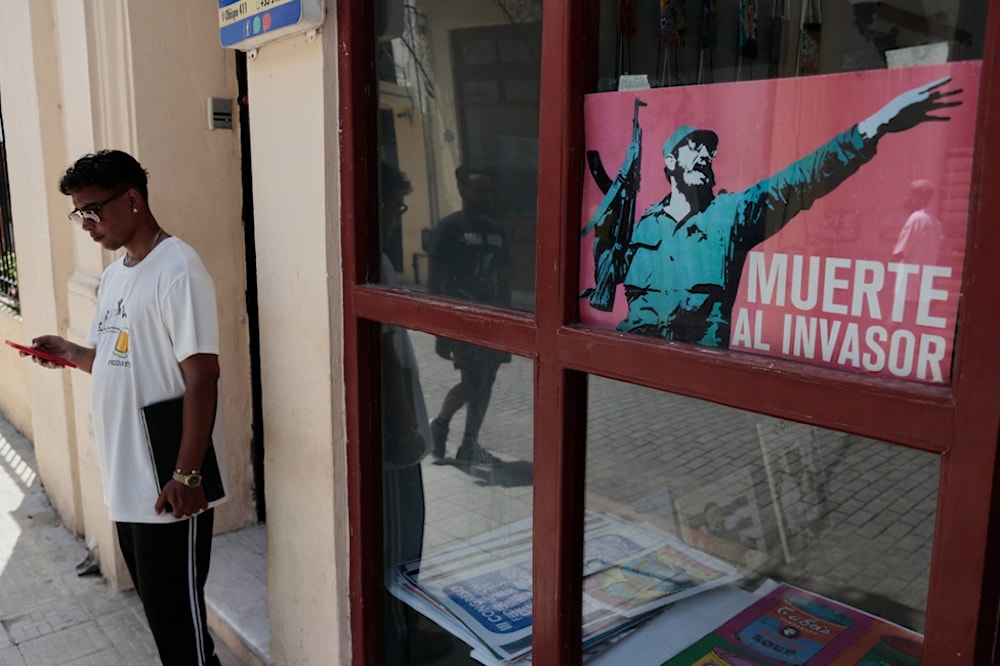
A man stands by an image of Fidel Castro, reading in Spanish, "Death to the invader," in Havana, Monday, May 25, 2026. (AP Photo/Jorge Luis Banos)
As Cuba marks the centennial of Fidel Castro’s birth, President and First Secretary of the Communist Party of Cuba Miguel Díaz-Canel argued that the revolutionary leader’s legacy must be understood not as a historical monument, but as a political method for confronting the crises of the present.
Speaking at the opening of the first International Colloquium “Fidel: Legacy and Future” in Havana on Tuesday, Díaz-Canel placed Fidel’s legacy within Cuba’s ongoing confrontation with US pressure, the country’s economic difficulties, and what he described as a wider struggle against imperialism and unipolarity.
“Fidel's legacy challenges us today with more force than ever,” Díaz-Canel said, presenting sovereignty, social justice, internationalism, and popular mobilization as central elements of the Cuban revolutionary experience.
Como parte del I Coloquio Internacional Fidel: Legado y Futuro, participamos junto a @DiazCanelB en el Foro Juvenil “Creo en ustedes”, donde se resaltó la entrega del Comandante en Jefe a las causas de las generaciones más jóvenes y la vigencia de su pensamiento. #100AñosConFidel pic.twitter.com/4Xa7oK7OD7
— Dr. Roberto Morales Ojeda (@DrRobertoMOjeda) August 11, 2026
From dependent Cuba to revolutionary sovereignty
Díaz-Canel argued that Fidel Castro’s political legacy cannot be separated from the social and economic conditions Cuba faced before the 1959 Revolution.
Drawing on Fidel’s historic 1960 address to the United Nations, he recalled widespread unemployment, illiteracy, inadequate housing and rural poverty, alongside extensive US corporate ownership of key sectors of the Cuban economy.
The speech emphasized that the Revolution’s subsequent achievements in health, education, science, culture, and sports must be viewed against that historical starting point.
Díaz-Canel cited Cuba’s reported rate of more than nine doctors per 1,000 inhabitants, a life expectancy of 77.7 years, and the country’s international health and education cooperation as examples of what he described as the enduring social gains of the Revolution.
He also recalled the 1961 literacy campaign, which mobilized more than 250,000 volunteers, and Cuba’s international medical cooperation program, through which more than 600,000 healthcare professionals have reportedly worked in 165 countries.
For Díaz-Canel, these achievements demonstrate a central principle of Fidel’s thought: sovereignty was not merely political independence, but the ability of a society to determine its own economic and social priorities.
Fidel’s method: sovereignty, knowledge and internationalism
Rather than presenting Fidel’s legacy as a collection of historical slogans, Díaz-Canel described it as a method centered on studying conditions, identifying structural problems, adapting tactics, and acting decisively.
He pointed to Fidel’s 1953 political program, the revolutionary government’s economic transformations, the defense of Cuba against the Bay of Pigs invasion, and the development of the “War of the Entire People” doctrine as examples of this approach.
A recurring element of the speech was the relationship between politics and economics. Díaz-Canel cited Fidel’s formulation, “There is no economy without politics, nor politics without economics.”
He also emphasized Fidel’s commitment to scientific knowledge. The Cuban leader’s 484 Reflections, published between 2007 and 2016, were presented as evidence of a continuing effort to study global developments and communicate directly with the Cuban people.
Internationalism was another central pillar.
Díaz-Canel recalled Fidel’s support for African liberation movements and Palestine, his opposition to apartheid and the Iraq War, and his collaboration with Venezuela’s Hugo Chávez in advancing Latin American integration.
Programs including the Comprehensive Health Program, the Latin American School of Medicine, Operation Miracle, the “Yes, I Can” literacy initiative, ALBA-Petrocaribe, and the Henry Reeve Contingent were presented as expressions of an internationalist conception in which solidarity is treated as a component of sovereignty rather than charity.
Read more: China slams new US sanctions on Cuba, calls for end to blockade
Cuba under pressure: resistance amid economic hardship
The speech also acknowledged the depth of Cuba’s present economic difficulties.
Díaz-Canel cited prolonged blackouts, fuel shortages, inflation, water shortages, difficulties obtaining basic goods, and emigration among the challenges facing Cuban society.
He attributed much of the pressure to the US blockade and a broader strategy aimed at economically and politically isolating Cuba.
The figures he presented were stark. He said that 1,400 megawatts of distributed generation capacity were currently unavailable because of fuel shortages, while Cuba faced electricity cuts that could last 20 hours or more.
In healthcare, he cited 98,500 people on surgical waiting lists, including 12,000 children; 34,000 pregnant women unable to receive sufficient prenatal ultrasounds; and 117,000 adults and 1,200 children with cancer who were not receiving adequate primary treatments.
He also said only 30% of essential medicines were currently available and that the technical availability of ambulances stood at 22% because of difficulties obtaining spare parts.
Díaz-Canel argued that these conditions cannot be separated from the geopolitical pressure placed on Cuba, while acknowledging that the country must also pursue economic reforms to increase production, generate wealth, and preserve social gains.
He stressed that revitalizing the economy does not mean abandoning socialism, saying Cuba would reject “rampant privatization” while maintaining fundamental means of production in public hands.
Read more: Unbreakable Cuba: Why Washington still fears a defiant island
A centennial as a call to action
Díaz-Canel framed Fidel’s centennial as a starting point rather than a commemorative endpoint.
He argued that the contemporary international system is marked by growing geopolitical confrontation, wars, climate crisis, forced migration and widening inequality, while the unipolar order is increasingly challenged by the emergence of a multipolar world.
Within that context, he portrayed Cuba’s resistance as part of a broader international struggle over sovereignty and the right of states and peoples to determine their own futures.
The Cuban president called on international supporters to move beyond symbolic expressions of solidarity and pursue practical cooperation, including scientific and cultural exchanges, fair trade, opposition to the blockade, and action through international organizations.
He also placed particular emphasis on Cuba’s youth, arguing that a new generation must apply Fidel’s method to challenges such as food production, the energy transition, technological development, import substitution, and economic transformation.
The central message of the address was that Fidel’s legacy cannot be reduced to memory. It must be measured through action.
For Díaz-Canel, that means defending Cuba’s sovereignty while confronting its internal difficulties, preserving social gains while reforming the economy, and maintaining international solidarity despite mounting pressure.
As he concluded, invoking Fidel’s own words: “Cuba will know how to remain an example of a revolution that does not surrender, that does not sell out, that does not give up, that does not kneel!”


