
Hegseth signals 'capturing' Cuban president remains possibility
 3 Min Read
Cuba has rejected US allegations regarding military drone acquisitions as a fabricated pretext for increased pressure and possible aggression.
-
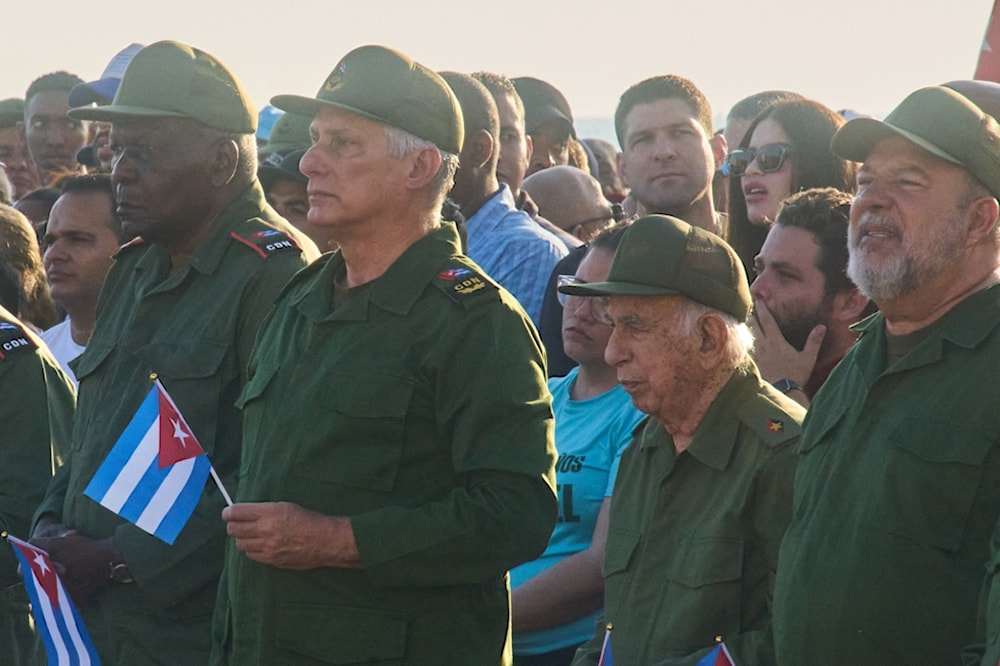
Cuba's President Miguel Diaz-Canel, second left, and Raul Castro's grandson Raul Guillermo Rodriguez Castro, center back, take part in a rally in support of former President Raul Castro in front of the US Embassy in Havana, Cuba, Friday, May 22, 2026 (AP)
US War Secretary Pete Hegseth on Thursday escalated rhetoric toward Cuba, warning Havana against acquiring military capabilities that Washington could perceive as a threat and suggesting that even action against the island's leadership remains among the options being considered.
Speaking to reporters, Hegseth issued a stark message to Cuba while responding to questions about reports concerning alleged weapons acquisitions.
"Our message to Cuba is, don't get into that game, don't get into the game where you're threatening Americans or the American homeland, because that won't go well for them," Hegseth said.
The remarks came despite the absence of publicly presented evidence that Cuba poses an imminent threat to the United States or has undertaken any specific weapons procurement that would justify such warnings.
In one of the most controversial moments of the exchange, Hegseth suggested that Washington continues to keep a wide range of measures under consideration.
"We've got options all over the map ... all those options are on the table," Hegseth told reporters when asked whether "capturing" Cuban President Miguel Díaz-Canel remained a possibility.
Cuba rejects allegations
The comments follow recent claims by US intelligence agencies alleging that Cuba has acquired hundreds of military drones from Russia and Iran since 2023. According to US media reports citing unnamed officials, Washington believes Havana obtained more than 300 drones and examined hypothetical scenarios involving US targets, including the Guantánamo Bay naval base.
Cuban authorities have firmly rejected the allegations, describing them as part of a broader effort to portray the island as a security threat. Havana maintains that its defense policies are rooted in the legitimate right of self-defense and the protection of national sovereignty.
Senior Cuban officials have accused Washington of fabricating a threat narrative to justify additional sanctions and pressure measures against the island. Cuban Foreign Minister Bruno Rodríguez has dismissed the allegations as a "fraudulent case", arguing that Cuba, like any sovereign nation, has the right to maintain defensive capabilities.
Cuba's Deputy Foreign Minister Josefina Vidal has also warned that recent US accusations could be used to create a pretext for more aggressive actions toward the island, stressing that Havana has neither the intention nor the capability to attack the United States.
Pressure campaign
The latest dispute comes against the backdrop of decades of US sanctions and political hostility toward Cuba, including the continued US military presence at Guantánamo Bay, which is occupied Cuban territory.
In recent months, UN officials have warned that US sanctions and fuel restrictions are worsening shortages of food, medicine and other essential goods on the island.
Read more: Cuba warns of US aggression, reveals pressure campaign scenarios


