
Cuba warns of US aggression, reveals pressure campaign scenarios
 3 Min Read
Cuban President Miguel Díaz-Canel outlines three scenarios Washington may pursue against Cuba, while Havana warns of a worsening humanitarian crisis.
-
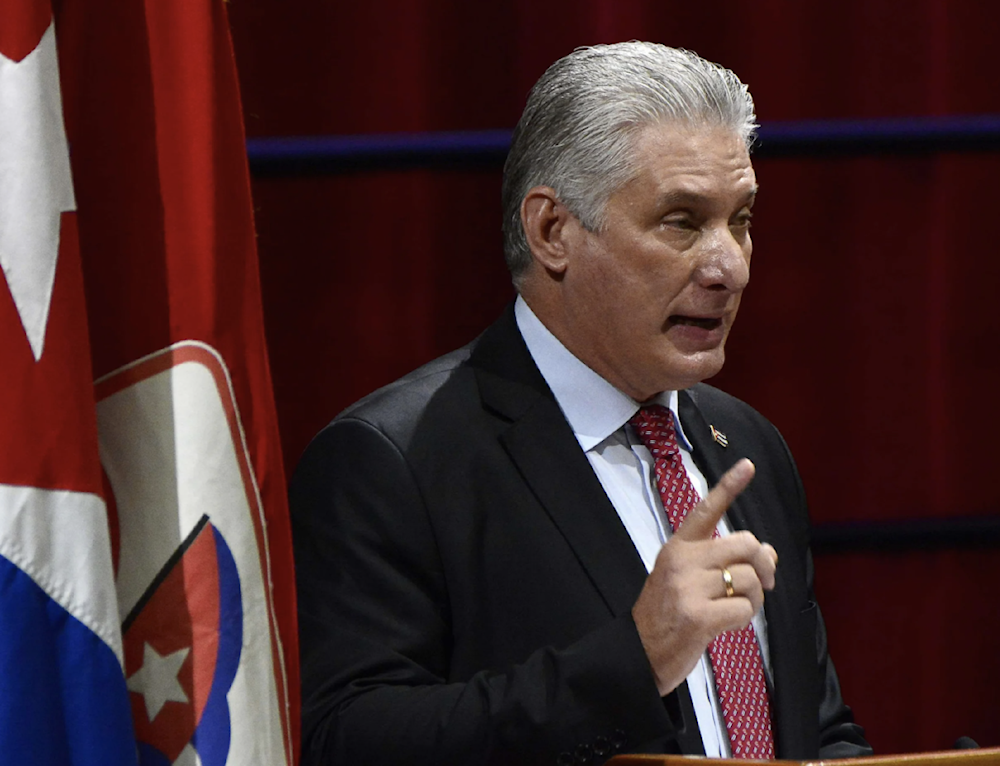
Cuba's President Miguel Diaz-Canel addresses party delegates after being elected First Secretary of the Communist Party during the 8th Cuban Communist Party's closing session at Convention Palace in Havana, Cuba, on April. 19, 2021. (AP)
Cuban President Miguel Diaz-Canel has warned that Washington is considering three possible courses of action against Cuba, ranging from economic strangulation and political pressure to outright military aggression, as the island faces mounting humanitarian challenges under an intensified US seige.
His remarks come amid growing concerns in Havana over the impact of aggressive measures imposed by US President Donald Trump, which Cuban officials stress have severely restricted the country's access to fuel, disrupted critical services, and increased pressure on the Cuban economy.
Diaz-Canel outlines Washington's three scenarios
In an interview published Monday, Diaz-Canel said the first scenario seeks to provoke a social crisis by suffocating the Cuban economy through sanctions and restrictions, creating conditions that could later be used to justify foreign intervention under humanitarian pretexts.
The second scenario, he said, revolves around forcing Cuba into negotiations under maximum pressure in an effort to reshape the country's political and economic system. According to Diaz-Canel, this strategy includes attempts to discourage foreign investment and pressure international companies to reduce or end their activities on the island.
The third possibility, he warned, is direct military aggression.
Diaz-Canel said these assessments are based on repeated statements by senior US officials, including Trump and Secretary of State Marco Rubio, who have repeatedly advocated tougher measures against Havana.
Oil blockade deepens humanitarian strain
Cuba's Ambassador to the United Nations, Ernesto Soberon Guzman, recently told Al Mayadeen that the humanitarian consequences of Washington's pressure campaign are becoming increasingly severe.
According to the ambassador, Cuba normally requires around eight oil tankers per month to sustain essential services. Since Trump signed an executive order imposing what Havana describes as an oil siege on January 29, the country has received only one tanker, delivered by Russia as humanitarian assistance.
The fuel shortage has affected hospitals, water systems, transportation networks, food production facilities, and pharmaceutical plants.
Soberón Guzmán said more than 100,000 people are currently awaiting surgical procedures, including approximately 12,000 children, while tens of thousands of pregnant women are facing difficulties accessing adequate medical care due to electricity shortages and fuel constraints.
The ambassador also accused Washington of expanding pressure beyond sanctions by targeting Cuba's international medical cooperation programs and discouraging foreign companies from maintaining economic ties with the island.
'Let Cuba live'
Concluding his remarks, Soberon Guzman called on the international community to allow Cuba to determine its own future free from external coercion.
"Let Cuba live," he said, underlining that the island is confronting the consequences of an economic war rather than an internal humanitarian collapse.
While acknowledging the severe challenges facing the country, Cuban officials maintain that Havana will continue seeking diplomatic solutions while strengthening domestic energy production and resilience measures to withstand mounting external pressure.


