
8 Arab-Islamic nations condemn Israeli land grab move in West Bank
 5 Min Read
The nations have warned that the move accelerates settlement expansion and further undermines the prospects of an independent Palestinian state.
-
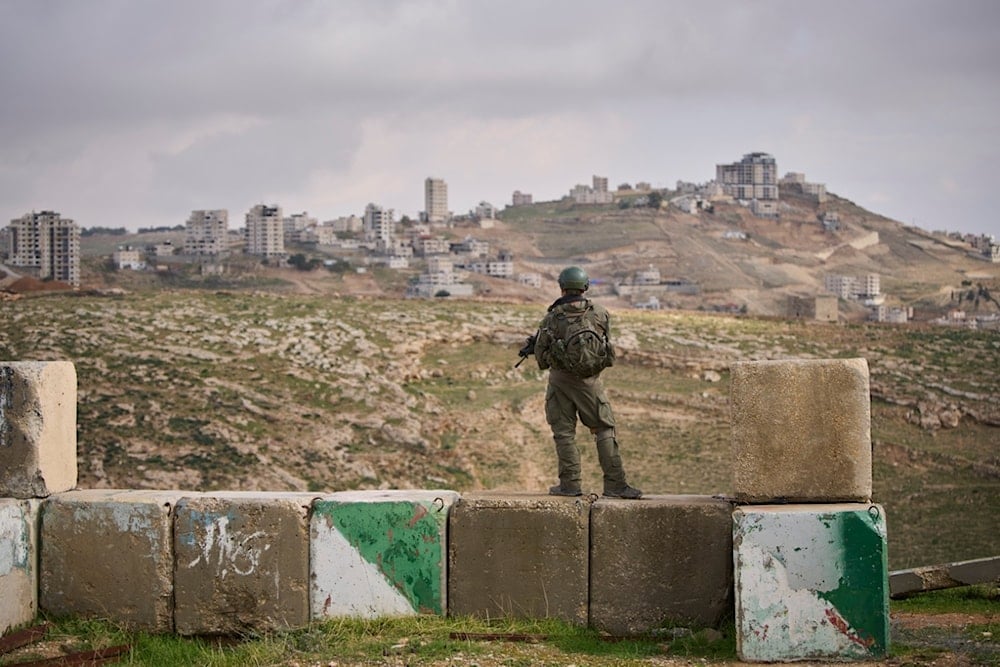
An Israeli soldier stands guard during the inauguration ceremony for the Israeli settlement of Yatziv, near the Palestinian town of Beit Sahour, in the West Bank, Monday, Jan. 19, 2026. (AP)
Eight Arab and Islamic countries on Tuesday issued a unified condemnation of "Israel’s" latest decision to designate vast areas in the occupied West Bank as “state land” and initiate comprehensive land registration procedures for the first time since 1967.
In a joint statement released from Doha, the foreign ministers of Qatar, Jordan, the United Arab Emirates, Indonesia, Pakistan, Turkey, Saudi Arabia, and Egypt described the move as a grave escalation designed to accelerate settlement expansion, entrench Israeli control, and impose what they termed unlawful sovereignty over occupied Palestinian territory.
Eight Arab and Islamic countries strongly condemn the decision issued by Israel to designate lands in the occupied West Bank as so called “state land"
— Ministry of Foreign Affairs - Qatar (@MofaQatar_EN) February 17, 2026
Doha | February 17, 2026
The foreign ministers of Qatar, Jordan, the United Arab Emirates, Indonesia, Pakistan, Turkey, Saudi… pic.twitter.com/zo86cMzLPY
The condemnation follows the Israeli cabinet’s approval on Sunday of a proposal to register large areas of the occupied West Bank as "state property", a move reportedly spearheaded by far-right Finance Minister Bezalel Smotrich, alongside so-called Justice Minister Yariv Levin and Security Minister Israel Katz. Israeli media reported ahead of the vote that the plan envisions the gradual settlement of 15% of Area C by 2030.
Under the 1995 Oslo II Accord, the West Bank was divided into Areas A, B, and C. While Areas A and B fall under varying degrees of Palestinian administrative control, Area C, comprising roughly 61% of the territory, remains under full Israeli control and hosts the majority of illegal settlements. The newly approved policy focuses squarely on this zone.
'State property' through registration
According to Israeli reports, the central implication of the cabinet decision is the conversion of extensive tracts of land into "state property" “provided that no other ownership is proven.” In practical terms, Palestinians would be required to submit documentation to prove ownership. Critics argue that decades of displacement, informal inheritance practices, administrative barriers, and restricted access to land records leave many Palestinian families unable to meet Israeli-imposed evidentiary standards.
If no documentation is recognized, the land risks being formally registered to "Israel", facilitating its allocation for settlement expansion. Israeli authorities have reportedly allocated funding for a multi-year implementation process, with watchdog groups warning it could structurally alter land control in the West Bank over the coming years.
The plan also envisions expanding the role of the Israeli Coordination of Government Activities in the Territories (COGAT) in overseeing land registration procedures, issuing permits, collecting fees, and preventing the Palestinian Authority from carrying out such functions in Area C. Under the Oslo arrangements, Palestinian land registration is limited to Areas A and B and is prohibited in Area C. Observers say that by centralizing registration under Israeli administration, the government is consolidating deeper administrative and legal authority over occupied land.
The measure follows a series of additional steps approved by the Israeli Security Cabinet aimed at facilitating settlement growth, including repealing restrictions on land sales to settlers, unsealing land ownership records, and transferring building permit authority in certain areas near al-Khalil to Israeli control.
Area C 'annexation' drive
Palestinian officials have warned that the decision amounts to de facto annexation. The Palestinian Authority presidency described the move as a direct step toward Israeli "annexation" of occupied territory, while Hamas denounced it as an attempt to impose “settlement-based Judaization realities” on the ground. More than 1,000 Palestinians have been killed in the West Bank since October 2023, amid intensified Israeli operations, settler violence, and widening displacement.
In July 2024, the International Court of Justice declared the Israeli occupation of Palestinian territory illegal and called for the evacuation of settlements in the West Bank and eastern al-Quds. The eight foreign ministers echoed that legal framework in their statement, describing the latest policy as “a flagrant violation of international law and international humanitarian law, particularly the Fourth Geneva Convention,” and a breach of UN Security Council Resolution 2334.
They warned that institutionalizing Israeli land registration across vast areas of Area C represents an attempt to impose a new legal and administrative reality on occupied territory, one that threatens to permanently fragment Palestinian lands and extinguish prospects for an independent and viable Palestinian state.
“This illegal step constitutes a grave escalation aimed at accelerating illegal settlement activity, land confiscation, entrenching Israeli control, and applying unlawful Israeli sovereignty over the Occupied Palestinian Territory,” the statement read.
Reiterating their categorical rejection of unilateral measures altering the status of occupied land, the ministers cautioned that such policies jeopardize the "two-state solution" based on the June 4, 1967, lines, with al-Quds as the capital of a sovereign Palestinian state.
Calling on the international community to assume its responsibilities, the eight countries urged immediate and decisive action to halt the violations, uphold international law, and safeguard the Palestinian people’s inalienable right to self-determination and to end the occupation.
Read more: Israeli regime deploys police at al-Aqsa for Ramadan


