
EU Foreign Ministers meeting with VP Kallas in Munich canceled
 3 Min Read
An informal meeting of EU foreign ministers planned by Kaja Kallas in Munich was canceled due to ministers’ departures, Politico reports.
-
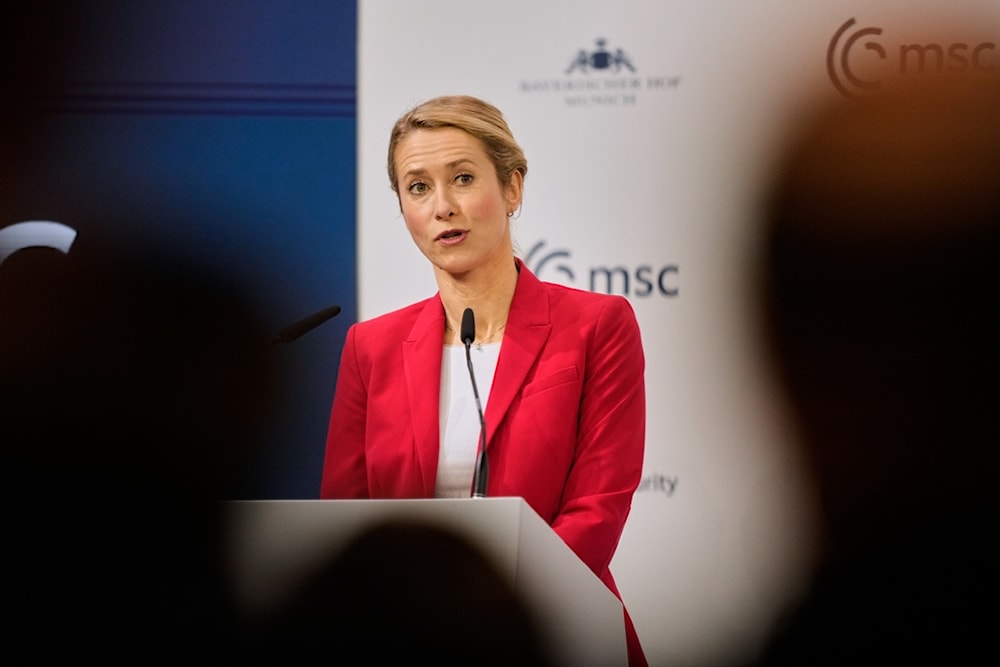
European Union foreign policy chief Kaja Kallas speaks during the Munich Security Conference in Munich, Germany, Sunday, February 15, 2026 (AP)
An informal meeting of European Union foreign ministers scheduled in Munich was canceled after most ministers had already left the city, Politico reported on Sunday, citing three officials.
The meeting had been planned by EU foreign policy chief Kaja Kallas on the sidelines of the Munich Security Conference, which ran from Friday through Sunday.
According to one official cited in the report, the cancellation was not linked to any political disagreement but stemmed solely from organizational issues, as the majority of foreign ministers had departed before the session could take place.
The episode underscores the logistical challenges surrounding high-level diplomatic gatherings held alongside major international events such as the Munich Security Conference.
Merz raises European nuclear deterrent
The planned talks between diplomats came on the heels of Berlin's launching confidential discussions with France on a potential European nuclear deterrent, emphasizing the need for Europe to strengthen its strategic position while maintaining ties with the United States.
Speaking at the opening of the Munich Security Conference, German Chancellor Friedrich Merz framed the move as part of Europe’s effort to navigate a “dangerous new era of great power politics.”
Merz stressed that Germany is fully adhering to its legal obligations, noting that any nuclear initiatives would remain strictly within the framework of NATO’s nuclear sharing. “We will not allow zones of differing security to emerge in Europe,” he said, highlighting concerns over regional security amid ongoing crises.
Turning to the US delegation, Merz addressed transatlantic relations directly, praising the historical trust among allies that made NATO “the strongest alliance of all times.” He warned, however, that in today’s era of global competition, “even the United States will not be powerful enough to go it alone.”
“Being part of NATO is not only Europe’s competitive advantage, it’s also the United States’ competitive advantage,” Merz added.
Transatlantic shake-up driving the decision
European leaders have grown increasingly uneasy about Washington’s commitment to security in the region, with NATO allies questioning whether the traditional US “nuclear umbrella” can be relied on. Analysts note that disagreements over defense burdens and strategic priorities have widened since the Trump presidency returned to power in early 2025, contributing to doubts about US leadership.
At the June 5, 2025, NATO summit in The Hague, allies agreed to raise defense spending to 5% of GDP by 2035, but divisions emerged over burden‑sharing and threats of tariffs for those who resisted, symbolizing deeper strains in transatlantic cooperation.
Events such as the United States’ brief halt of military intelligence sharing with Ukraine in March 2025 sparked concern in European capitals that reliance on US support was no longer guaranteed, reviving debate on a European nuclear deterrent and broader strategic autonomy.
This unease has been compounded by a series of controversial US actions, most notably Trump's pursuit to acquire Greenland. European leaders see the move not simply as a diplomatic misstep, but as a stark example of unilateral decision-making that undermines the spirit of alliance consultation. The proposal sparked intense debates in capitals across Europe, with officials warning that such actions could destabilize transatlantic relations and weaken collective security.


