
EU ministers to weigh sanctions, tariffs on Israeli settlements
 4 Min Read
EU foreign ministers will meet Monday in Brussels to discuss tariffs on Israeli settlement goods and sanctions against Ben-Gvir and Smotrich amid record settlement expansion.
-
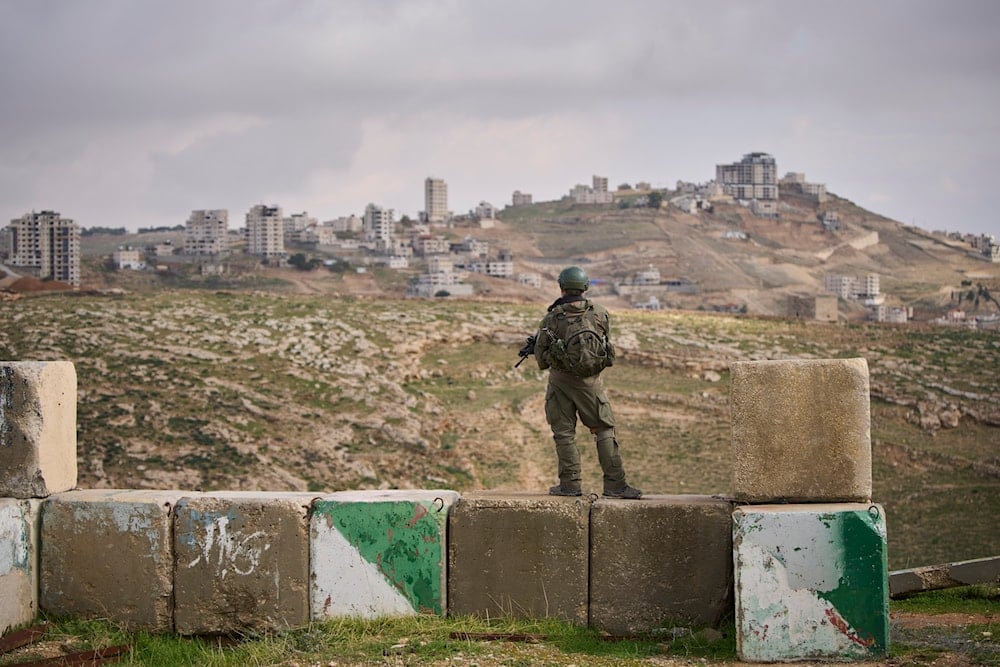
An Israeli soldier stands guard during the inauguration ceremony for the illegal settlement of Yatziv, near the Palestinian town of Beit Sahour, in the West Bank, Monday, Jan. 19, 2026 (AP)
The European Union is poised to take its most concrete steps yet against Israeli settlement expansion in the West Bank, with a meeting of EU foreign ministers scheduled for Monday in Brussels set to place a series of potential punitive measures at the top of its agenda.
Central to the discussions is a joint French-Swedish initiative calling on the European Commission to impose customs duties on goods originating from Israeli settlements in the occupied West Bank, the occupied Golan Heights, and occupied East al-Quds.
The proposal, contained in a letter sent to EU foreign policy chief Kaja Kallas, would raise tariffs on settlement exports, including dates, wine, and Dead Sea products, making them significantly more expensive in European markets.
The initiative falls within the EU's existing policy of "differentiation," which holds that settlement-produced goods are not entitled to the preferential treatment granted under the EU-Israel Association Agreement.
Kallas confirmed after a previous ministerial meeting in late April that she would refer the French-Swedish proposal to EU Trade Commissioner Maros Sefcovic, signalling that the groundwork for a formal decision is being laid.
Ministers also weighing sanctions on Ben-Gvir, Smotrich
Alongside the tariff proposal, ministers are expected to discuss targeted sanctions against Israeli occupation government ministers Itamar Ben-Gvir and Bezalel Smotrich, as well as against settlers implicated in acts of violence against Palestinians.
EU Ambassador to "Israel" Michael Mann said this week that for Brussels, settlement expansion is a "red line," adding that additional measures to pressure the occupation government are actively under consideration.
The acceleration of settlement construction has drawn growing European condemnation. According to Peace Now, 54 new settlements were approved in 2025 alone, a record, and more than 100 have been approved since the Netanyahu government took office in December 2022.
Over 400 former European ministers, ambassadors, and officials last week urged EU leaders in an open letter to act before 1 June, when the occupation government is set to issue tenders for the E1 settlement project, a plan that would effectively sever the occupied West Bank in two.
Hungary's veto and the qualified majority question
For years, Hungary under Viktor Orbán served as "Israel's" most reliable shield inside the EU, repeatedly vetoing measures that required unanimous member-state support. Orbán's defeat last month removed that guarantee, but his successor Péter Magyar has said Budapest will continue blocking EU decisions on "Israel," leaving the picture murkier than many had anticipated.
That said, Hungary's stance is most consequential for sanctions against individual settlers and occupation ministers, which do require unanimity. The settlement tariff measure (French-Swedish initiative) at the heart of Monday's agenda operates under a different threshold, a qualified majority of 55% of member states representing 65% of the EU's population, meaning it can pass without Budapest's approval. There, the decisive voices are Germany and Italy, both of which have so far resisted the most sweeping measures against the occupation.
Italy's cooling ties with the occupation
The broader diplomatic context has also shifted. Italy, long among "Israel's" staunch European partners, has grown increasingly estranged from the occupation government.
Rome suspended the automatic renewal of its defence cooperation agreement with "Israel" last month after Israeli forces fired warning shots at an Italian UNIFIL convoy in Lebanon. Tensions were further compounded when the occupation prevented Italian Catholic clergy from holding a Palm Sunday ceremony at the Church of the Holy Sepulchre in al-Quds.


