
Europe weighs Hormuz navigation fee framework à la Malacca, Channel
 5 Min Read
As talks advance, Europe is giving serious consideration to Iran's approach to managing navigation in the Strait of Hormuz through internationally supported mechanisms.
-
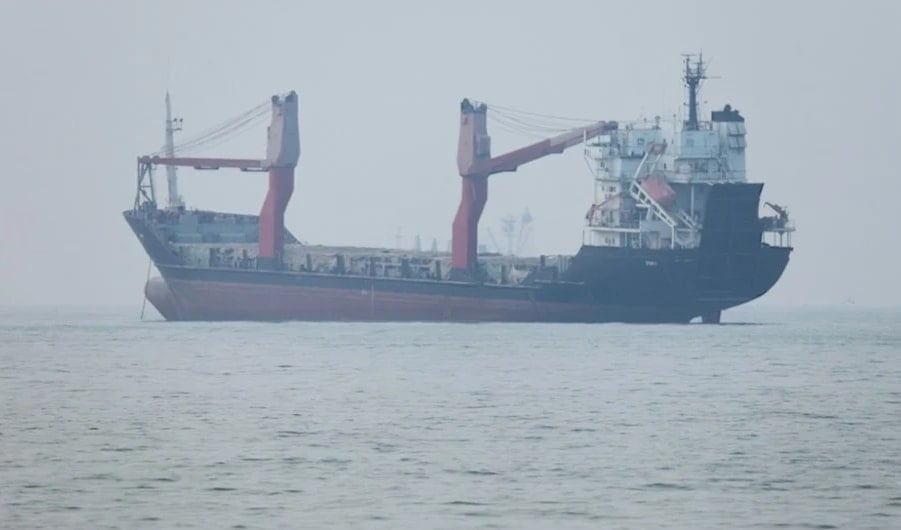
A cargo ship appears anchored in the Strait of Hormuz off Bandar Abbas, Iran, June 30, 2026 (AP)
European governments are examining proposals that could allow navigation-related fees in the Strait of Hormuz, provided that any charges remain voluntary and receive backing from the UN body responsible for regulating international maritime transport, The Guardian reported.
Britain’s Deputy Prime Minister, David Lammy, said mandatory tolls would be catastrophic. However, several cabinet colleagues acknowledged that payment systems covering specific navigation services are already permitted in a number of major waterways, including the Strait of Malacca and the English Channel.
The discussions come as US officials have called on Iran to publicly state that the Strait of Hormuz is open and that vessels transiting the key shipping route will no longer face attacks.
On Friday, Trump repeated on social media that he regarded the interim ceasefire agreement as "over" while saying the United States would continue negotiations aimed at securing a permanent end to the war.
Hours afterward, the US president issued new threats against Iran over any alleged assassination attempt, saying "1000 missiles are locked and loaded and aimed at the Islamic Republic of Iran".
Oman advances alternative legal framework
Oman, working alongside British legal experts, has already drafted a proposal that adapts principles used in the Strait of Malacca. Muscat has since offered to dispatch legal specialists to Tehran to present the proposal in detail.
Iranian state media reported Friday that Foreign Minister Abbas Araghchi will travel to Oman on Saturday for talks focused on the waterway. The visit "will be focused on the strait of Hormuz and shipping safety" and is "a continuation of the consultations that we started with Oman over the past one or two months," Iran’s official IRNA news agency quoted Foreign Ministry spokesperson Esmaeil Baghaei as saying.
Oman, which controls most of the navigable waters in the strait, opposes mandatory transit fees. Qatar Foreign Ministry spokesperson Majed al-Ansari claimed, "Giving the Iranians sovereignty over the strait in a way that contradicts international maritime law will be basically agreeing to be hostages to whatever radical element that wants to take over the strait at any time."
Research paper backs transparent service fees
The group's paper argued that a transparent service fee incorporated into a broader regional framework would encourage cooperation among all parties. It added that the proposal should not be viewed as a simple transit toll imposed on ships passing through the Strait of Hormuz.
Addressing the International Maritime Organization (IMO) Council in London on Thursday, Oman’s delegate, Khamis bin Mohammed Al Shamakhi, alleged. "The right of transit passage through straits used for international navigation is guaranteed under international law and does not support the imposition of transit fees on vessels passing through the Strait of Hormuz."
He added that Oman nevertheless supported exploring voluntary arrangements "relating to navigational support services that could further enhance maritime safety and security, protect the marine environment, reduce the risk of pollution and strengthen preparedness for maritime emergencies, including collisions and fires on board of ships and tankers."
Malacca model under consideration
Oman's proposal is based on governance arrangements used in the Strait of Malacca, which connects the Indian and Pacific oceans. An IMO Council report on the cooperative mechanism governing the Straits of Malacca and Singapore said the waterway handles more than 120,000 vessel transits each year.
According to the report, the mechanism "has evolved into a structured and inclusive platform through which emerging risks, technological developments and environmental priorities in the straits may be collectively addressed." It added that voluntary contributions, particularly from Japan, have sustained the system.
IMO debate exposes international divisions
During the London meeting, a coalition of Gulf and European countries pushed for a resolution condemning Iran over efforts to control the Strait of Hormuz through attacks on shipping. Russia and China declined to support the proposal.
Russia argued that the resolution ignored the underlying causes of the crisis, while China described the draft as one-sided and beyond the scope of the IMO's mandate.
The debate followed US strikes, mainly in southern Iran, earlier this week. Iran responded by striking US bases in Kuwait and Bahrain.
It is worth noting that Iran has repeatedly said that US military bases and economic assets in the Gulf region have been used to launch acts of aggression against Iran, including strikes that have resulted in civilian casualties. In this framing, any Iranian action targeting such facilities is a retaliation against hostile military activity originating from or enabled by those bases.
Uncertainty remains over shipping routes
Despite that setback, the United States has continued encouraging commercial vessels to use the southern route. US Central Command claimed that since early May, US forces "have helped facilitate the successful transit of more than 800 commercial vessels and 380m barrels of crude oil through the vital international trade corridor."
Meanwhile, the IRGC Navy maintained, "We reiterate that foreigners have no role in this land or the Strait of Hormuz."
In a similar vein, Iranian Parliament Speaker Mohammad Bagher Ghalibaf said Tehran would not allow the United States to interfere in the Strait of Hormuz, adding that Iran would continue implementing its navigation mechanism in the waterway while consulting with other Gulf littoral states.
Ahead of his visit, Araghchi held a series of phone calls on Thursday with Omani Foreign Minister Badr al-Busaidi, Turkish Foreign Minister Hakan Fidan, and Pakistan's Chief of Army Staff General Asim Munir, during which he warned against any US military adventurism in the region.


