
Eurozone, Asian business slows as war on Iran drives uncertainty
 4 Min Read
Business activity in the eurozone and parts of Asia slowed to its lowest level since May 2025 as the US-Israeli war on Iran drives up energy prices and disrupts global trade, with economists warning of stagflation if the conflict continues.
-
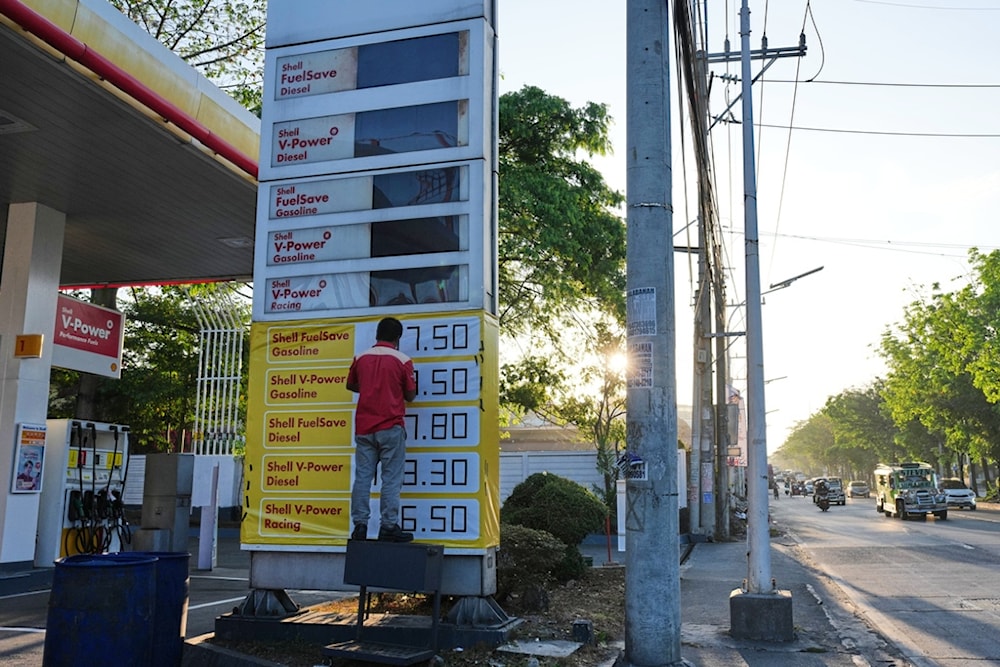
A worker uses black tape to adjust the prices of their sign as the digital board on top cannot accommodate the additional digits at a gasoline station as oil prices continue to rise, Tuesday, March 24, 2026, in Quezon City, Philippines. (AP)
Business activity in the eurozone and parts of Asia slowed in March, driven by higher energy prices and uncertainty from the US-Israeli war on Iran, according to data released Tuesday.
S&P Global said its composite Purchasing Managers Index for the eurozone fell to 50.5 in March, down from 51.9 in February and marking the lowest level since May 2025. The index remains only just above the 50-point threshold that separates growth from contraction.
"The flash eurozone PMI is ringing stagflation alarm bells as the war in the Middle East drives prices sharply higher while stifling growth," said Chris Williamson, chief business economist at S&P Global Market Intelligence.
Economic fallout spreads
Input cost inflation rose at its fastest rate in over three years, while overall output growth was dragged down by a deterioration in new orders, S&P reported. Companies were surveyed between March 12 and March 20, following the US-Israeli aggression on Iran that began on February 28.
In the most severe scenario, where oil prices would peak at $145 a barrel, the European Central Bank last week projected inflation would average 4.4 percent this year.
"The economic outlook has weakened significantly, but all now rests on how the conflict unfolds," ING economist Bert Colijn said in a note to clients.
Asia feels the impact
Similar surveys released Tuesday pointed to a sharp slowdown in activity in India, which relies heavily on energy imports that transit through the Strait of Hormuz. Before the war on Iran began, 60 percent of India's liquefied petroleum gas came from the Gulf, according to Capital Economics.
Input costs in India climbed to a near four-year high, with a range of items reported as up in price, including aluminum, chemicals, electronic components, energy, food, iron ore, leather, oil, rubber, and steel. The composite PMI there fell to 56.5 from 58.9, its lowest level since October 2022.
Australia recorded its strongest fall in output since 2023, while Japanese activity also slowed. In the United Kingdom, activity fell to a six-month low, as squeezed margins led to a further increase in job shedding.
Global trade at risk
The World Trade Organization last week said the war could weigh heavily on trade and output, penciling in growth in trade volumes this year at 1.9 percent, a slowdown from 2025's 4.6 percent.
Trump over the weekend said he would strike Iranian power facilities unless Tehran fully reopened the Strait of Hormuz, which it closed because of the US-Israeli aggression on its territory. On Monday, he announced a five-day pause on strikes, claiming "productive conversations" with Iran, though Iranian officials denied any direct talks took place.
ECB Vice-President Luis de Guindos reiterated Monday that the longer and more widespread the conflict, the greater its impact would be on the eurozone's economy. The central bank has raised its inflation forecasts and lowered its growth expectations for this year.
In Europe, climbing oil and gas prices will likely threaten some of the recent boost to industry coming from Germany's fiscal stimulus, which unlocked approximately $1 trillion and helped industrial production pick up toward the end of 2025. However, analysts warn that firms may have accelerated purchases in anticipation of future supply chain shocks, artificially boosting current activity at the expense of future months.


