
Ex-US defense chief: Pentagon ‘turmoil’ over Iran message of weakness
 5 Min Read
Leon Panetta says Trump faces few options to end the Iran conflict, warning it could become another prolonged war in West Asia.
-
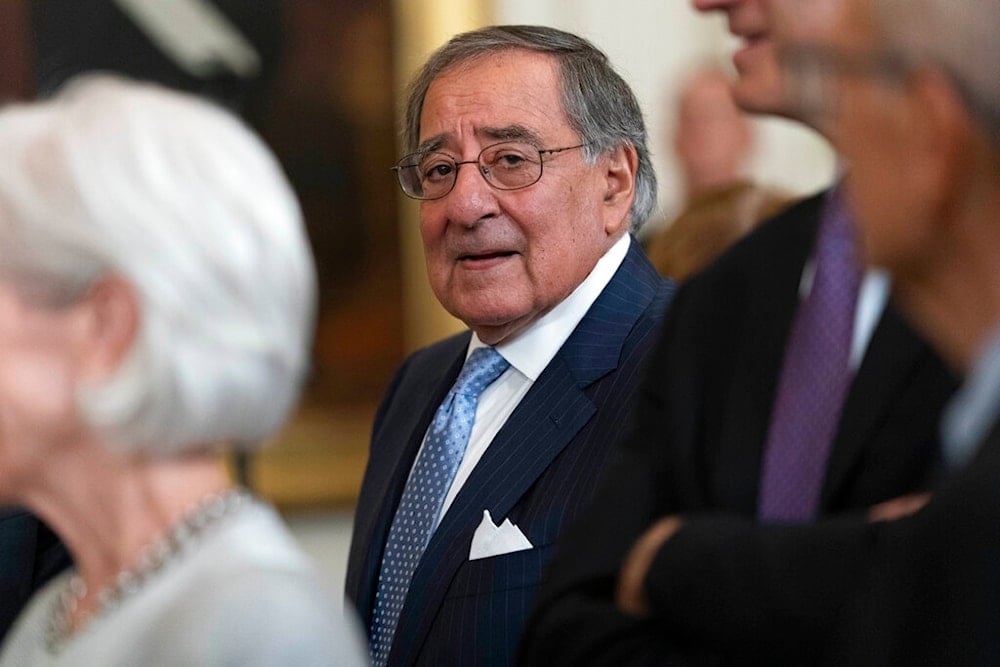
Former Secretary of Defense and CIA Director Leon Panetta stands in the audience during an event in the East Room of the White House in Washington, September 7, 2022 (AP)
The war between the US and Iran could continue for another six months, former US Defense Secretary Leon Panetta warned, saying that US President Donald Trump is struggling to find a way out of the controversial conflict.
In an interview for The Guardian, Panetta said the war launched by Trump more than six months ago risks becoming another “forever war in the Middle East," with no clear end in sight.
“It’s no mystery that the United States and Iran are caught in a terrible stalemate, in which there really are very few options available to bring this war to an end,” said Panetta, who also served as CIA director under Barack Obama, suggesting that the conflict is on course to become “another failed war” in West Asia “like Iraq and Afghanistan."
“I think the likelihood is this war is going to continue for another six months without being resolved,” he added.
Panetta warns of prolonged Iran conflict
Panetta spoke to The Guardian days after US Army Secretary Dan Driscoll abruptly resigned amid the conflict, following reports of tensions with War Secretary Pete Hegseth over a series of firings.
US service members “are going to war at a time when there’s tremendous turmoil at the Pentagon, in the command structure, which really creates a sense that there’s nobody in charge," Panetta, who served as defense secretary from 2011 to 2013, said.
He told the British newspaper, “My biggest concern right now is we live in a very dangerous world, with the primary threats coming from China, from Russia, from North Korea, and from terrorism, and yes, from Iran as well. But what I’m concerned about is that we’re sending a message of weakness to our primary adversaries."
The Pentagon rejected Panetta's assessment, insisting in a statement that it was “firing on all cylinders” under Hegseth’s leadership.
“The premise that the Department is in disarray is completely baseless and an insult to every dedicated professional and warfighter in this building who comes to work every day to defend this nation,” chief Pentagon spokesperson Sean Parnell said. “This is what reform looks like.”
Trump faces three options
In March, three weeks after the US and "Israel" launched their aggression against Iran, Panetta told The Guardian that Trump was caught between a “rock and a hard place” as he considered whether to expand the war to eliminate Iran’s leverage over the Strait of Hormuz or “just simply walk away and declare victory," despite the risk of appearing to have failed.
According to Panetta, Trump now has three options. The first would be to withdraw and “admit that it’s a failed war," something Panetta said he finds difficult to imagine Trump doing.
The second would be to prolong the current “stalemate, with periodic attacks going back and forth, tit for tat," while both sides attempt to “avoid the startup of a more dangerous war” without negotiating or surrendering.
Panetta said that approach would result in “what all parties feared”: another prolonged war in West Asia.
The third option, he said, would be for the US to take control of the Strait of Hormuz and remove Iran’s “most dangerous leverage point” over the US, “which is the ability to close and disrupt” the global trade chokepoint.
“So the president either steps up and does what’s necessary to open up the Strait of Hormuz, or, as I said, he just continues to play this game of pretending that somehow he’s winning a stalemate when the fact is he’s not,” Panetta said.
Panetta says Hormuz key to ending the conflict
Asked whether he believed the war was “winnable” for the US, Panetta replied, “It’s only winnable if there is a dramatic change in the attitude of the United States that makes clear that the objective, the primary objective by the United States at this point in time, is to reopen the strait of Hormuz.”
He also argued that Trump had damaged his credibility by repeatedly claiming, incorrectly, that a deal to end the war was imminent and that the Strait of Hormuz was open.
“So the real question is, is he going to make a decision to actually deliver?” Panetta asked. “For a lot of reasons, right now, he’s caught in the worst of every world because not only does he not have credibility, but any threats he makes are totally ignored.”
Earlier this week, Vice President JD Vance told reporters that he would not describe the current military conflict with Iran as a “war”.
Asked whether he expected the conflict to end by the November US midterm elections, Vance said, “I think the reality is I don’t know the answer to that question. You would have to ask the Iranians.”


