Exclusive | Araghchi: I was in Sayyed Khamenei's office when bombed
 4 Min Read
Iranian Foreign Minister Abbas Araghchi reveals that he was inside Sayyed Khamenei's offices when the building was bombed, and spent two days not knowing whether the Leader had survived.
-
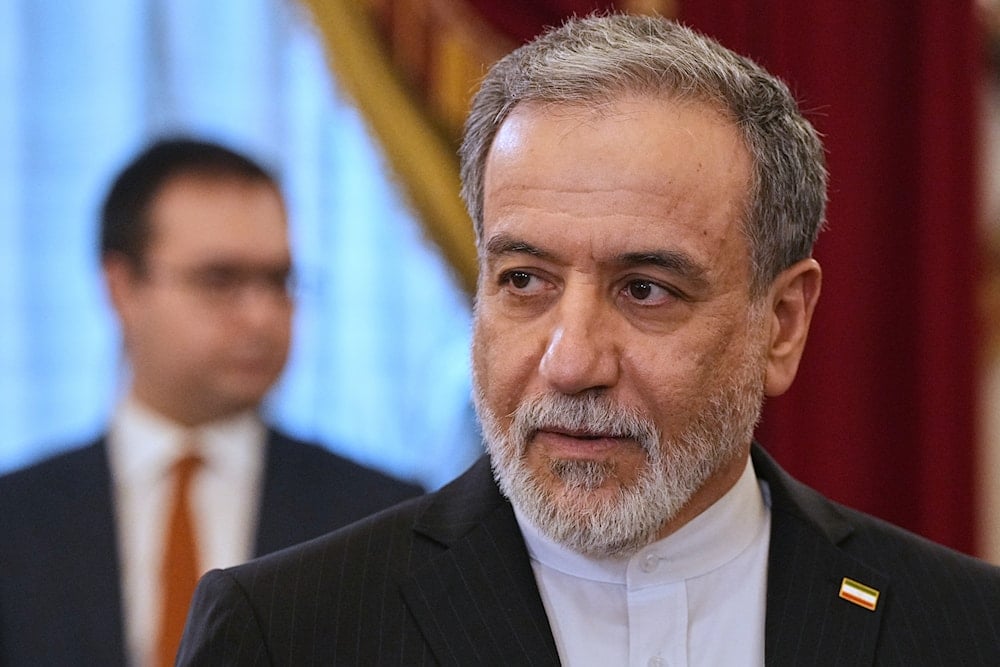
Iranian Foreign Minister Abbas Araghchi arrives to attend the talks with Russian President Vladimir Putin at the Boris Yeltsin Presidential Library, in St. Petersburg, Russia on April 27, 2026. (AP Photo/Dmitri Lovetsky, Pool)
Iranian Foreign Minister Abbas Araghchi has revealed for the first time that he was inside Sayyed Ali Khamenei's office when the building came under attack in the opening hours of the US-Israeli aggression on Iran, and that he spent two days uncertain whether the Leader had survived.
For the first time, Iranian Foreign Minister Dr. Abbas Araghchi reveals in an interview with Al Mayadeen the harrowing details of the day the Iranian Leader, Sayyed Ali Khamenei, was martyred.
— Al Mayadeen English (@MayadeenEnglish) June 4, 2026
Araghchi recounts being inside the very same building during the targeted airstrike,… pic.twitter.com/ToJ1wZ1dnT
Speaking in an exclusive interview with Al Mayadeen, Araghchi offered the most detailed personal account yet of the moments surrounding the Leader's martyrdom.
View this post on Instagram
'I was not worried about myself'
Araghchi told Al Mayadeen that he had returned from the Geneva negotiations on Friday and gone to Sayyed Khamenei's office the following morning to brief him in person.
"After returning from the Geneva negotiations on Friday, I went to Sayyed Khamenei's office at 9:00 am on Saturday to present my report, which concerned the negotiations and the developments that had emerged on Friday, which made the prospect of war far more likely," he said.
In an exclusive interview with Al Mayadeen, Iranian Foreign Minister Abbas Araghchi affirmed that during his tours in the Gulf region, he had already conveyed to all the countries of the region that Iran does not want war, but if war is imposed on it, then Tehran will certainly… pic.twitter.com/ni93lwmluZ
— Al Mayadeen English (@MayadeenEnglish) June 4, 2026
The attack came while he was still there. The wing of the building where Araghchi was seated was not destroyed, but the building was bombed, and he found himself trying to get out from under the rubble.
"At the moment of Sayyed Ali Khamenei's martyrdom, I was in his office, which came under attack," he said. "As we were trying to make our way out from beneath the rubble, my thoughts were entirely focused on whether he had been targeted."
His first instinct, he said, was not concern for his own safety. "At the moment of the bombing, I was so deeply concerned for the Leader that I was not worried about myself."
"From what I knew of his routine, I was certain the Leader would have been in his office," Araghchi explained. He described the following 48 hours as agonising, waiting for news that ultimately confirmed Sayyed Khamenei had been martyred.
Araghchi also noted that Sayyed Khamenei had refused to take shelter despite the mounting likelihood of war.
In an exclusive interview with Al Mayadeen, Chairman of the Board Ghassan Ben Jeddou asked Iranian Foreign Minister Abbas Araghchi whether reports were true that Sayyed Khamenei had been advised to move to a highly secure location but refused.
— Al Mayadeen English (@MayadeenEnglish) June 4, 2026
Araghchi said it was reported that… pic.twitter.com/s66pC7dyCX
A wound that will not heal
"What happened will never be forgotten, not now, not ever," Araghchi said. "It left a wound on our hearts that may never fully heal."
He described Sayyed Khamenei's martyrdom as a moment that, contrary to what Iran's enemies had anticipated, did not break the Islamic Republic.
Iranian Foreign Minister Abbas Araghchi said in an interview with Al Mayadeen that Sayyed Ali Khamenei personally issued the orders regarding the current war on Iran.
— Al Mayadeen English (@MayadeenEnglish) June 4, 2026
"In fact, the directives came directly from him," the minister added.
Commenting on Trump's reaction,… pic.twitter.com/LlODiukHB6
"They expected it to become a point of weakness and lead to the collapse of the regime," he said. "Instead, the opposite happened."
A test the system passed
In Araghchi's telling, the aftermath became proof of the Islamic Republic's institutional resilience. The system's structures were activated, a new leadership was convened, and Sayyed Mojtaba Khamenei was selected to succeed his father.
In an interview for Al Mayadeen, Iranian Foreign Minister Abbas Araghchi highlighted that Sayyed Mojtaba Khamenei has a highly influential and strong presence in the country’s ongoing affairs and holds full control over the reins of authority.
— Al Mayadeen English (@MayadeenEnglish) June 4, 2026
Araghchi also affirmed that… pic.twitter.com/UXlCE1Fshy
"The Islamic Republic of Iran is stronger than any system that depends on individuals," Araghchi said.
He added that throughout the period, the Foreign Ministry had worked to ensure that Iran's position reached the world, that governments and publics understood "the injustice Iranian people had suffered, and the legitimacy of their cause."
Tune in tonight for the full interview with Iranian Foreign Minister Abbas Araghchi on Al Mayadeen at 8:30 p.m. Al-Quds time and 9:00 p.m. Tehran time, where he discusses the latest developments surrounding indirect negotiations with the United States, regional dynamics, and Iran’s foreign policy priorities.