
FAO warns US blockade on Hormuz could trigger global food crisis
 3 Min Read
FAO official David Laborde warned that escalating tensions and potential disruption in the Strait of Hormuz could deepen a global input crisis and evolve into a food security catastrophe if preventive measures are not taken.
-
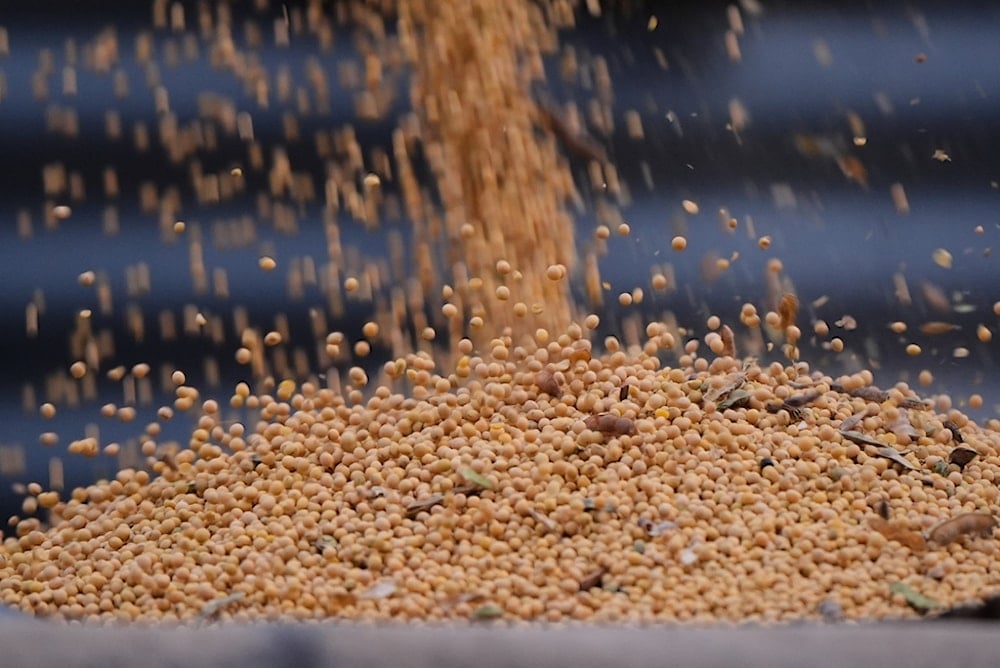
Soybeans from last year's harvest are loaded into a truck at Doug Bartek's farm near Wahoo, Neb., on Monday, April 6, 2026 (AP Photo/Charlie Riedel)
A senior United Nations official has warned that escalating tensions around the Strait of Hormuz could spill over into a wider global crisis affecting food production, as disruptions to key supply chains threaten access to essential agricultural inputs.
David Laborde, director of the Agrifood Economics Division at the UN’s Food and Agriculture Organization (FAO), said the world is already under growing pressure from constrained resources, cautioning that further escalation could significantly worsen the situation.
"We are in an input crisis; we do not want to make it a catastrophe ... The difference depends on the actions we take," Laborde said in a podcast released on the organization’s YouTube channel.
He explained that prolonged instability in the Strait of Hormuz could disrupt access to fertilizers and other inputs critical for agricultural production, particularly in countries that rely heavily on imports. Such disruptions, he added, could weaken food systems and contribute to rising prices and shortages.
Laborde called for early preventive measures if the standoff persists, urging international institutions to provide financial support to countries at risk of losing access to essential fertilizers.
Hormuz crisis deepens
The warning comes amid escalating tensions following US President Donald Trump’s announcement that Washington would enforce a naval blockade targeting vessels entering or leaving the Strait of Hormuz, with US forces instructed to monitor and intercept ships that had paid Iran for passage through the corridor.
The move builds on an already tightly managed maritime environment in which Iran had been regulating transit through the Strait in line with its security considerations. Prior to the US announcement, passage remained possible for vessels not deemed hostile, with navigation coordinated under Iranian oversight to ensure stability in the waterway, while actors linked to adversarial activity faced restrictions, contributing to a reduced but controlled flow of shipping.
Following Trump’s announcement of a naval blockade, Iran’s Khatam al-Anbiya Central Headquarters said maritime security in the Persian Gulf and the Sea of Oman would be enforced on a reciprocal basis. Spokesperson Ebrahim Zolfaghari stated that “the security of ports in the Persian Gulf and the Sea of Oman is either for everyone or for no one,” warning that any threat to Iranian ports would carry broader regional consequences.
The Strait of Hormuz remains a vital artery for global trade, particularly for energy shipments, and any sustained disruption is expected to have far-reaching economic implications, extending beyond oil markets into agriculture and global food security.
Read more: UKMTO reports Iran coast blockade notices amid rising tensions


