
Four seats down, Netanyahu's bloc struggles to secure Knesset majority
 7 Min Read
Netanyahu's bloc falls to 51 seats in the latest Channel 13 poll, as Eisenkot leads and neither camp appears close to securing a parliamentary majority.
-
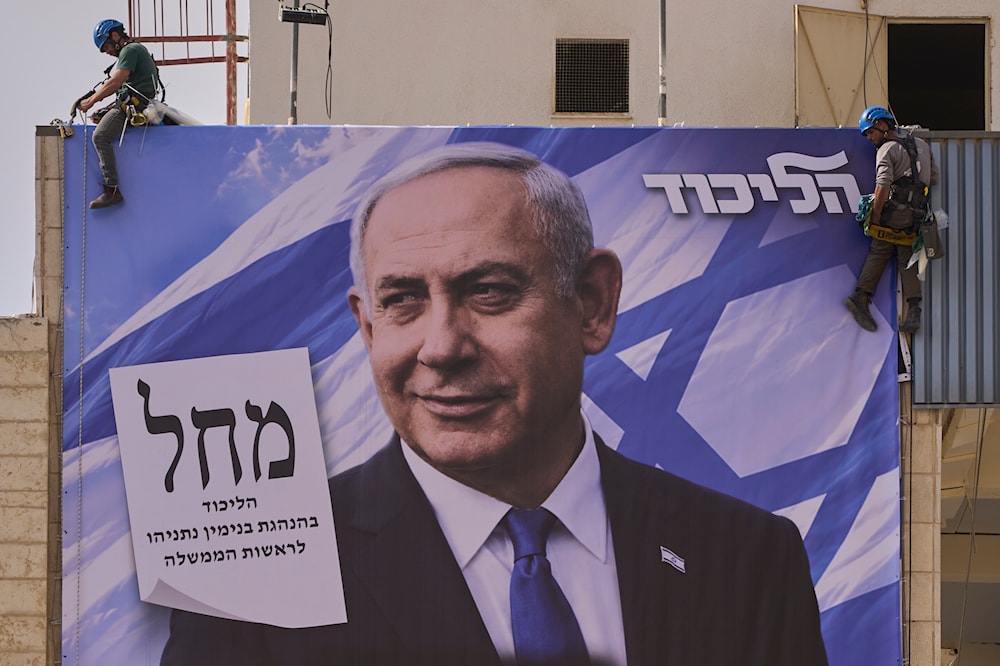
Workers hang up an election campaign billboard for the Likud Party in occupied al-Quds, Wednesday, Oct. 14, 2026, showing Israeli Prime Minister Benjamin Netanyahu ahead of the Israeli general election (AP)
Israeli Prime Minister Benjamin Netanyahu’s right-wing bloc has lost four seats in Israeli Channel 13’s latest weekly poll, leaving it with 51 seats and well short of the parliamentary majority required to form a government, as the alliance led by former military chief Gadi Eisenkot also struggles to secure enough support.
The survey projects Eisenkot’s Yashar party as the largest political force with 20 seats, ahead of Netanyahu’s Likud with 18. The opposition-aligned bloc is projected to win 50 seats, leaving both major camps short of the 61 seats needed for a majority in the 120-member Knesset.
Parties outside the two blocs are projected to secure the remaining 19 seats. These include the predominantly Arab Joint List with nine seats, Islamist Ra’am with six, and the alliance led by former minister Yoaz Hendel and economist Yaron Zelekha with four. The latter is hovering around the electoral threshold, making its entry into parliament a potentially decisive factor in coalition negotiations.
With "Israel’s" election scheduled for October 27, the poll points to a parliamentary deadlock in which neither major camp has a clear path to power. "Israel's" system requires a prime minister to assemble a parliamentary majority through coalition agreements rather than win a direct popular vote, placing considerable weight on the performance of smaller parties.
Right-wing divisions threaten Netanyahu’s parliamentary majority
Netanyahu’s prospects have been complicated by several right-wing parties' failure to unite before the election. Finance Minister Bezalel Smotrich’s Religious Zionism is running separately from Police Minister Itamar Ben-Gvir’s Otzma Yehudit and Amcha Yisrael, led by retired Brigadier General Ofer Winter.
Religious Zionism is polling at around five to six seats, while Winter’s party is estimated to have support equivalent to four or five seats. Both face the risk of falling below the 3.25% electoral threshold, which determines whether a party qualifies for representation in the Knesset. Votes cast for parties that fail to qualify do not translate into parliamentary seats, potentially weakening Netanyahu’s bloc.
Dr. Gayil Talshir, a political scientist at the Hebrew University of Jerusalem, said Netanyahu had previously succeeded in bringing Ben-Gvir and Smotrich together on a joint electoral list ahead of the 2022 election. “Netanyahu has been considered Israel’s political magician for many years, the man who managed in 2022 to bring Ben-Gvir and Smotrich together on a joint list,” Talshir said.
“We haven’t seen that happen in this election,” Talshir noted, adding, “Netanyahu is entering this election in the weakest position we have seen him in over the past decade in terms of the parties running.” Personal rivalries and ideological differences have contributed to the split, with Winter calling for new political leadership and Smotrich and Ben-Gvir maintaining separate political positions.
Arab parties could influence government formation
The opposition-aligned bloc has also lost ground in recent polling, falling from approximately 58–59 seats to around 50–53, based on the survey. This leaves it unable to form a government without additional parliamentary support, while Arab-led parties hold a potentially influential position outside the two main camps.
Talshir linked the changing balance partly to the decision by three Arab parties to unite under the Joint List. The merger strengthens their collective electoral position and reduces the risk of one of the participating parties failing to cross the threshold. It could also encourage greater turnout among Arab voters. The latest Channel 13 poll projects nine seats for the Joint List and six for Ra’am.
Both major political camps have ruled out including Arab parties in their governing coalitions. Opposition figures, including Eisenkot, Yair Lapid, and Avigdor Lieberman, have pledged not to repeat the arrangement established in 2021, when a government led by Naftali Bennett and Lapid included Ra’am to secure a parliamentary majority.
However, Talshir argued that another electoral deadlock could test those commitments. One possible scenario would involve Eisenkot securing Ra’am’s support for a minority government while the party remained outside the coalition. Ra’am leader Mansour Abbas has previously said his priority was replacing Netanyahu’s government, while Joint List chairman Youssef Jabareen said on Saturday that his party would support any government that ends Netanyahu’s rule, subject to unspecified conditions.
Smaller parties could reshape the election outcome
The performance of smaller parties remains another major uncertainty, particularly for Netanyahu’s bloc. Veteran pollster Shmuel Rosner identified three parties whose support could affect the distribution of seats: the Reservists-Economic Party led by Hendel and Zelekha, the Haredi-oriented HaTzibbur HaHaredi led by Moti Leitner, and Benny Gantz’s Blue and White party.
Rosner said the Hendel-Zelekha alliance was the most consequential of the three because its support is close to the electoral threshold. “It is on the edge of the threshold,” Rosner said. “It could pass or fall with four seats.” The party’s political alignment remains unclear, although Rosner considers it more likely to cooperate with the opposition-aligned camp than with Netanyahu’s coalition, partly because of tensions surrounding military service exemptions for ultra-Orthodox men.
Gantz’s Blue and White, which previously led the opposition before joining Netanyahu’s government, is polling at approximately 1%, leaving it well below the threshold. Gantz has said he would seek to establish a unity government involving Netanyahu and parties from the opposition’s change bloc if his party wins enough votes to enter the Knesset.
HaTzibbur HaHaredi is also polling below the threshold and could draw support away from established ultra-Orthodox parties, potentially reducing the number of seats available to Netanyahu’s allies. The new party has expressed support for a “broad national government” without specifying which bloc it would join. If either party enters the Knesset, its seats could alter the balance of power between the competing camps.
Election could lead to another political stalemate
Even if Religious Zionism and Winter’s party both cross the electoral threshold, current polling still leaves Netanyahu’s bloc well short of a majority. The opposition faces a similar problem, with neither side projected to reach 61 seats independently and both dependent on smaller parties to secure enough parliamentary support.
Rosner said the distribution of seats makes the election particularly difficult for Netanyahu’s camp. “The party lineup is more challenging for Netanyahu than for his opponents,” he said.
“In the anti-Netanyahu camp, there is currently no party that is at risk of falling below the electoral threshold, while in the bloc that leans toward Netanyahu, there is at least one - and potentially another - party in that position,” he added.
The uncertainty extends beyond which parties voters support to whether those supporters turn out on election day. Rosner said the immediate contest was increasingly focused on mobilizing existing voters rather than persuading them to change political allegiance. “The struggle right now is much less about moving voters from one side to the other and much more about making sure voters leave their homes and vote,” he said, emphasizing that “and I estimate that the more difficult test will be for the right-wing bloc.”
If neither camp can assemble a governing majority, "Israel" could face another election, extending the political instability that began in 2019 and led to five elections over the following two years. Netanyahu would remain caretaker prime minister in the interim.
Rosner assessed the current prospects for a majority as bleak for both sides, saying, “Looking at the scenarios and the polls we are seeing right now, we see a very small chance that either bloc will be able to reach 61 seats.”


