
Palestinians face existential battle amid Israeli elections: MK Odeh
 4 Min Read
Knesset member Ayman Odeh says the Palestinian question is central to "Israel’s" elections and warns that another Netanyahu term could deepen efforts against Palestinian citizens.
-
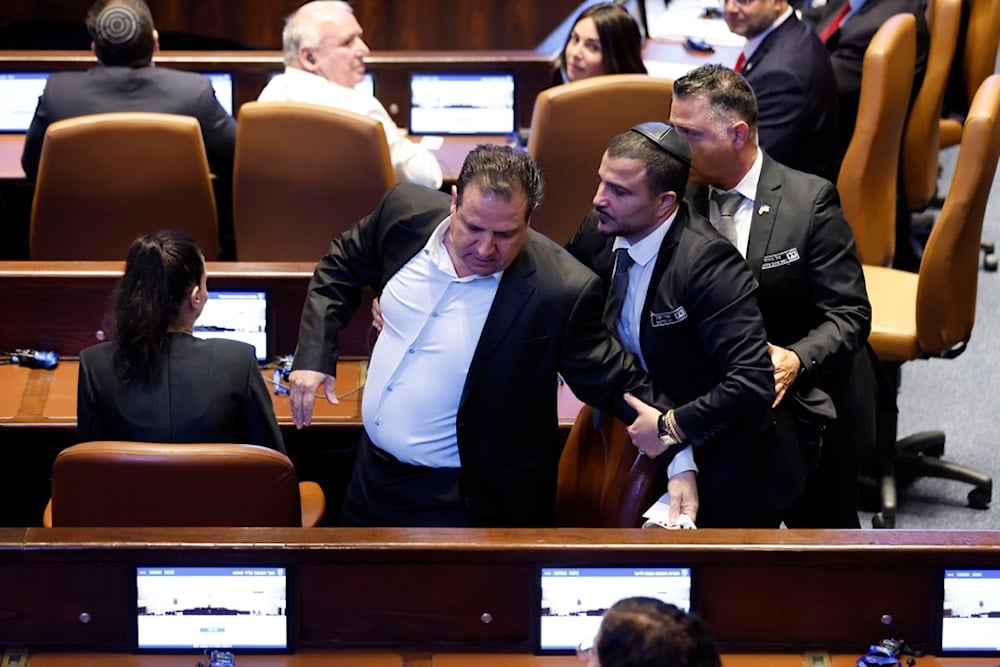
Arab member of Knesset Ayman Odeh is removed from the hall after raising a sign reading "genocide" while US President Donald Trump addressed the Knesset Monday, October 13, 2025, in occupied al-Quds, occupied Palestine (AP)
The Palestinian question remains at the heart of the Israeli elections, Ayman Odeh, head of the Hadash-Ta’al list, said, stressing that Palestinian citizens face an existential political battle.
Speaking to Al Mayadeen, Odeh warned that “Israel” and its government, institutions, and public seek to expel Palestinians, saying, “Israel with its government, institutions, and people wants to expel us, so we consider the battle existential.”
He added that Palestinian steadfastness remains a central factor in confronting such efforts, saying, “In the face of the government’s intention to expel us, there is the steadfastness of our people, who cannot be an easy target.”
Odeh warns of efforts to expel Palestinians
Odeh said the objective of his political camp is to “bring down the fascist right in the Israeli elections.”
However, he also pointed out “a form of racist supremacy that brings together the right and left in Israel.”
Odeh warned that another term for the Netanyahu government would give it the opportunity to erase historical issues to serve itself. “A victory for the Netanyahu government for one additional term will allow it to close all the historical files,” he said.
Palestinian unity seen as key to confronting the right
Odeh said his camp would seek to prevent the Netanyahu-Smotrich-Ben-Gvir government from continuing, even if that meant "choosing between the lesser of two evils."
“We will do everything to prevent the Netanyahu-Smotrich-Ben-Gvir government from continuing, even if it is through choosing the lesser of two evils,” he said.
He added, “We are not facing a choice of bringing benefits, but rather preventing harm.”
“After the genocidal war and the spread of fascism and crime among our people, we stressed the need to renew unity among ourselves,” he said.
Odeh has faced attempts to remove him from the Knesset over his opposition to the policies of racial segregation pursued by successive Israeli governments.
Supreme Court overturns Arab party election bans
The Israeli occupation regime's Supreme Court overturned on Friday the Central Elections Committee's decisions to disqualify the Joint List and the United Arab List from the upcoming Knesset elections, according to Al Mayadeen's correspondent.
The court also overturned the disqualification of Ofer Cassif, a candidate on the Joint List.
The decisions came after the Central Elections Committee voted in September to bar the two Arab-majority political lists and two candidates from participating in the October 27 regime's legislative elections.
The Joint List and United Arab List had challenged the decisions before the Supreme Court, arguing that the disqualifications should not prevent them from contesting the election.
The Central Elections Committee's September decisions had targeted the United Arab List, also known as Ra'am, led by Mansour Abbas, as well as the Joint List, which includes Hadash, Balad, and Ta'al. The committee also voted to disqualify Cassif and Balad chairman Sami Abu Shehadeh.
Contest over Arab political representation
The developments underscore the continuing legal and political contest over the participation of Arab political parties and candidates in the Israeli occupation regime's electoral system.
The episode reflects the occupation’s tiered divide-and-conquer system imposed on the Palestinian people: some may participate in elections as second-class citizens, others endure apartheid, settler attacks, and the constant threat of ethnic cleansing in the occupied West Bank, while Palestinians in Gaza are subjected to an ongoing genocide.
The Central Elections Committee voted on September 23 to disqualify the Joint List and United Arab List, as well as Cassif and Abu Shehadeh. According to Adalah, which represented the affected lists and candidates, the committee's decisions effectively targeted major forms of Arab political representation.
The Supreme Court's decision to overturn the disqualifications of the two lists and Cassif means those political forces can proceed toward the October 27 election, while Abu Shehadeh's withdrawal leaves his individual candidacy outside the race.


