
Funeral for Sayyed Ali Khamenei to pass through Iraq before burial
 4 Min Read
The funeral procession for Iran's martyred Supreme Leader Sayyed Ali Khamenei will pass through Iraq before his burial in Mashhad, with Tehran officials expecting a crowd of nearly 20 million people.
-
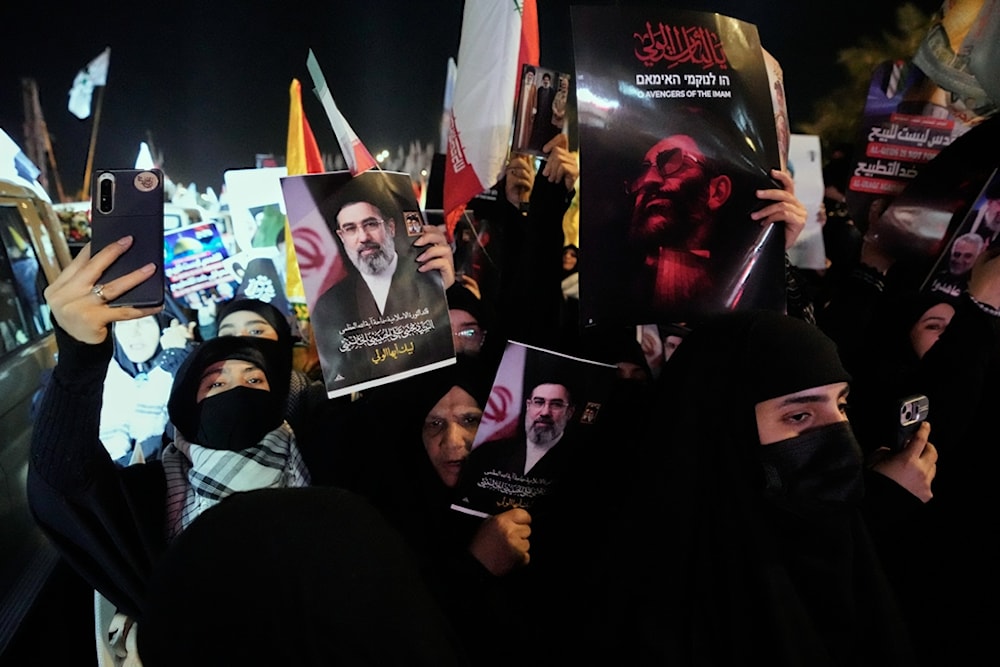
Iraqis Muslim women hold portraits of the Iran's late leader Ayatollah Ali Khamenei, and his son Ayatollah Mojtaba Khamenei during the annual rally Quds Day, or Jerusalem Day, in support of Palestinians in Baghdad, Iraq, Friday, March 13, 2026. (AP)
The funeral procession for Iran's late leader Sayyed Ali Khamenei, who was martyred in US-Israeli aggression in February, will pass through Iraq before his burial in the Iranian city of Mashhad, Tehran mayor Alireza Zakani announced on Wednesday.
In a video carried by state media, Zakani said the farewell ceremonies and funeral for Khamenei would be held from July 4 to 9. "On July 8, 2026, they will take place in Iraq, and on July 9, 2026, God willing, in Mashhad" in Iran, where Khamenei will be buried, he added.
Like Iran, neighboring Iraq has a Shiite majority and is home to the holiest sites in Shiite Islam, including the shrine of Imam Hussein in Karbala and Imam Ali in Najaf.
Zakani did not specify where Khamenei's body would be taken during the planned processions in Iraq.
Preparations underway for massive crowds in Tehran
Zakani also said preparations were underway for funeral processions in Tehran, where officials expect a crowd of almost "20 million people." He said the capital "has never had such a large crowd in its history up to now."
The massive expected turnout reflects the deep reverence for the martyred leader, who was assassinated on February 28, the same day the United States and "Israel" launched their war on Iran.
Sayyed Khamenei's martyrdom has galvanized Iranian society, with millions expressing their loyalty and grief in the months since his assassination.
Context: Assassination of Supreme Leader
Sayyed Ali Khamenei was martyred in the opening salvo of the US-Israeli war on Iran. His assassination was part of a broader campaign that targeted Iranian military and political leadership in an attempt to destabilize the Iranian government.
However, despite the martyrdom of their leader, the Iranian people and state institutions have remained united, and the country has continued its military and diplomatic resistance against the aggression.
The funeral procession through Iraq underscores the strong bond between Iran and Iraq, as well as the deep religious and cultural ties that unite the Shiite populations of both countries.
No statement has yet been issued by Iraqi authorities regarding the planned processions.
Leader of the Ummah, Sayyed Ali Khamenei, martyred in US-Israeli aggression
The leader of the Islamic Revolution in Iran and the Islamic Republic of Iran, Sayyed Ali Khamenei, was martyred in the joint US-Israeli aggression on Iran on February 28, 2026.
Iranian state television reported that the leader of Iran, Sayyed Ali Khamenei, was martyred at his workplace while he was carrying out his duties in his office following the joint US-Israeli attacks in the early hours of Saturday.
According to Iranian state television, Sayyed Khamenei's martyrdom at his workplace once again refuted claims by "outlets linked to the Israeli regime and regional reactionary currents that the leader was in a secure and undisclosed location," affirming that he remained present on the frontlines of responsibility among his people.
Aged 86, Sayyed Ali Khamenei guided the Islamic Republic of Iran from the early days of the post-revolutionary era through decades of struggle and transformation. After taking part in the 1979 Revolution that overthrew the oppressive, US-backed Pahlavi monarchy, he served as president throughout much of the 1980s before being elected as the Leader of Iran in 1989 following the death of Imam Ruhollah Khomeini.
In that position, he became the highest authority in Iran's political and religious system, shaping domestic policy, overseeing national institutions, and directing Iran's strategic orientation for nearly four decades.
During his leadership, he maintained Iran's sovereignty in the face of international pressure, steered the country through regional conflicts, and fostered alliances with movements and governments across West Asia.
His tenure also oversaw significant developments in Iran's nuclear program and the expansion Iran's Armed Forces, making him one of the most significant figures in contemporary Iranian and regional history.
Read More: Iran announces funeral, burial services for martyr Sayyed Ali Khamenei


