
GCC leaders urge faster rollout of missile early warning system
 3 Min Read
The GCC summit in Jeddah highlights plans to fast-track a shared missile detection system and deepen regional defense coordination.
-
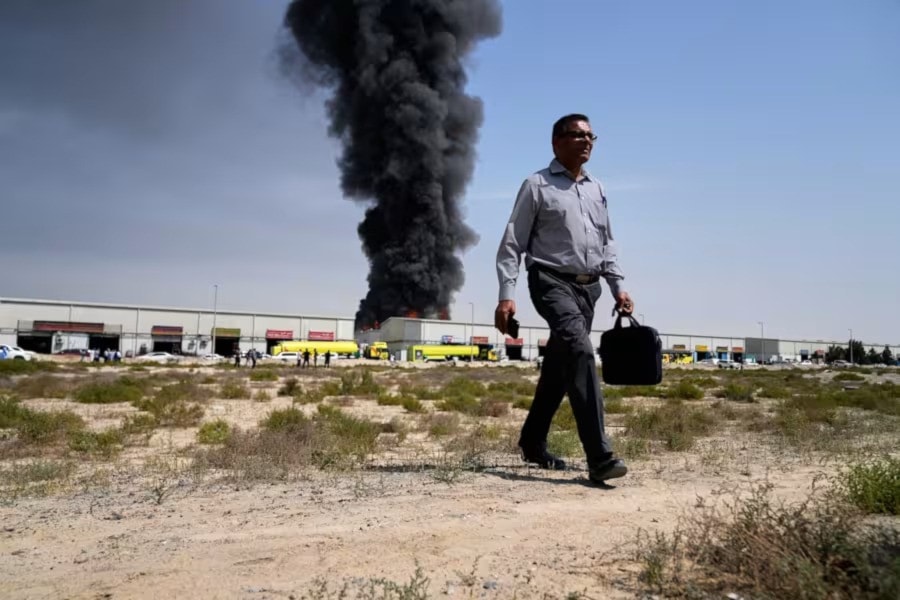
A man walks away after watching as a black plume of smoke rises from a warehouse in the industrial area of Sharjah City, United Arab Emirates, on March 1, 2026, following reports of Iranian strikes in Dubai. (AP Photo/Altaf Qadri, File)
Leaders of the Gulf Cooperation Council (GCC) have called for accelerating efforts to establish a unified ballistic missile early warning system, alongside deeper military integration among member states, according to an official statement.
GCC Secretary-General Jasem Mohamed Albudaiwi said the bloc’s leaders emphasized the need to fast-track the completion of the joint early warning system designed to detect ballistic missile threats.
“His Excellency added that the Leaders of the Council countries underlined the importance of intensifying military integration among the member states, and accelerating the completion of the early warning system project against ballistic missiles,” the organization said.
The announcement came during the 19th GCC consultative summit, held in Jeddah on Tuesday, where monarchs, crown princes, and senior officials convened to discuss regional security developments.
Discussions at the summit focused on strengthening collective defense mechanisms, particularly in light of the ongoing war on Iran, with member states exploring coordinated responses to emerging threats.
Doubts over US protection
The renewed push by GCC leaders to fast-track a unified ballistic missile early warning system and deepen military integration comes amid a broader strategic reassessment within the bloc, as regional dynamics expose lingering gaps in collective defense.
Analysts suggest that growing doubts about the reliability of traditional security guarantees, particularly from Washington, are driving Gulf states to both strengthen internal coordination and explore diversified defense partnerships, as seen in recent agreements and emerging alignments.
A commentary by The Daily Star last week said that GCC states now view Washington as either unable or unwilling to protect them during crises, while prioritizing "Israel’s" security interests. As a result, these countries may reassess their reliance on a single security power and consider diversifying their defense and strategic partnerships.
It further notes that, irrespective of the future status of the Strait of Hormuz, Iran’s capacity to influence the flow of West Asian energy exports has become increasingly evident.
The analysis adds that this enhanced leverage could incentivize Gulf Cooperation Council states to pursue a pragmatic accommodation and broader normalization with Tehran, underscoring that Saudi Arabia had already begun a rapprochement process with Iran prior to the latest phase of the war.
On the other hand, the Saudi-Pakistan defense agreement is cited as an example of Saudi Arabia’s efforts to diversify its security partnerships. The vulnerabilities exposed among GCC states during the war are expected, in the longer term, to push them to develop new security frameworks, particularly as the GCC’s collective security system is seen as having fallen short.
In this context, members of the Quad, Pakistan, Saudi Arabia, Turkey, and Egypt, may eventually consider formalizing their informal coordination into a structured regional security arrangement.
Read more: After war on Iran, is US protection still worth the cost for the Gulf?


