
Germany fast-tracks $638M combat drone deal with Helsing, Stark
 4 Min Read
Germany plans to expedite a €536 million drone deal with Helsing and Stark Industries to boost Bundeswehr capabilities amid rising NATO tensions.
-
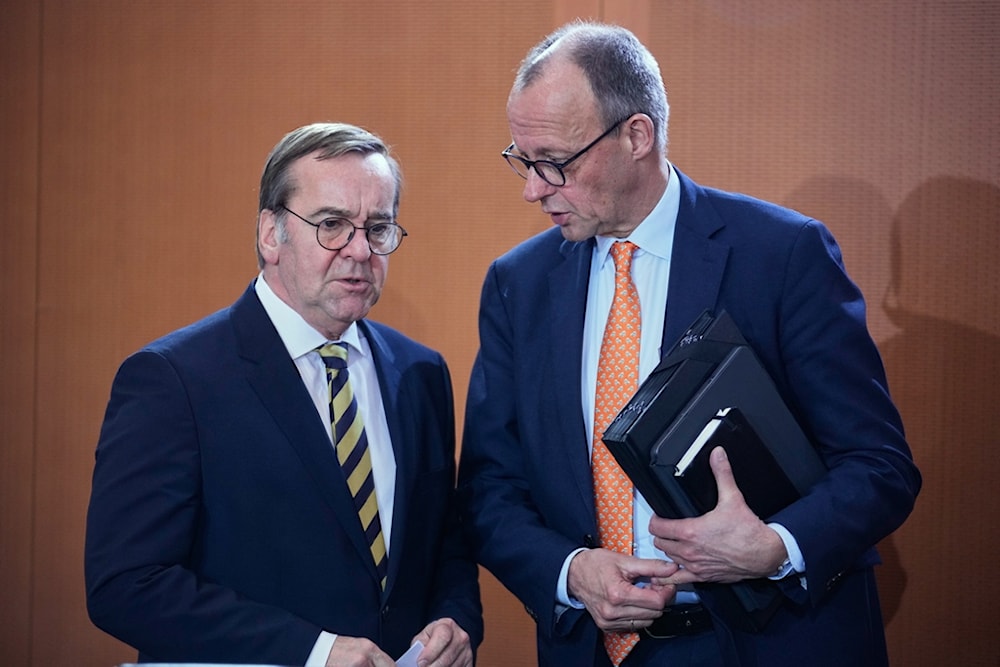
German Chancellor Friedrich Merz, right, speaks with German Defense Minister Boris Pistorius prior to the cabinet meeting at the chancellery Berlin, Germany, Wednesday, Jan. 14, 2026. (AP)
Germany's Defense Ministry is set to fast-track a €536 million ($638 million) procurement deal for combat drones, with defense startups Helsing and Stark Industries as key suppliers, Spiegel reported on Tuesday, citing internal government sources.
The move comes as part of a broader effort by Berlin to enhance its defense capabilities and reduce reliance on the United States, amid growing geopolitical tensions in Europe and beyond.
Details of the €536 million drone deal
The ministry reportedly plans to place urgent orders for thousands of loitering munitions: unmanned aerial vehicles capable of being armed with warheads.
The procurement includes two drone models: the Virtus, manufactured by Stark Industries, and the HX-2, developed by Helsing.
Helsing’s HX-2 and Stark’s Virtus drones
These combat drones are intended to enhance the operational capacity of the Bundeswehr, Germany's armed forces.
According to the report, the order is expected to be fulfilled by the end of 2026.
Bundeswehr deployment in Lithuania
The drones will be deployed with a Bundeswehr brigade stationed in Lithuania.
This is seen as a strategic move to strengthen Germany’s forward military presence on NATO’s eastern flank, especially in light of NATO’s growing military posture in Eastern Europe.
Concerns over drone performance in Ukraine
Last week, Politico reported that the Bundeswehr’s planned investment in Helsing-manufactured drones comes despite reports of poor performance by the same systems in Ukraine.
The criticism has raised concerns that the German military may again misallocate funds on underperforming technology.
Part of a larger military shift: missile detection in space
This combat drone deal follows another recent announcement that Germany plans to become the first European power to develop a space-based missile detection system. The initiative, described as a national project open to European cooperation, was revealed by Major General Michael Traut, head of Germany’s space command, during the European Space Conference in Brussels.
Traut emphasized the urgency of satellite-based early warning systems, stating that “the threat is imminent.”
The system is aimed at boosting both national and European defense independence while complementing existing cooperation with the US.
Josef Aschbacher, Director-General of the European Space Agency (ESA), confirmed that ESA is in discussions with Germany to potentially integrate such technologies into European infrastructure, though the agency will not participate in developing offensive capabilities.
EU defense independence in focus
Germany’s recent defense initiatives, including drone procurement and space-based detection systems, align with a broader shift within the European Union toward greater strategic autonomy.
Amid growing doubts over US military support under President Donald Trump, EU member states are reassessing their dependence on NATO’s Article 5 clause. Calls for a European security framework, including a potential EU army and defense council, are gaining momentum as Brussels pushes for sovereign defense capabilities.
The drive has been fueled by Washington’s unpredictable stance, tariff threats, and geopolitical friction, leading many European leaders to argue that the bloc can no longer rely on the US for its security.
Russia reacts to NATO buildup in Europe
In recent years, Russia has repeatedly pointed to increased NATO activity near its western borders as a cause for concern. The alliance has intensified its military posture in the region under the pretext of deterring "Russian aggression."
The Russian Foreign Ministry has reiterated that Russia remains open to dialogue with NATO on equal terms, but warns that continued militarization of the European continent by the West undermines regional stability.
Read More: EU considers European alternative to NATO amid Trump-era doubts


