
Germany weighs return to conscription as Merz warns of troop shortages
 4 Min Read
Chancellor Merz says Germany may need to revive conscription if the Bundeswehr cannot meet recruitment goals, as Berlin reviews military and civil service reforms.
-
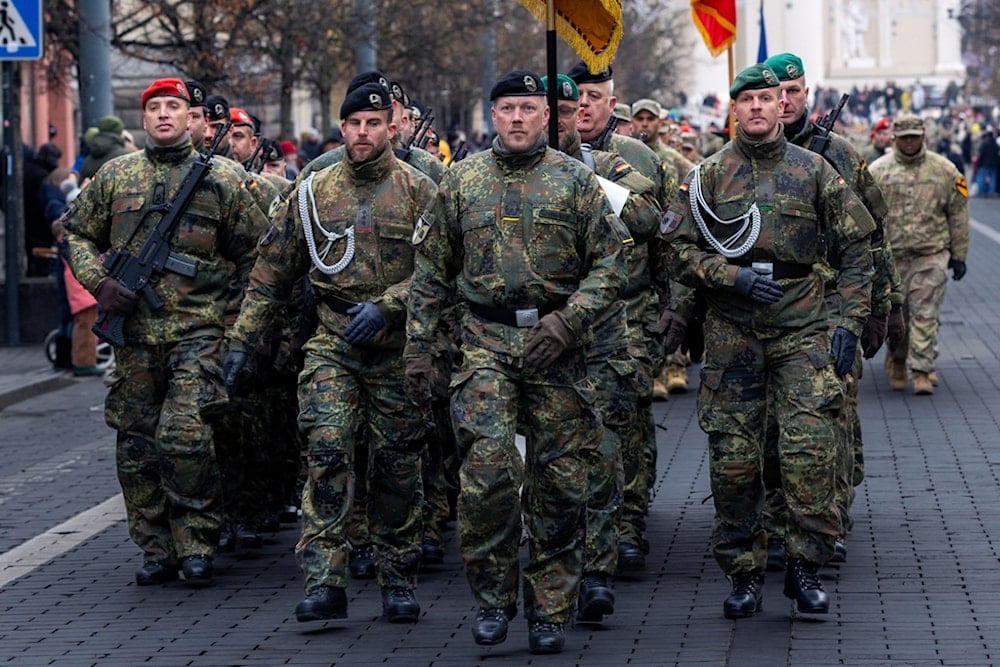
Members of the German army march during a military parade ceremony marking the 107th anniversary of the Lithuanian military, on Armed Forces Day in Vilnius, Lithuania, Sunday, November 23, 2025 (AP)
German Chancellor Friedrich Merz said on Saturday that he would not rule out reinstating conscription in the coming years if the Bundeswehr continues to fall short of its recruitment targets. Speaking at a congress of the Christian Social Union (CSU), Merz also called for restoring mandatory alternative civilian service, arguing that Germany needs broader participation in national service.
His remarks come as the German government begins preliminary consultations with civil society on reintroducing compulsory community service, a move triggered by ongoing challenges in meeting voluntary enlistment goals. Merz said Germany may be forced to consider “mandatory elements of military service” during the current election cycle if the army cannot expand quickly enough.
Merz noted that the German constitution does not allow compulsory military service for women, adding that he supports introducing a mandatory year of community service as an alternative. “We cannot yet involve women, as the Constitution does not allow it. I would like it to be different,” he said.
Mordernizing military service
On December 5, the Bundestag approved a bill modernizing the country’s military service system, keeping Bundeswehr enlistment voluntary but requiring all 18-year-old men to undergo medical examinations for military registration. The legislation permits a return to compulsory conscription only if security conditions deteriorate or recruitment levels remain insufficient, enabling the Bundestag to activate a “needs-based military duty” through a randomized lottery.
Germany has been working since 2018 to expand its armed forces to 203,000 personnel after years of decline. Despite recruitment drives and structural reforms, the Bundeswehr stood at roughly 182,000 troops as of March, leaving Berlin short of its long-term goal.
NATO guidelines envision Germany fielding 460,000 personnel, 260,000 active soldiers, and 200,000 reservists, yet the Bundeswehr currently operates with around 182,000 in active duty and approximately 49,000 in the reserves. Years of understaffing and equipment shortages have widened the gap between Berlin’s obligations and its actual capabilities.
Defense Minister Boris Pistorius urged lawmakers to approve the reform, describing it as a “decisive step for our ability to defend ourselves.” He reminded MPs, “Our allies are looking to us,” framing the buildup as a necessary response to Europe’s shifting security landscape. Pistorius also warned that if recruitment levels remain inadequate, parliament would eventually need to consider “at least a partial reintroduction of conscription.”
Conscription Clash
The bill passed with 323 votes to 272, with one abstention, and is expected to clear the upper house before the holidays. However, the decision has underscored internal divisions: parts of the CDU/CSU demand a swift return to full conscription, while Pistorius and the SPD maintain they prefer a voluntary system, at least for now.
Opposition came from both ends of the political spectrum. AfD MP Heinrich Koch said many families fear “our children will be sent to conflicts outside our borders,” citing Ukraine as an example. The government has rejected this fear, stating the reform does nopppppp,.t force anyone into deployment abroad.
Die Linke MP Desiree Becker condemned the measure as socially regressive, arguing it burdens working-class youth while protecting elite interests. “Young people have other plans than serving in a 'Merz regiment' to protect the capital of the rich,” she said, referring to anti-conscription protests held outside parliament.
Despite a slight rise in enlistment, about 15,000 recruits expected this year, an increase of 5,000, Germany remains far from its long-term goals. Berlin hopes to nearly triple annual volunteer numbers to 40,000 by 2031, a target critics say is unlikely to be met without resorting to more coercive measures.


