
Ghalibaf: Order in West Asia is changing, not on US terms
 4 Min Read
Iranian Parliament Speaker Ghalibaf says the enemy's plan to defeat Iran in 72 hours has failed, all US bases are now targets, and Tehran will no longer accept cycles of war and truce.
-
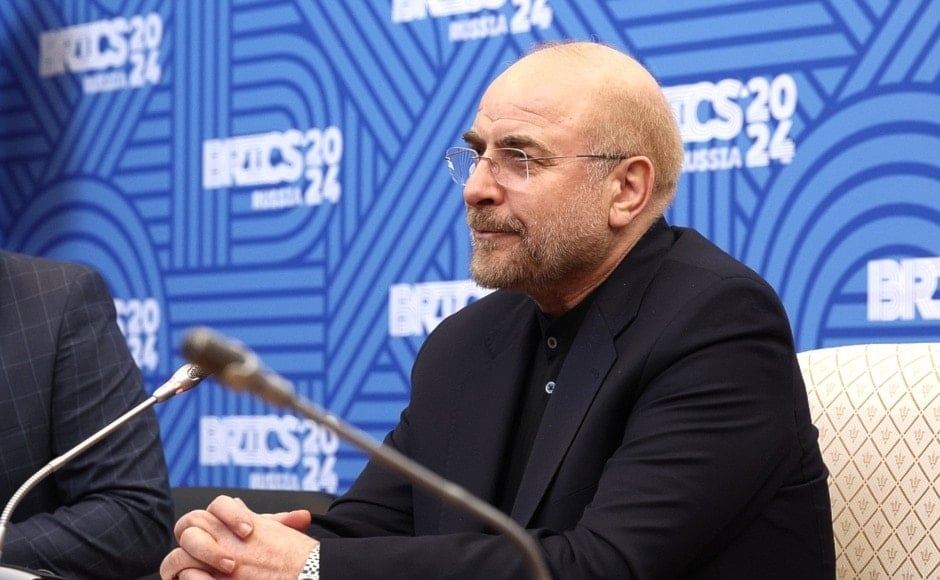
Speaker of the Islamic Consultative Assembly of Iran Mohammad Bagher Ghalibaf during the 2024 BRICS summit in Moscow, Russia (TASS)
Iranian Parliament Speaker Mohammad Bagher Ghalibaf has affirmed that Iran neither sought nor initiated the current war, but will defend itself and respond with overwhelming force to any aggression against it.
Speaking on Tuesday, Ghalibaf said Iran's armed forces are successfully intercepting and destroying enemy drones, regardless of their sophistication, using domestically developed technologies and capabilities.
"We have never allowed the enemy to impose its plans on us," he said, against the backdrop of the ongoing US-Israeli war on the Islamic Republic.
He revealed that Iran has modified its missile-launch platform systems following previous strikes, warning that "the enemy will not be able to destroy them."
72-Hour plan has failed
Addressing the objectives behind the aggression, Ghalibaf said the enemies had expected to defeat Iran within 72 hours. The outcome, he noted, has been the opposite, with all US bases in the region now becoming targets for Iran.
He accused US President Donald Trump of spreading lies "multiple times a day" due to his "incapacity and despair," adding that "the face and order of the Middle East are changing," but not in the way the United States desires.
Regional security must be rebuilt without the US
Ghalibaf recalled that Iran had long warned neighbouring countries that the US presence would not bring them security, and that they are now witnessing the consequences firsthand. He said Tehran intends to work with regional states to establish new local security arrangements on both the economic and security levels.
He further rejected the recurring cycle of "war, then truce, then negotiations, then war," stressing the need to permanently end threats to Iran. Addressing Trump directly, he said: "He must understand that peace cannot be achieved through the misuse of force."
Ghalibaf clarified that during the previous round of aggression in June 2025, Iran agreed to a ceasefire only after the opposing side pressed for it, and only after delivering its final strikes against the entity. "The other side has proven it did not learn the lesson," he said.
He also raised questions about external leverage over Washington, saying: "We do not know what happened in the Epstein scandal, nor what documents exist against Americans that allow Israeli Prime Minister Benjamin Netanyahu to exert such control over them."
Unused missiles, offensive posture
On Iran's military capabilities, Islamic Revolution Guard Corps (IRGC) spokesperson Brigadier General Ali Mohammad Naeini announced on Sunday that many of the missiles produced following the "12-day war" of June 2025 have not yet been deployed.
Meanwhile, a member of the Iranian Parliament's presiding board, Ruhollah Motefakker Azad, told Al Mayadeen on Monday that Iran has successfully thwarted every objective announced by Trump and the Israeli entity since the start of the aggression, adding that the war scenario they devised "has suffered a major defeat."
Motefakker Azad said the operations conducted so far were part of pre-planned phases, and that Iran has transitioned from a defensive to an offensive posture, now capable of striking enemy targets with high-precision missiles.
"What we are working toward is the establishment of long-term, sustainable security across the region," Motefakker Azad said, stressing that Iran's ultimate objective is for "West Asia to be free of Zionists and Americans." He noted that bases built over the past 50 years were destroyed by the Islamic Republic in the opening days of the war.


