
Ghalibaf details ceasefire negotiations and war outcomes
 5 Min Read
Iran’s Ghalibaf reveals ceasefire terms, Pakistan’s mediation role, and Tehran’s military stance after conflict with US and "Israel".
-
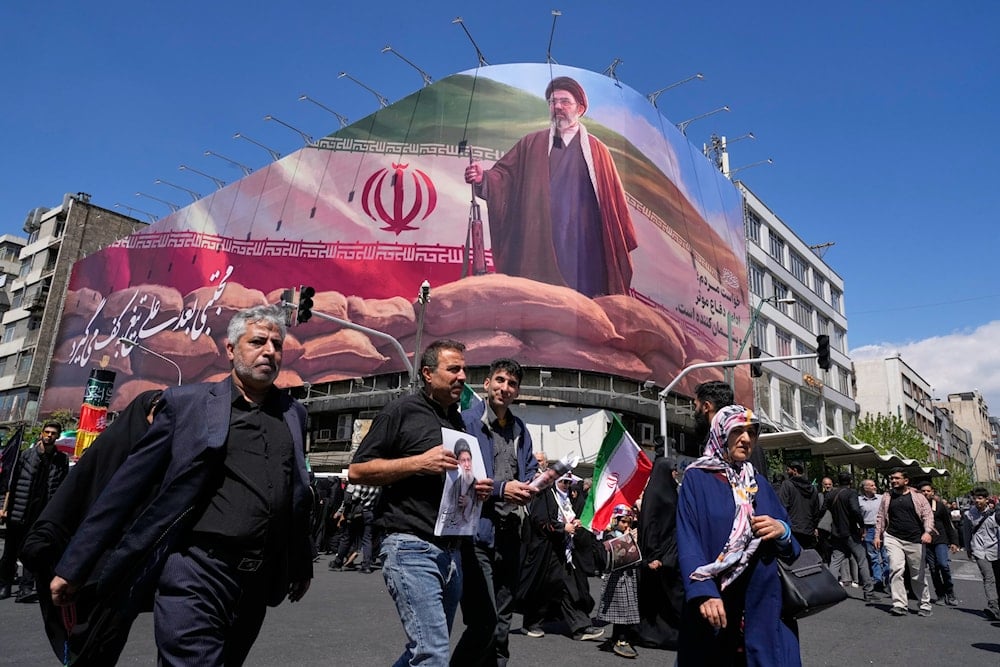
Iranians walk past a billboard depicting Iran's Leader Sayyed Mojtaba Khamenei as they gather to mark the 40th day since the martyrdom of his father, late Leader Sayyed Ali Khamenei, in Tehran, Iran, April 9, 2026 (AP)
Iran forced its adversaries into a ceasefire following weeks of war, and the Iranian people managed to bring the United States and "Israel" to their knees.
In an interview with Iranian state television, Ghalibaf stressed that “no negotiations took place before the ceasefire,” adding that talks only began after Pakistan’s prime minister publicly signaled mediation efforts. “The request for negotiations was accepted when the Pakistani prime minister posted his tweet, and from that day the talks began,” he said.
Ghalibaf was sharply critical of US President Donald Trump, calling him “a master of lying.”
Ceasefire Conditions and Negotiations
According to Ghalibaf, Iran presented a set of demands shortly before the ceasefire. “The ten-clause proposal was made in the last 48 hours before the ceasefire,” he said, noting that key conditions included a ceasefire in Lebanon and the release of frozen Iranian funds.
“We said that if these two issues were not resolved, we would not enter discussions on the rest of the ten clauses,” he added.
He also revealed direct coordination with Pakistan’s military leadership, stating: “We spoke for two hours and fifteen minutes with Asim Munir about the ceasefire in Lebanon, and that was also the first issue he discussed with the American side.”
Strait of Hormuz and escalation threats
Ghalibaf said Iran used the strategic Strait of Hormuz as leverage during the war, explaining that “We said that if the ceasefire was not implemented, we would not continue negotiations and would start the war, and for that reason we closed the Strait of Hormuz,” he stated.
He warned that Tehran could take further action if pressure continues. “If the maritime blockade against us continues, we will continue closing the strait,” he said, adding that the waterway is now “under the control of the Islamic Republic of Iran.”
At the same time, he emphasized that Iran does not seek to disrupt global shipping indiscriminately. “We believe all nations in the region and the world should benefit from the strait—we are not like the Americans,” he said, while insisting that Washington would not be allowed to “define a right for itself” in the passage.
Negotiation process and terms
Ghalibaf outlined the multi-stage negotiation process involving Pakistani mediation, stating an initial 15-point proposal was submitted via Pakistan and reviewed by Iran’s Supreme National Security Council, before Tehran responded with its own framework.
“The result was the preparation of ten clauses containing the demands and rights of the Iranian people, which we handed to Pakistan,” he said. “We told them we do not accept those 15 clauses, and if the Americans accept these ten, they are negotiable.”
He added that the US later proposed a nine-point plan, but “we insisted on our ten clauses, and they agreed.”
Ghalibaf described a firm Iranian response to threats during the war. “Every time they issued a warning, we responded,” he said. “They said they would strike infrastructure, and we told them: if you strike, we will strike as well.”
He warned of broader consequences, stating: “If you hit our infrastructure, we will hit American infrastructure, and other countries will also be affected.”
Iran won while the enemy failed to achieve its objectives
The Iranian speaker asserted that Tehran emerged victorious. “We won while the enemy failed to achieve its objectives,” he said, adding that Trump “requested a ceasefire after 40 days.”
He dismissed claims that Iran sought total destruction of its adversaries, saying: “We did not completely destroy them, but we are the victors on the battlefield.”
Ghalibaf also rejected claims of regime instability, stating: “They were seeking regime change and thought Iran was like Venezuela.”
Military Capabilities and Readiness
Highlighting recent military developments, Ghalibaf said Iran had made rapid advances. “In the technical field, we targeted around 180 drones; this was a capability we did not have in the previous war,” he said.
He also pointed to an incident involving an advanced fighter jet. “Targeting an F-35 was not accidental; it was an operation with technical and design dimensions,” he said.
Despite acknowledging US military superiority in resources, he argued that Iran had succeeded through strategy. “They have more money and equipment, but they lack determination and the ability to use them effectively,” he said.
Ghalibaf concluded with a warning that tensions remain high. “We have no trust in the enemy,” he said. “We are fully prepared to respond to any mistake at any moment—even as we sit here, they may start a war.”
He added that Iran’s military and public remain mobilized: “Just as the people are present in the streets, the armed forces are also fully ready.”


