
Global press freedom at 25-year low; US down 7 slots under Trump: RSF
 4 Min Read
According to RSF’s 2026 Index, only 4% of countries are rated as having a "good" press freedom environment.
-
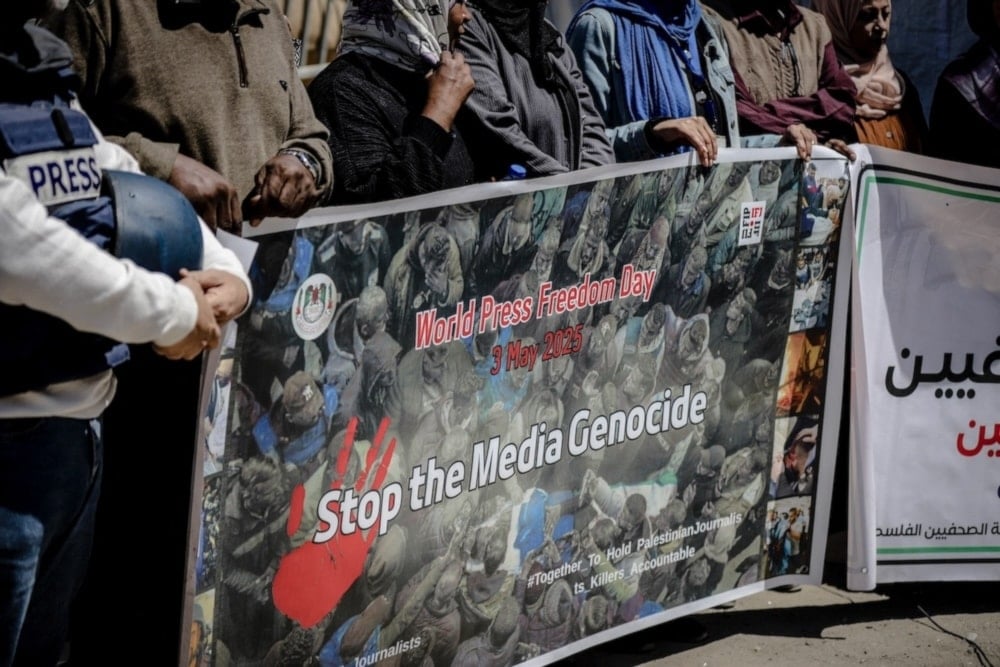
Journalists and media workers hold banners condemning the attacks on journalists, during a World Press Freedom Day gathering in Gaza City, May 4, 2025 (AFP)
Global press freedom has fallen to its lowest level in 25 years, Reporters Without Borders (RSF) has warned, with more than half of the world’s countries now classified as having a “difficult” or “very serious” environment for journalism.
According to RSF's 2026 World Press Freedom Index, released Thursday, the average score across 180 countries and territories has never been lower since the Index was first published. RSF attributed the long-term decline to the expansion of increasingly restrictive legal frameworks, particularly those tied to national security policies introduced after the September 11, 2001 attacks. It said such measures are increasingly being used to criminalize journalism, making the legal environment the most deteriorated indicator over the past year.
RSF also pointed to a stark global shift in media freedom conditions. In 2002, around 20% of the world’s population lived in countries rated as having “good” press freedom, while today that figure has dropped to under 1%. Only seven countries, all in Northern Europe and led by Norway, remain in the “good” category. France ranked 25th under “fairly good conditions.”
Trump's war on media downgrades US rating
The United States, already downgraded to a “problematic” environment in 2024, fell a further seven places to 64th. RSF said the decline reflects a worsening climate for journalism, citing systematic hostility toward the press under President Donald Trump.
It referenced repeated attacks on journalists, including the detention and deportation of Salvadoran journalist Mario Guevara, as well as major funding cuts to the US Agency for Global Media, which contributed to the closure or downsizing of outlets such as Voice of America, Radio Free Europe/Radio Liberty, and Radio Free Asia.
The report also highlighted broader regional declines across the Americas, including Argentina, which fell to 98th, and El Salvador, which dropped to 143rd, amid rising political pressure on media outlets and increasing alignment with US political rhetoric under Trump.
"Israel" fell 4 places as it continues its aggression on Gaza. Since it launched its war on Gaza in October 2023, "Israel" killed more than 220 journalists, 70 of whom were carrying out their duties when they were attacked by the occupation. According to the Committee for the Protection of Journalists, "Israel" alone contributed to two-thirds of the 129 journalists killed in the course of their work in 2025.
This systematic targeting of journalists also extends to Lebanon, where "Israel" killed nine journalists so far in 2026, most recently murdering Al-Akhbar journalist Amal Khalil in a double-tap attack after she took refuge inside a home with journalist Zeinab Faraj, who was wounded in the aggression. Earlier in March 2026, "Israel" killed Al Mayadeen's journalist Fatima Ftouni and her brother Mohammad, in addition to Al Manar's veteran correspondent Ali Shoeaib, in a direct strike on their car, clearly marked press, in Jezzine.
Violence in Sahel region leads to sharp decline
The sharpest decline in the 2026 Index was recorded in Niger, which fell 37 places to 120th, reflecting a continued collapse of press freedom in the Sahel region. The report cited violence by armed groups, as well as repression by military juntas, which have severely restricted access to independent reporting. Mali (121st) and Burkina Faso (110th) also saw significant deterioration following military takeovers.
In the Middle East, Saudi Arabia dropped 14 places to 176th, with RSF citing continued repression of journalists, including the 2025 execution of writer Turki al-Jasser.
At the bottom of the Index, Eritrea remains ranked last out of 180 countries.


