
Grossi: 'Very strong' nuclear verification needed in Iran after war
 4 Min Read
IAEA Chief Rafael Grossi says talks with Tehran over its uranium stockpile have only "barely begun", and locating the material is now the agency’s top priority.
-
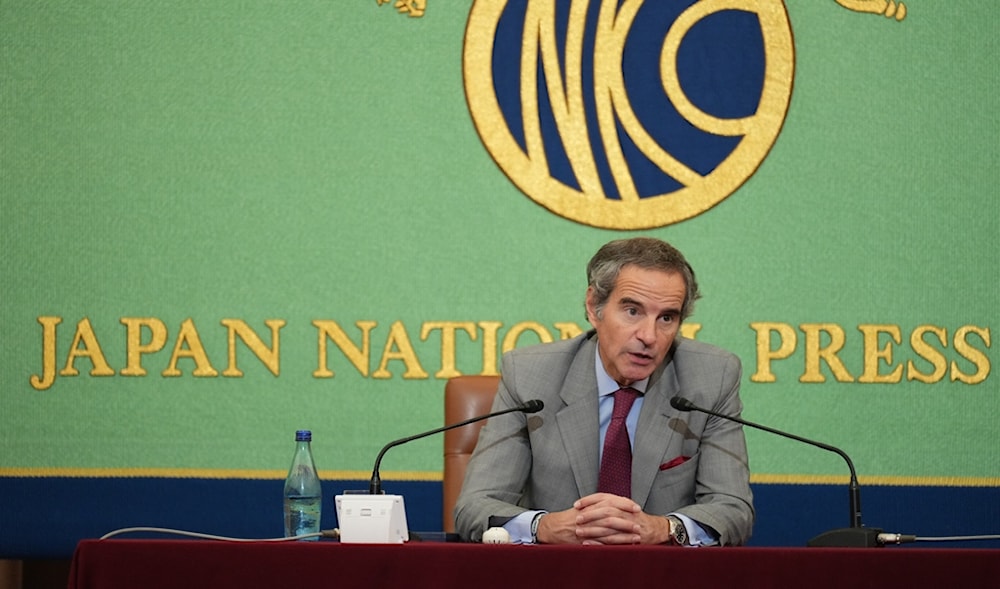
Rafael Grossi, International Atomic Energy Agency Director General and a candidate for United Nations Secretary-General, during a news conference at the Japan National Press Club in Tokyo on June 26, 2026. (AP Photo/Hiro Komae)
The head of the International Atomic Energy Agency (IAEA), Rafael Grossi, said a robust verification mechanism must be put in place to confirm Iran is not pursuing nuclear weapons, as Washington and Tehran continue negotiating a broader agreement to end the US war on Iran, with Tehran's nuclear programme remaining a key sticking point.
"I think the objective of this [recent US-Iran preliminary] agreement is to ensure that there is no development of nuclear weapons in Iran. The government of Iran has declared quite clearly that this is not their intention", Grossi told reporters in Japan on Friday.
"But of course, intentions are not enough. We have to have a very strong verification system in place... as soon as is practicable", the IAEA chief said.
Talks with Tehran 'barely initiated'
Engagement between the agency and Iran over the fate of its uranium stockpile remains at a very preliminary stage, Grossi indicated, despite the framework deal Tehran reached with Washington. He described the discussions so far as only "barely initiated".
"Initial conversations have taken place... We expect this work to pick up soon", he said.
IAEA estimates from before the war put Iran's holdings at roughly 440 kilograms (970 pounds) of uranium enriched to 60 percent, just short of the 90-percent purity needed for weapons-grade material, and well beyond the 3.67-percent cap Tehran had accepted under the now-collapsed 2015 nuclear accord.
Under the preliminary US-Iran agreement, the stockpile is meant to be "downblended," its enrichment level diluted, under the agency's watch.
Widespread impression stockpile remains near Isfahan
Grossi said the "widespread impression" is that the stockpile remains where it was before June 2025, near Iran's Isfahan facility. However, that facility was bombed, and Iran has said it does not plan to allow the IAEA to inspect sites that were attacked.
He added that an alternative to downblending could be shipping the enriched uranium out of Iran entirely.
"The memorandum of understanding, as you may have noted, includes the possibility of downblending as one alternative," he said. "It could also be shipped out directly. It would perhaps be more complicated, but there are a few technical alternatives to deal with the material."
Locating the stockpile is the 'top priority'
In a separate interview with Japan's national broadcaster NHK during his trip to Tokyo, Grossi said the agency's top priority in any renewed inspection effort would be confirming the whereabouts of Iran's highly enriched uranium, stressing that Tehran itself must disclose where the material is being held.
He told NHK earlier this week that the IAEA has an idea of where the uranium could be, but that some of the storage sites were attacked and partly destroyed during the war, complicating the agency's ability to assess how to safely access the material.
Grossi said the agency would discuss inspection dates and other details with Iran soon. "We think the sooner the better, especially since this agreement has a time frame of 60 days, so we will have to be working without losing much time", he told NHK.
He also underlined the IAEA's independence from the negotiating parties. "If Iran wishes to invite the United States or other observers, this is another matter," Grossi said, adding: "We do not foresee that somebody needs to help us or control us."
Iran does not seek nuclear weapons
Tehran has long rejected accusations that it is working toward a nuclear weapon, insisting on its right to run a full-scale civilian nuclear programme.
Iran's nuclear infrastructure, including the Natanz, Fordow, and Isfahan facilities, sustained significant damage in the joint US-Israeli attacks carried out during last year's 12-day war, prompting Tehran to suspend its cooperation with the IAEA.
Until then, Iran had operated as a party to the Non-Proliferation Treaty, granting IAEA inspectors access to its sites under its safeguards agreement with the Vienna-based body, a status "Israel," widely believed to hold an undeclared nuclear arsenal of its own, has never accepted.
In 2015, Tehran struck a landmark agreement with six world powers that capped its enrichment activity in exchange for sanctions relief, an arrangement that collapsed after President Donald Trump withdrew the US from it during his first term.


