
Guatemala ends 30-year Cuban medical program under US pressure
 6 Min Read
Guatemala's termination forces the withdrawal of 412 healthcare workers serving marginalized communities.
-
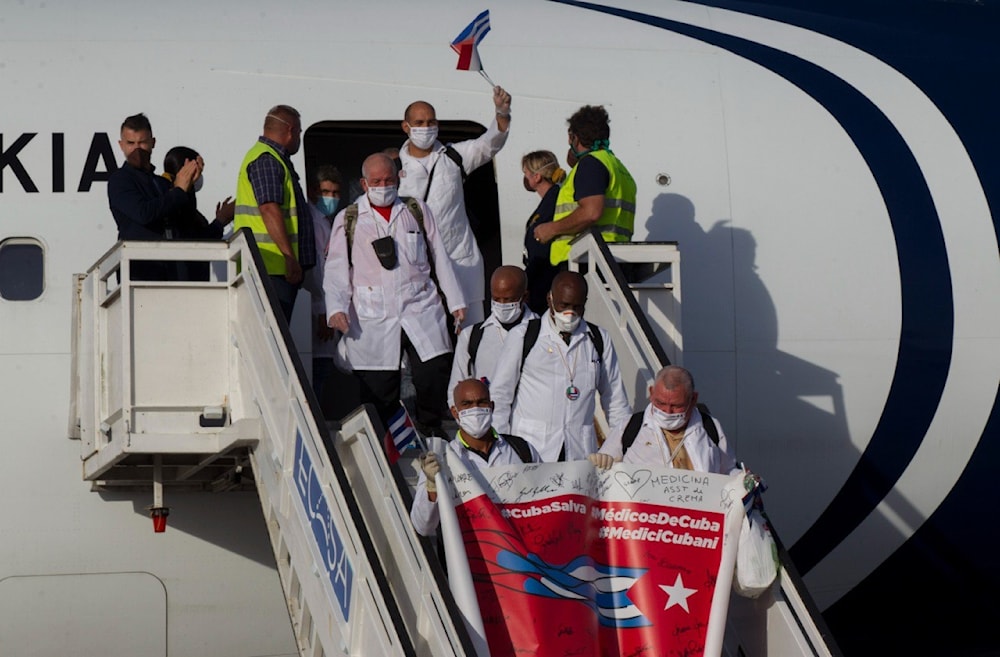
The first Cuban medical brigade of the Henry Reeve Contingent arrives at the Jose Marti International Airport in Havana, Cuba, June 8, 2020 (AP)
Guatemala announced Tuesday it will phase out its nearly 30-year partnership with Cuban medical brigades, becoming the latest country to buckle under sustained US pressure on Cuba.
The Guatemalan Health Ministry said 412 Cuban healthcare workers, including 333 doctors, will be gradually withdrawn throughout 2026 as their contracts expire. The Ministry framed the decision as a "technical analysis" aimed at strengthening the national health system and guaranteeing service continuity, language that thinly veils the geopolitical pressures driving the policy shift.
The announcement follows months of escalating US diplomatic coercion under the Trump administration, which has explicitly threatened visa restrictions against foreign government officials who maintain ties to Cuba's medical missions.
US Secretary of State Marco Rubio has spearheaded the campaign, characterizing the programs as exploitative labor schemes while pressuring regional allies to sever decades-old healthcare partnerships.
A pattern of coercion
Guatemala joins a growing list of countries that have terminated or scaled back Cuban medical programs under US pressure. The Bahamas announced in June 2025 that it was preparing to cancel contracts with Cuban healthcare professionals following discussions with Washington.
Paraguay and Guyana have similarly ended their programs, with Guyana's health minister stating that Cuban doctors would now be hired independently rather than through government channels.
In August 2025, Rubio announced visa restrictions against Brazilian and Grenadian officials for their roles in the Cuban medical program.
Additionally, in early February 2026, Saint Lucia Prime Minister Philip J. Pierre said that the United States was actively discouraging his government from sending its nationals to study medicine in Cuba. "I have a big problem. Many of our doctors got trained in Cuba, and now the great United States has said we can't do that any longer," Pierre explained.
The pressure campaign has intensified dramatically since January 2026, when President Trump declared Cuba an "unusual and extraordinary threat" to US national security through Executive Order 14380. The order authorized tariffs on any country supplying oil to Cuba, effectively creating a secondary sanctions regime that punishes third-party nations for lawful trade with the island.
Strangling Cuba's lifeline
The island nation operates what is widely recognized as the largest sustained medical internationalism program in history. Since 1963, more than 600,000 Cuban health workers have provided medical services in over 160 countries, consistently providing more medical personnel to the developing world than all G8 countries combined.
Cuba's medical brigades have long been a cornerstone of the island's foreign policy and a vital source of hard currency. According to Cuba's Foreign Ministry, nearly 24,000 medical professionals were working in 56 countries as of 2023. The program generated $6.3 billion in revenue for the government in 2018 and $3.9 billion in 2020, some in the form of oil from Venezuela.
The US government portrays these missions as exploitative, noting that Cuban doctors receive only a small fraction of what host countries pay Havana for their services. However, this characterization ignores the developmental model underpinning Cuba's approach.
A history of medical solidarity under siege
Cuba's medical internationalism has responded to some of the world's most severe humanitarian crises. During the 2014 West Africa Ebola epidemic, Cuba dispatched 256 health workers to Sierra Leone, Liberia, and Guinea, a contribution the World Health Organization publicly praised as among the most significant from any single country.
The Henry Reeve Brigade, established in 2005 after the United States declined Cuba's offer to send 1,500 medical professionals following Hurricane Katrina, has saved over 93,000 lives worldwide, benefited 3.6 million patients, and performed 31,000 surgeries. The WHO awarded the brigade its Dr. Lee Jong-wook Memorial Prize for Public Health in 2017, and it has been nominated for the Nobel Peace Prize.
During the COVID-19 pandemic, Cuba deployed more than 3,700 medical professionals to 39 countries, including Italy's hard-hit Lombardy region, treating over 360,000 people and saving more than 10,000 lives in the first six months alone. The island also developed its own COVID-19 vaccines, Abdala and Soberana, making Cuba the first Latin American nation to produce a successful coronavirus vaccine.
Beyond emergency response, Cuba operates the Latin American School of Medicine (ELAM), founded in 1999, which provides completely free medical education, including tuition, room, board, and stipends, to students from 110 countries. The school specifically recruits from the poorest communities with the expectation that graduates return to practice in medically underserved areas.
Guatemala's healthcare gap: Who will fill the void?
For Guatemala, the withdrawal of Cuban doctors threatens healthcare access in the country's most marginalized regions. The program began in 1998, the same year President Álvaro Arzú restored diplomatic relations with Cuba, and Cuban doctors have since served in Indigenous and impoverished areas neglected by the government or devastated during Guatemala's long civil war.
The Guatemalan Health Ministry claims it will implement "a phased replacement plan" including hiring more local employees, boosting incentives for hard-to-reach positions, and redistributing workers. However, given Guatemala's chronic healthcare infrastructure challenges and persistent corruption in social services, skepticism about the feasibility of this transition is warranted.
Guatemala's decision comes as the country has increasingly aligned itself with Washington's regional priorities. Under President Bernardo Arévalo, Guatemala recently struck a reciprocal trade deal with the United States, accepted increased deportation flights, and deepened cooperation with US law enforcement on prison and gang issues, making the country particularly vulnerable to economic and diplomatic pressure.


