
Gulf allies push Trump to prolong war on Iran as Washington flounders
 4 Min Read
US allies in the Gulf push Trump to prolong US attacks on Iran as Washington falters, claiming Tehran has not been sufficiently "weakened".
-
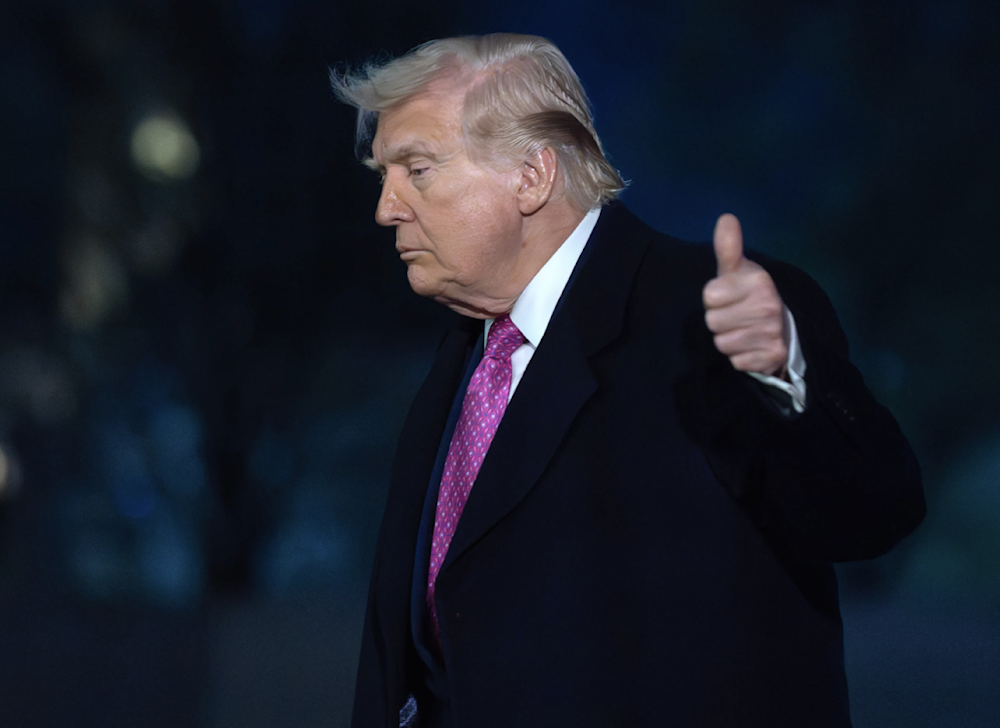
President Donald Trump waves to the media as he walks on the South Lawn upon his arrival at the White House on March 29, 2026. (AP)
Gulf states aligned with the United States, chiefly Saudi Arabia and the United Arab Emirates, are privately urging US President Donald Trump to sustain the US military aggression on Iran, claiming Tehran has not been "sufficiently weakened" by a month of US-Israeli bombings, according to the Associated Press (AP), citing regional and Western sources.
The push comes despite earlier frustration within the Gulf over Washington’s decision to ignite the war without adequate notice, and despite warnings that US‑Israeli aggression would devastate the wider region. Now, Gulf rulers are attempting to push Trump to impose a "decisive strategic defeat" on Iran’s leadership and reshape the regional balance in their favour as US positions in the Gulf are being targeted.
According to AP, officials from Saudi Arabia, the UAE, Kuwait, and Bahrain told US interlocutors they oppose ending the aggression until Iran’s leadership is "significantly weakened" or its behavior "dramatically altered", a reflection of Gulf dependence on Washington’s security umbrella and their willingness to prolong a destructive war.
Trump’s wavering strategy reveals US weakness
Trump has oscillated between claiming Iran’s leadership is on the brink of collapse and threatening further escalation if no agreement is reached, revealing a lack of coherent strategy. Meanwhile, the war has exacted a heavy toll with heavy human losses and rising global energy prices.
Gulf states are losing approximately $1.1 billion per day in oil revenue while the Strait of Hormuz remains closed.
Despite these mounting failures, Trump has sought to portray Gulf states as firmly behind Washington’s agenda. “Saudi Arabia’s fighting back hard. Qatar is fighting back. UAE is fighting back. Kuwait’s fighting back. Bahrain’s fighting back,” he told reporters aboard Air Force One, attempting to mask deep concerns about the war’s direction.
Hawks and doves: Gulf divisions surface
While many Gulf leaders now publicly back the US aggression, divisions persist. Saudi Arabia and the UAE are pressing hardest for increased pressure on Tehran, including calls for a ground invasion, as Gulf elites seek to deflect domestic criticism and project strength. Kuwait and Bahrain have backed this line, driven in part by vulnerability to Iranian drone and missile volleys.
Oman and Qatar, historically intermediaries with Iran, continue to favor a diplomatic path, highlighting the varying regional calculations about the costs of aligning too closely with US aggression. Senior Emirati voices have openly vilified Tehran, demanding guarantees that Iran will be permanently weakened.
US rhetoric masks strategic failure
The Gulf states had publicly lobbied against the war before it began, but, behind closed doors, the Washington Post reported that MBS made multiple private calls to Trump advocating military action against Iran, despite his public support for diplomacy.
The New York Times separately reported that MBS has since urged Trump to continue the war, calling it a "historic opportunity" to reshape the region, and reportedly pushing for US ground operations inside Iran and the military seizure of Kharg Island.
The White House declined to comment on Gulf deliberations, but Secretary of State Marco Rubio echoed Washington’s hostile framing of Iran, calling its leadership “religious zealots” rather than expressing a clear strategy to end the war.
Trump has publicly lauded Gulf leaders for “bravery” in supporting the war and criticized NATO allies for not joining Washington’s campaign. He has claimed that Gulf states were hesitant at first but have rallied behind US policy; a narrative that glosses over deep unease about Washington’s mismanagement and the war’s mounting human and economic costs.
“They weren’t thinking this was going to happen, nobody was,” he claimed, adding that “And they turned against them and really became very powerfully aligned. And they were with us, but they weren’t with us very obliquely. They were with us.”
Despite repeated calls for Gulf military involvement, Trump has stopped short of formally asking them to launch operations, likely wary of complicating an already chaotic theatre of war.


