
Trump wants Gulf states to pay for Iran war while Gulf economies bleed
 3 Min Read
Trump has expressed interest in calling on Gulf states to fund the US-Israeli war on Iran, as Gulf economies lose $1.1 billion daily and face GDP contractions of up to 15%.
-
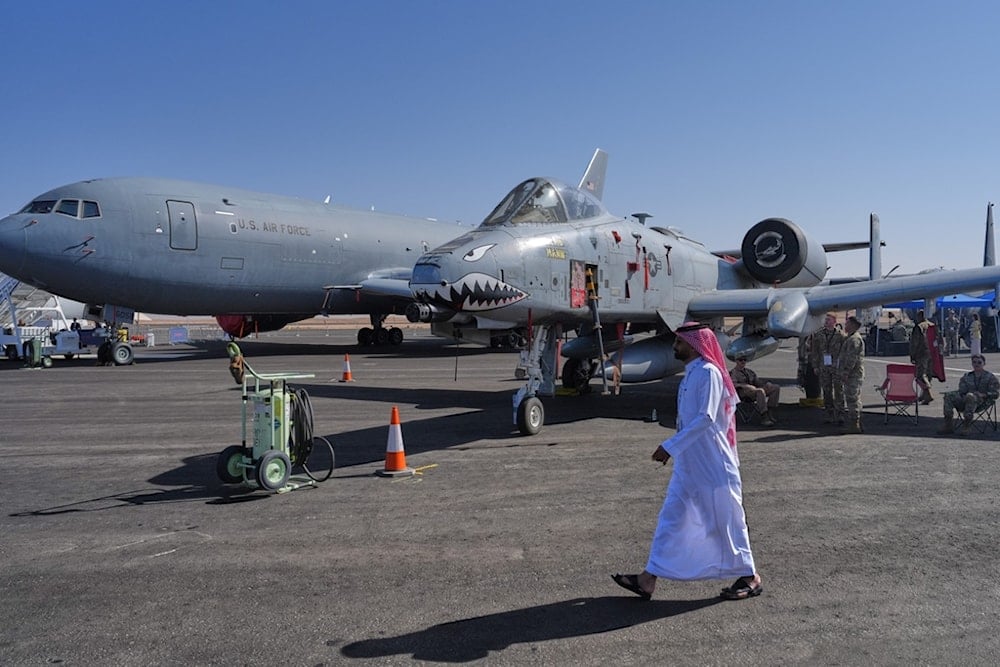
A visitor walks past a U.S. Air Force A-10 Thunderbolt II aircraft as it is on display at the World Defense Show in Riyadh, Saudi Arabia, Sunday, Feb 8, 2026 (AP)
US President Donald Trump has expressed interest in calling on Arab countries to pay for the cost of the US-Israeli war on Iran, the White House said Monday.
White House press secretary Karoline Leavitt, asked whether Arab countries would step up to help pay for the war, confirmed it was an idea Trump had, without elaborating on specifics.
"I think it's something the President would be quite interested in calling them to do," Leavitt said. "It's an idea that I know that he has and something that I think you'll hear more from him on." She added that the US estimates Operation Epic Fury is expected to last another 4 to 6 weeks.
The Gulf War precedent
The proposal echoes a model Washington deployed during the 1991 Gulf War. Under an arrangement brokered by then-Secretary of State James Baker, Gulf oil states covered the lion's share of that war's costs, with Kuwait contributing around $16 billion, Saudi Arabia $16.8 billion, and the UAE $4 billion. Whereby allies outside the US fund over 80 percent of the estimated $61.1 billion war.
The sums now circulating are of an entirely different scale. An Omani commentator told BBC Arabic that leaked reports suggest Trump has demanded Gulf states pay approximately $5 trillion to continue the war, or $2.5 trillion to stop it, claims neither US nor Gulf authorities have confirmed.
Trillions pledged, publicly humiliated
The request follows an extraordinary period of Gulf financial courtship of Washington. Saudi Arabia, the UAE, and Qatar collectively pledged over $2.2 trillion in investments to the US during Trump's May 2025 Gulf tour. Qatar additionally gifted Trump a $400 million luxury jet for use as Air Force One.
Those pledges bought the Gulf little diplomatic leverage. On 27 March, Trump stood at the PIF-backed FII Priority summit in Miami, a Saudi-organized, Saudi-funded event, and told the assembled investors that MBS was "kissing my a**."
"He didn't think he'd be kissing my a**… but now he has to be nice to me," Trump said, framing the relationship as one of compelled deference.
#WATCH | US President Donald Trump drew backlash on social media with his blunt, offensive remarks against Saudi Crown Prince Mohammad Bin Salman, while speaking at an event in Miami.
— Al Mayadeen English (@MayadeenEnglish) March 29, 2026
Trump said that MBS "didn’t think he’d be kissing my a**… He really didn’t," warning, "He… pic.twitter.com/cxvBpU5jjr
Bleeding economies
The Gulf states had publicly lobbied against the war before it began, but, behind closed doors, the Washington Post reported that MBS made multiple private calls to Trump advocating military action against Iran, despite his public support for diplomacy.
The New York Times separately reported that MBS has since urged Trump to continue the war, calling it a "historic opportunity" to reshape the region, and reportedly pushing for US ground operations inside Iran and the military seizure of Kharg Island.
The economic consequences have been severe regardless of those private calculations. Gulf states are losing approximately $1.1 billion per day in oil revenue while the Strait of Hormuz remains closed.
Capital Economics has warned that GCC GDP could fall between 10 and 15 percent if the war lasts at least three months. Having pledged trillions, absorbed Iranian missiles, and been publicly mocked at their own investment forum, Gulf states are now being asked by Washington to pay once more.


