
Gulf trillions in US investments threatened by war
 3 Min Read
The war in the Persian Gulf threatens more than $3 trillion in promised Gulf investments in the US as regional instability raises economic concerns.
-
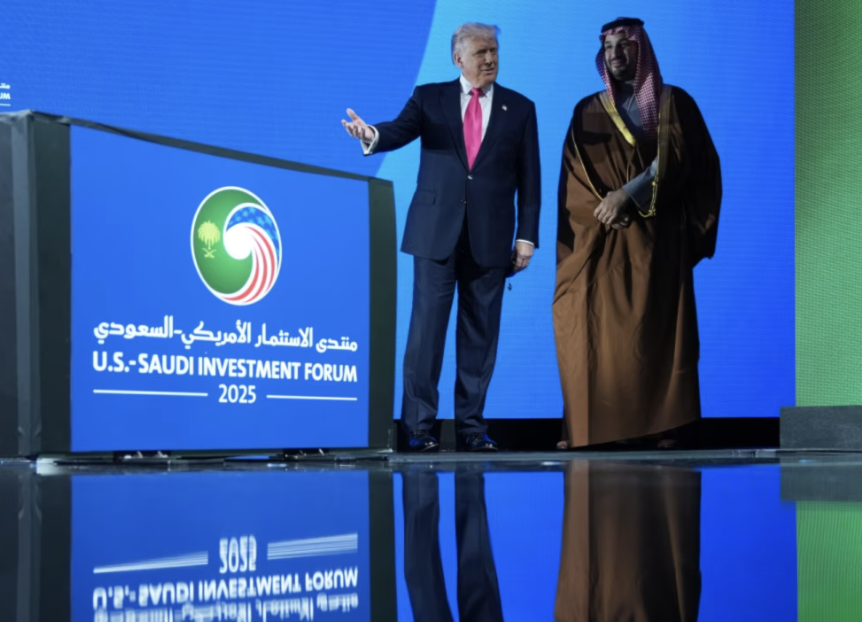
President Trump and Crown Prince Mohammed bin Salman at the US-Saudi Investment Forum in November 2025. (AP)
The expanding war in the Persian Gulf is putting trillions of dollars in promised Gulf investments in the United States at risk, raising concerns about the future of a rapidly growing economic partnership between Washington and wealthy Gulf states.
Over the past year, Saudi Arabia, the United Arab Emirates, and Qatar pledged more than $3 trillion in investment in the US, part of a broader effort to strengthen ties with President Donald Trump and deepen economic cooperation.
However, the ongoing war on Iran has begun to strain that relationship.
Prominent Emirati businessman Khalaf Al Habtoor publicly criticized the escalation, questioning Washington’s decision to launch strikes.
“Who gave you the authority to drag our region into a war?” Al Habtoor wrote in a post on X, warning that the US had placed Gulf states “at the heart of a danger they did not choose.”
Gulf states caught between war and economic ambitions
Iran’s retaliatory attacks on US bases in the Gulf, including missile and drone strikes targeting regional infrastructure, have heightened fears that prolonged instability could disrupt the region’s economic outlook.
Before the war escalated, Gulf countries had become some of the largest sources of foreign investment in the United States, backing projects ranging from artificial intelligence and infrastructure to development initiatives.
President Trump frequently cited these investment pledges as proof of growing economic ties, particularly following his 2025 visit to the Gulf, where major deals were announced.
Economic risks of prolonged war
Analysts warn that a prolonged regional war could force Gulf states to redirect financial resources.
Rachel Ziemba, an adjunct senior fellow at the Center for a New American Security, said the war raises questions about whether Gulf governments will maintain their planned level of investment in the United States.
If the war persists, governments in the region may face declining energy revenues and increased defense spending, potentially reducing the funds available for foreign investments.
Economists have already begun revising economic forecasts for the region.
Capital Economics said Gulf economic growth could decline by up to one percentage point if the war lasts several weeks, noting that uncertainty may lead companies to delay major investment decisions.
Deepening financial ties under scrutiny
In recent years, Gulf sovereign wealth funds have played a major role in global dealmaking and corporate acquisitions, while also supporting large projects tied to US businesses.
At the same time, Trump-linked business ventures have expanded across the Gulf, including real estate developments, investment partnerships, and technology initiatives.
Despite growing concerns, some investors remain optimistic that tensions will eventually ease. “My gut here is this will ultimately get resolved,” said Blackstone President Jon Gray, suggesting that the US and its allies could emerge from the war in a stronger position.
Still, analysts warn that prolonged instability could reshape one of the most significant financial partnerships between Washington and the region.


