
Guterres warns war on Iran is spiraling beyond control
 3 Min Read
UN Secretary-General Antonio Guterres warns that the Iran war has spiraled beyond control, urging urgent diplomacy and respect for international law.
-
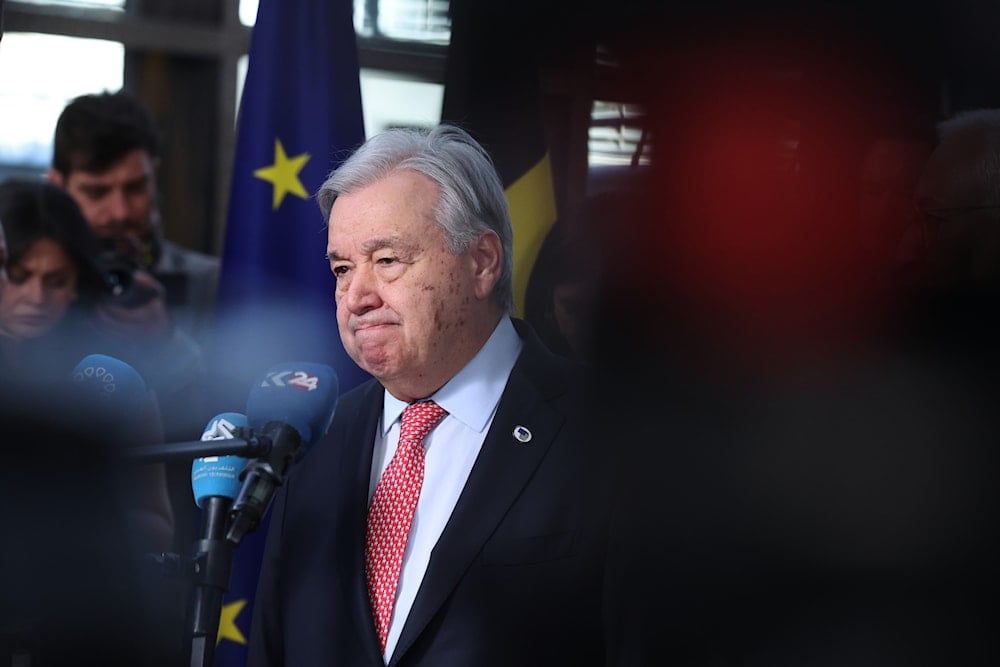
United Nations Secretary General Antonio Guterres delivers a statement during a media conference at the EU summit in Brussels, Thursday, March 19, 2026 (AP)
The war on Iran has spiraled beyond control, UN Secretary-General Antonio Guterres warned on Wednesday.
"More than three weeks on, the war is out of control. The conflict has broken past the limits even leaders sought unimaginable," Guterres said at the Security Council Media Stakeout.
He emphasized the urgent need to halt the escalation and revive diplomatic efforts, calling for a return to full respect for international law, adding that "I've been in close contact with all those that I believe can help to try to put an end to this horrible conflict."
Selective outrage at its finest
Earlier on March 25, United Nations High Commissioner for Human Rights Volker Turk warned that strikes near Iran's and "Israel's" nuclear facilities risk unleashing an "unmitigated catastrophe".
Speaking before the UN Human Rights Council during an urgent debate on Iran’s retaliatory attacks across the Gulf, Volker Turk said many of the strikes in the weeks-long war "raise serious concerns under international law."
In particular, Turk cautioned that "recent missile strikes near nuclear sites in both Israel and Iran underscore the immense danger of further escalation. States are flirting with unmitigated catastrophe."
His comments followed a report from the UN nuclear watchdog that Iran had informed it that "another projectile hit the premises" of the Bushehr nuclear power plant on Tuesday, though it caused no damage. Over the weekend, an Iranian strike targeted Dimona in occupied Palestine, home to a nuclear facility, in response to an earlier attack on Iran’s Natanz site; the strike did not approach the facility.
'Israel', US gets spared the condemnations
The rare urgent debate, requested by Bahrain on behalf of the six Gulf Cooperation Council countries and Jordan, focused exclusively on Iran’s strikes in the Gulf and did not mention "Israel" or the United States.
The council considered a draft resolution that "condemns in the strongest terms the egregious attacks" by Iran, calls on Tehran to "cease all unprovoked attacks" against GCC states and Jordan, and demands reparations for damages. Tehran dismissed the debate as "detached from reality."
"The situation is extremely dangerous and unpredictable, and has created chaos across the region," Turk said, insisting that "we cannot go back to war as a tool of international relations." He also warned that "this conflict has an unprecedented power to ensnare countries across borders and around the world. The complex dynamics could ignite further national, regional or global crises at any moment, with an appalling impact on civilians and people everywhere."


