
Jordanian Muwaffaq Salti base was used to strike our territory: Iran
 3 Min Read
Iran's UN envoy Iravani rejects Jordan's denial, asserting F-15, F-16, and F-35 jets launched strikes on Iran from Muwaffaq Salti Air Base with US tanker support.
-
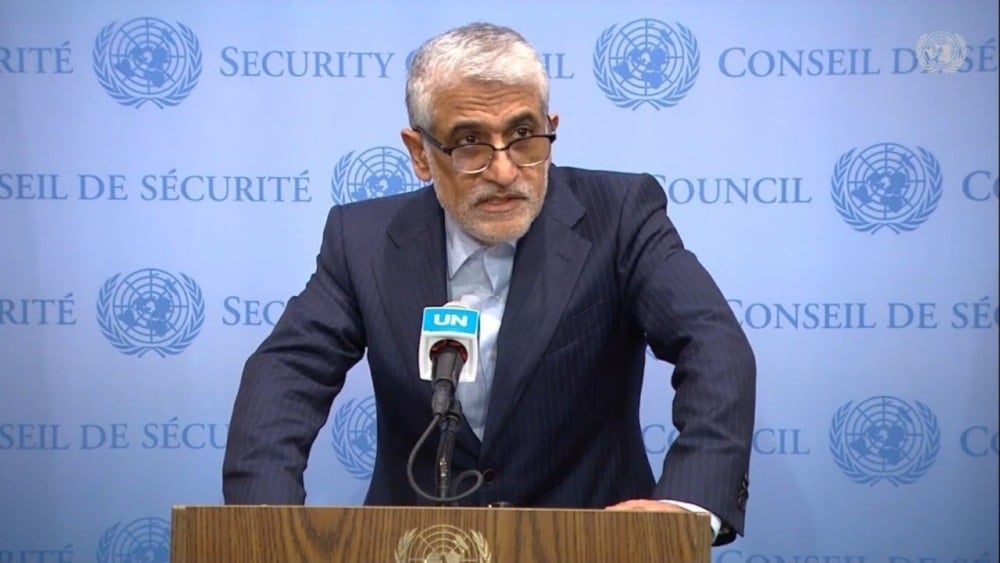
Iran's permanent representative and ambassador to the United Nations, Amir Saeid Iravani, undated (IRNA)
Iran's Permanent Representative to the United Nations, Amir Saeid Iravani, has flatly rejected the "baseless and misleading accusations" in a letter submitted by Jordan's UN mission, which denied that Amman had placed its territory at the disposal of the United States to launch attacks against the Islamic Republic.
In a letter addressed to UN Secretary-General António Guterres and the President of the Security Council, Iravani affirmed that attacks on Iran had been carried out repeatedly from Jordanian territory and airspace, stating that this was "clear and undeniable" and that it entails direct international responsibility for Amman.
Iravani detailed that fighter jets stationed at Jordan's Muwaffaq Salti Air Base, including F-15, F-16, and F-35 aircraft, launched strikes on Iran's southern provinces after being refuelled mid-air over Jordanian airspace, he said.
More so, US aerial refuelling aircraft, including KC-46 and KC-135 tankers, conducted those operations while transiting through Jordanian airspace.
Iran further warned that the use of regional countries' territory and airspace to target the Islamic Republic exposes US military bases in those countries to Iranian operations.
The Muwaffaq Salti base
The scale of the US military presence at Muwaffaq Salti left little ambiguity about the base's intended function. Satellite imagery and flight-tracking data published by The New York Times and analyzed by Airbus in mid-February 2026, weeks before the war began, showed a threefold increase in the number of US warplanes at the base.
Between 60 and 70 fighter aircraft were ultimately deployed, including F-35A Lightning IIs, F-15E Strike Eagles, and electronic warfare aircraft. More than 68 military cargo flights delivered munitions and support equipment in a matter of days.
Iran targeted the base repeatedly. A US THAAD radar system at Muwaffaq Salti, valued at approximately $300 million, was destroyed in early March, with satellite imagery confirming the strike.
Safadi's promise and what followed
The Iranian rebuttal carries particular weight given Jordan's own public assurances. On February 2, 2026, Jordanian Foreign Minister Ayman Safadi told his Iranian counterpart Abbas Araghchi in a phone call that "Jordan will not be a battleground in any regional conflict or a launching pad for any military action against Iran," adding that Amman "will not permit any party to violate its airspace or threaten its security."
That pledge came after Israeli media reported Jordan might provide logistical and intelligence support to the US military ahead of its strikes.
When the war began on 28 February, Safadi condemned Iran's retaliatory strikes on Jordan as unjustified, even as Muwaffaq Salti was operating as a forward strike base for US aircraft targeting Iranian territory.
Iravani had submitted seven separate letters to Guterres last week documenting the illegal use of regional countries' territory and airspace, covering Jordan, the UAE, Bahrain, Saudi Arabia, Oman, Qatar, and Kuwait.
Iran has called upon the governments of all these states to "observe the principle of good neighbourliness and to prevent the continued use of their territories against the Islamic Republic," while reserving its right to self-defense under international law.


