
Hezbollah's FPVs redefine battlefield, threat level for 'Israel': WSJ
 4 Min Read
Hezbollah’s use of explosive FPV drones is reshaping the battlefield along the occupied border, exposing military vulnerabilities and raising the cost of aggression for "Israel".
-
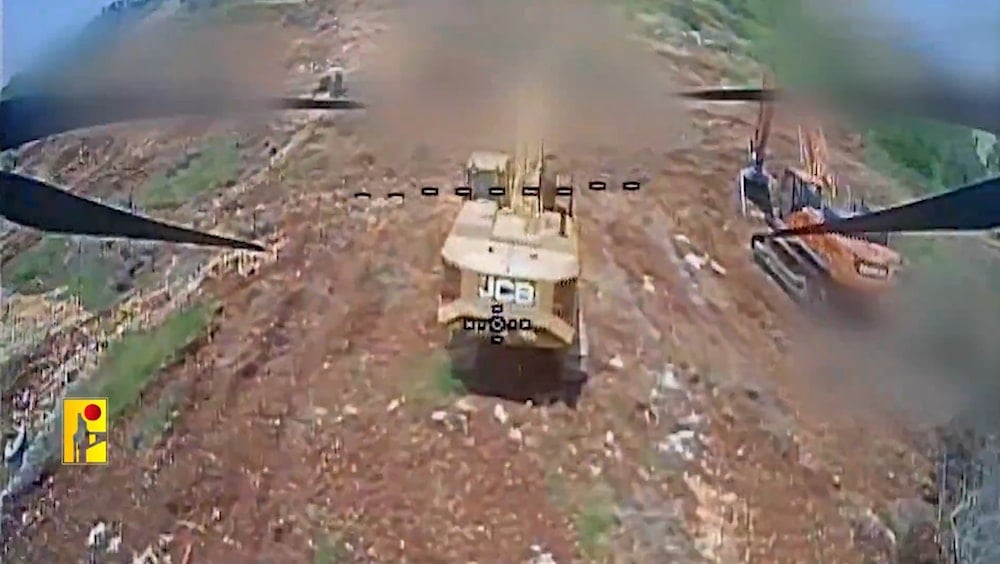
Hezbollah shares footage from an operation carried out on May 12 targeting an Israeli engineering vehicle in the town of Tayr Harfa in southern Lebanon using an FPV. (Screengrab)
Hezbollah is increasingly using explosive drones alongside night-vision equipment and first-person-view (FPV) systems, marking a shift in tactics that has dramatically deterred Israeli ground operations along the occupied Lebanese-Palestinian border, the Wall Street Journal reported.
Within weeks, Israeli officials have voiced concerns over Hezbollah’s one-way drones, which have become the most pressing threat facing the occupied north. According to Israeli military figures, these systems are now responsible for a majority of recent battlefield deaths, including seven of the 11 Israeli occupation soldiers killed since the so-called "ceasefire" came into effect in April.
Recent footage shared by Hezbollah's Military Media shows FPV drones striking Israeli military vehicles, including fuel tanks, in tactics similar to those widely used in Ukraine, WSJ said. Hezbollah has also released material showing the use of night-vision capabilities and drones operating inside occupied territory.
'Israel' expands aggression amid weakness against drones
The growing use of FPV drones, the report said, reflects a broader transformation in asymmetric warfare, with relatively low-cost systems increasingly able to bypass conventional counter-systems. Israeli officials and military analysts say the rapid adoption of these tools has altered the threat landscape on the northern front in a short period of time.
The increased effectiveness of drone attacks has also intensified domestic pressure on Israeli Prime Minister Benjamin Netanyahu to escalate the aggression against Lebanon, particularly its civilians. Admitting that the drones have exposed vulnerabilities in "Israel's" military systems, several Israeli officials have called for the bombardment of civilian structures in the Lebanese capital to pressure the Islamic Resistance.
Since then, in a blatant violation of the "ceasefire" and further proof of "Israel's" ambitions in Lebanon, the occupation forces ordered the evacuation of the entirety of South Lebanon to the north of the Zahrani River and have since expanded their aggression across the South, Bekaa, and even Beirut.
Illegal Israeli settlers in the occupied north have reported growing anxiety amid frequent drone operations and sightings. In Adamit, occupiers voiced fatigue and frustration with the ongoing security situation and limited clarity on long-term solutions.
Political pressure within the Israeli occupation has also mounted, with officials of both the governing occupation and opposition calling for a more aggressive approach. Extremist minister Itamar Ben-Gvir, who has repeatedly called for the annihilation of Lebanon, Gaza, and Iran, demanded that Netanyahu "bang" on Trump's table.
Nets to catch drones?
The Israeli occupation military has acknowledged the growing threat posed by Hezbollah’s drone capabilities, stating that it is implementing new measures, including protective netting and expanded training for soldiers, although military officials admitted that no effective solution exists.
However, drone warfare experts argue that Hezbollah has exploited gaps in Israeli field practices, particularly the clustering of vehicles and equipment in exposed positions. They also point to lessons from the Russia-Ukraine war, where FPV drones rapidly reshaped battlefield survivability standards on both sides.
One Israeli soldier told WSJ that the Israeli military and political leadership have instructed soldiers to take cover at night to avoid being targeted by the drones. “No one gave a crash course on what to do,” the soldier said.
A video released by Hezbollah shows a drone striking an Israeli military vehicle, with analysts noting evidence of fuel tank targeting and insufficient protective coverage.
⭕️بالفيديو | مشاهد من عملية استهداف #المقاومة_الإسلامية بتاريخ 19-05-2026 آلية هندسيّة تابعة لـ "جيش" العدو الإسرائيلي في مدينة الخيام جنوبيّ لبنان بمحلّقة #أبابيل انقضاضيّة.#الميادين_لبنان #لبنان pic.twitter.com/Jh81hE9EOr
— الميادين لبنان (@mayadeenlebanon) May 28, 2026
Hezbollah successfully uses drones against anti-drone systems
As drone warfare evolves, Hezbollah has also adapted by using fiber-optic-controlled drones, which are resistant to electronic jamming. According to Israeli security sources, around 80 percent of these drones operate via such systems, complicating interception efforts.
For example, Hezbollah has successfully struck the "Drone Dome" anti-aircraft system used by the Israeli occupation forces, further demonstrating its drone operational superiority.
Military analysts emphasize that countering the threat will require measures beyond electronic warfare or protective barriers.


