
Pentagon sends personnel to Ukraine to study drone warfare
 7 Min Read
US deepens military footprint in Ukraine through drone-focused programs, raising concerns over its role in studying active combat operations and accelerating integration of battlefield technologies.
-
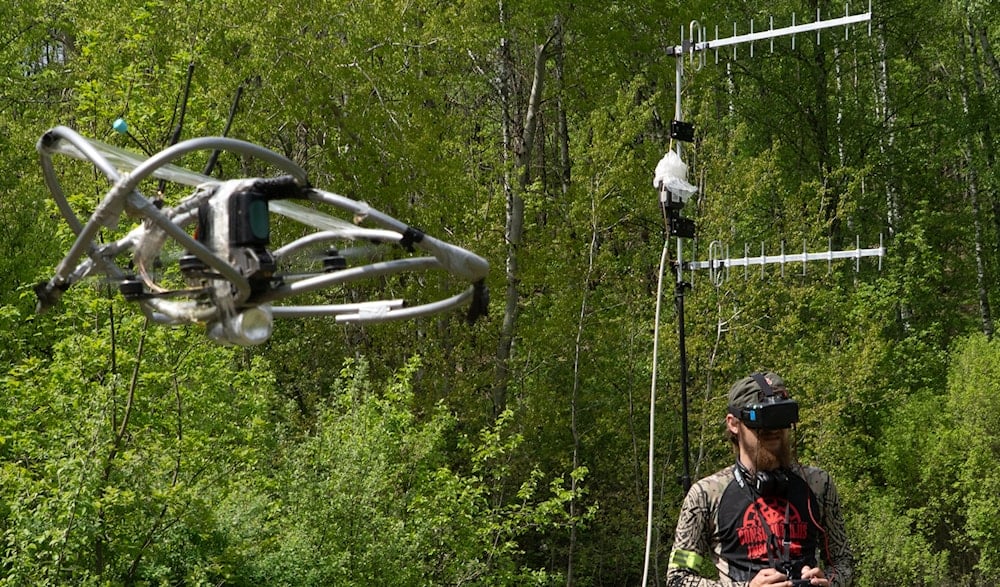
A recruit of Ukraine's 58th Mechanized Brigade practices military skills with an FPV drone at a training ground near the frontline in the Kharkiv region, Ukraine, May 12, 2026 (AP)
US War Secretary Pete Hegseth stated on Tuesday that he has authorized the deployment of additional personnel to Ukraine to examine the use of unmanned aerial vehicles (UAVs) in both offensive and defensive operations.
“I have personally approved additional personnel there [in Ukraine] to learn from that drone battlefield, both on offense and defense, to ensure that we are learning every possible lesson from that conflict,” Hegseth said during a Senate defense budget hearing.
He emphasized that the United States must adjust to an era in which drone superiority is critical, adding that such technologies need to be rapidly integrated across all branches of the armed forces.
In April, the US Department of War requested $74.2 billion for Fiscal Year 2027, aimed at securing “drone dominance” and enhancing counter-drone capabilities.
Separately, between April 27 and May 8, US paratroopers conducted their first training exercises in Alaska involving the use of FPV (first-person view) strike drones.
This comes as Hezbollah's drone warfare highlights structural gaps in "Israel’s" defense systems, as fiber-optic UAVs reshape modern battlefield dynamics and strategy.
'Israel' and Hezbollah drone revolution: failure and future challenges
The challenge posed by Hezbollah drone warfare continues to dominate assessments within the Israeli security and military establishment, in an effort to understand and confront the evolving threat. This includes examining operational failures and exploring potential solutions amid growing criticism over Israeli shortcomings.
This comes amid a series of casualties resulting from Hezbollah attacks using explosive unmanned aerial vehicles (UAVs), including fiber-optic guided drones, which exposed cracks in the existing Israeli defense systems and the broader strategic Israeli preparedness in dealing with this form of warfare.
Fiber-optic guided drones
A range of analyses points to an increasingly integrated and evolving Israeli approach aimed at developing a clearer understanding of the threat posed by Hezbollah’s aerial systems, particularly those operating via fiber-optic technology.
These assessments put forward a central argument: that the current breach on the Lebanese front is not purely technological in nature, but also structural, operational, and conceptual. They suggest that “Israel” does not face a shortage of solutions, but rather a persistent gap between its technological output and its ability to translate it into timely and effective operational capability in the field.
Israeli air defense failures and structural gaps
At the first level, recurring assessments underscore “Israel’s” difficulty in effectively responding to the “drone revolution.”
Operations carried out by Hamas, and later by Hezbollah, have revealed a gap between the development of advanced Israeli systems - reportedly manufactured within the occupied territories or offered to it - and their timely integration into, and deployment with, combat units.
A structural flaw within the security and military establishment itself, reflected in the absence of any dedicated military body assuming responsibility for counter-drone defense. According to experts, this has created a critical gap between knowledge and early warning on one side, and operational implementation on the other.
This failure is attributed to the bureaucracy of the security and military establishment, particularly within the Israeli army, including weak prioritization and the absence of a centralized authority responsible for managing counter-drone defense, which led to a pattern of "reactive learning" rather than prior preparedness.
UAV threats on the Lebanon Front
At the second level, it is increasingly evident that the threat is no longer conventional in nature. Fiber-optic guided drones have altered the logic of the battlefield, shifting it away from traditional air superiority toward a model defined by low-cost, high-impact systems. This transformation has significantly complicated detection, reduced the effectiveness of electronic warfare and jamming measures, and made interception both costly and operationally slower.
More importantly, the Israeli approach reflects a growing recognition that geography has lost much of its traditional value and that distance is no longer as significant as it once was. Military commentators have increasingly questioned the effectiveness of the new so-called "security belt" as a means of protecting northern settlements, whether from explosive drones, rockets, or even anti-tank missiles.
According to Israeli analyses, the "home front" has effectively become a direct part of the battlefield, where low-cost threats are capable of targeting expensive defense systems.
Lessons from Ukraine drone warfare
At the third level, an international comparative dimension becomes increasingly evident, particularly in relation to Ukraine. The conflict there is often described as a “live laboratory” of modern warfare, revealing the rapid evolution of aerial combat, most notably the widespread proliferation of drones and their transformation into networked, collectively operated systems.
Based on this reading, "Israel" failed to absorb the lessons of Ukraine quickly enough, while actors such as Russia and Hezbollah benefited from the transfer of knowledge and battlefield experience. The result, Israeli analyses suggest, is that "Israel" now finds itself in an uneven race: its adversaries are learning rapidly from global battlefields, while the security establishment lags in translating knowledge into operational deployment.
Multi-layered defense systems and ongoing limitations
At the fourth level, “Israel” has been developing a multi-layered defense system designed to address aerial threats across several domains.
This includes:
- Multi-sensor detection systems (radar, optical, acoustic, and AI-based tools)
- Kinetic interception systems
- Laser-based interception technologies
- Counter-drone measures
- Passive defenses such as fortifications and protective structures
Despite this framework, analysts note that many of these systems remain partially deployed, and the gap between development and full operational readiness continues to be identified as a major vulnerability.
The future of drone warfare
At the fifth level, Israeli analysis suggests that the evolution of drone warfare is expected to accelerate further into a broader strategic dimension. Drones are no longer viewed as a purely tactical threat, but as part of a fundamental transformation in warfare.
This shift is reflected in the erosion of the distinction between front lines and the home front, the declining role of manned aircraft in favor of small, dense, and low-cost unmanned systems, and the emergence of “swarm warfare,” where numerical density becomes more decisive than the quality of individual weapons.
In this context, war is increasingly viewed as a continuous, high-tempo learning environment, where superiority depends less on technological scale alone and more on the speed of adaptation and response.
Among the points highlighted in the analysis is a warning that the current drone threat is only the beginning of a more complex phase.
Strategic paradox facing 'Israel'
Emerging threats under development include "cellular drones" that rely on mobile communication networks instead of traditional transmission systems, making them harder to detect and jam. There is also the development of drone swarms operating in coordinated groups, which increases interception difficulty and amplifies their destructive potential.
In conclusion, the Israeli approach, as reflected in analyses and commentary, highlights a structural paradox: while “Israel” is advanced in developing offensive and defensive technologies, it continues to lag in converting these capabilities into fully operational, field-ready systems deployed in a timely and effective manner.
At the same time, its adversaries, most notably Hezbollah, are evolving rapidly through low-cost, highly flexible models that draw on global battlefield experience, particularly from Ukraine, and adapt it to the nature of the battlefields in Lebanon and Gaza.
At the core of Israeli concern in the available analytical discourse is no longer whether “Israel” possesses a solution, but rather whether its response to the threat can be deployed to the battlefield in time, before it becomes outdated, insufficient, or ineffective.


