
IOF memo flags FPV drone threat on battlefield, action came too late
 3 Min Read
An Internal IOF document reveals fiber-optic drone threat awareness while raising questions over the delayed implementation of countermeasures and procurement gaps.
-
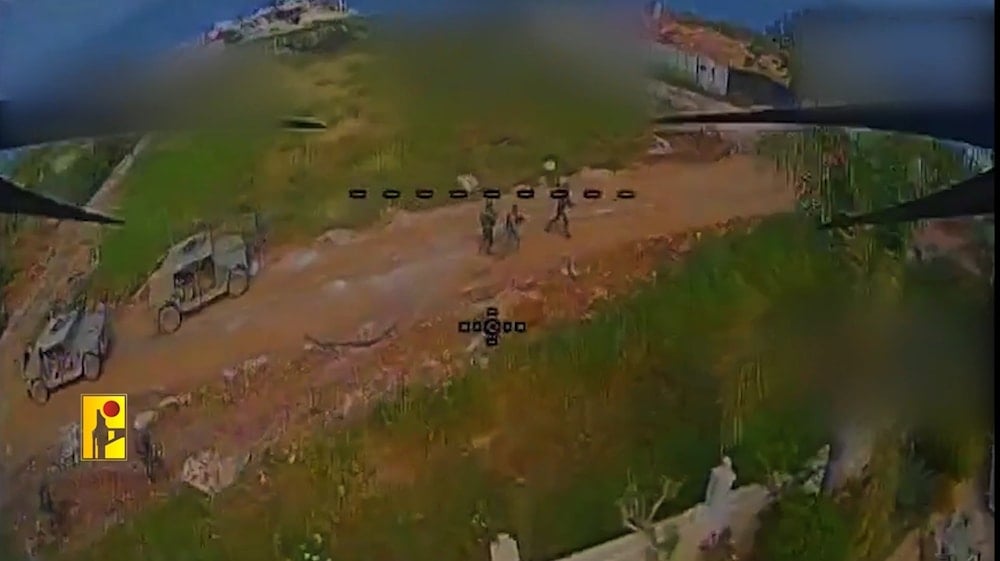
Three Israeli soldiers can be seen through the camera of a Hezbollah-operated FPV drone before striking them in al-Bayyada, South Lebanon, May 1, 2026 (Islamic Resistance Military Media)
An internal document from the Israeli Occupation Forces’ (IOF) Operations Branch has issued a stark warning about the growing threat of fiber-optic guided explosive drones, according to a report by Israeli Army Radio’s military correspondent Doron Kadosh. The paper details critical vulnerabilities and urges the urgent development of both defensive and counter-offensive measures.
The document opens with an analysis of fiber-optic drones on the Russian-Ukrainian battlefield, highlighting their "operational impact" and the tactical lessons learned from the conflict there.
The IOF document delivers a blunt assessment of the threat’s reach. "An area extending 15 to 20 kilometers from the line of contact is not a safe rear depth," it states. It warns that "every assembly area, vehicle position, temporary headquarters, or exposed movement falls within the direct crosshairs of fiber-optic guided drones.”
Crucially, the paper notes that traditional electronic warfare (EW) protective solutions are ineffective against these systems, which are immune to jamming due to their physical fiber-optic cable connection.
Countermeasures: Too little, too late
To counter the threat, the document recommends several immediate measures:
- Autonomous anti-drone fire systems to protect headquarters and vital assets;
- Rapid light-weapons and machine-gun fire by field-deployed troops;
- Equipping forces with 12-gauge shotguns, using either standard or specialized munitions for drone interception.
However, commenting on these proposals, Kadosh notes a significant delay. "Unfortunately, the IOF and the Ministry of Defense only began the procurement process for these shotguns and specialized ammunition in recent weeks, with a major delay, despite the fact that it could have been done earlier," he reports.
The document further stresses an "urgent" need to integrate the new hardware with substantial changes to training, operational awareness (particularly for maneuvering forces), and the deployment of overhead camouflage netting, even above short-range firing positions.
Intelligence gaps
The paper also identifies a critical intelligence requirement: defining the intelligence needs regarding the "enemy’s value chain," including their capabilities, training, and operating units.
Prompted by the document’s findings, Kadosh questions the official response: "Why only now? Why, even though everything was placed on the table of all IOF and Defense Ministry bodies a full year ago, has nothing been implemented?"
While the army itself did not respond to these questions, the Israeli Ministry of Security issued a statement, acknowledging that "the drone threat was indeed known to the security establishment and has been under study for some time."
The Ministry added that the Directorate of Defense Research & Development (MAFAT) has been "developing a range of technological solutions for several years, without waiting for any specific memo, in order to confront this threat." The statement claimed that some of these solutions have already been deployed operationally and are "saving lives", while others have failed testing or remain under development.
The Ministry emphasized that the evolving threat "poses a challenge and requires technological building blocks, some of which are different and some of which do not yet exist anywhere in the world." It added that the decision to equip forces with new systems is led by the IOF, which "have accelerated and continues to speed up the delivery of countermeasures to the field in cooperation with MAFAT."


