
‘Minab 168' Iran delegation heads to Zurich for implementation talks
 6 Min Read
A high-level Iranian delegation has departed for Zurich to discuss the implementation of the Iran-US Memorandum of Understanding and review compliance.
-
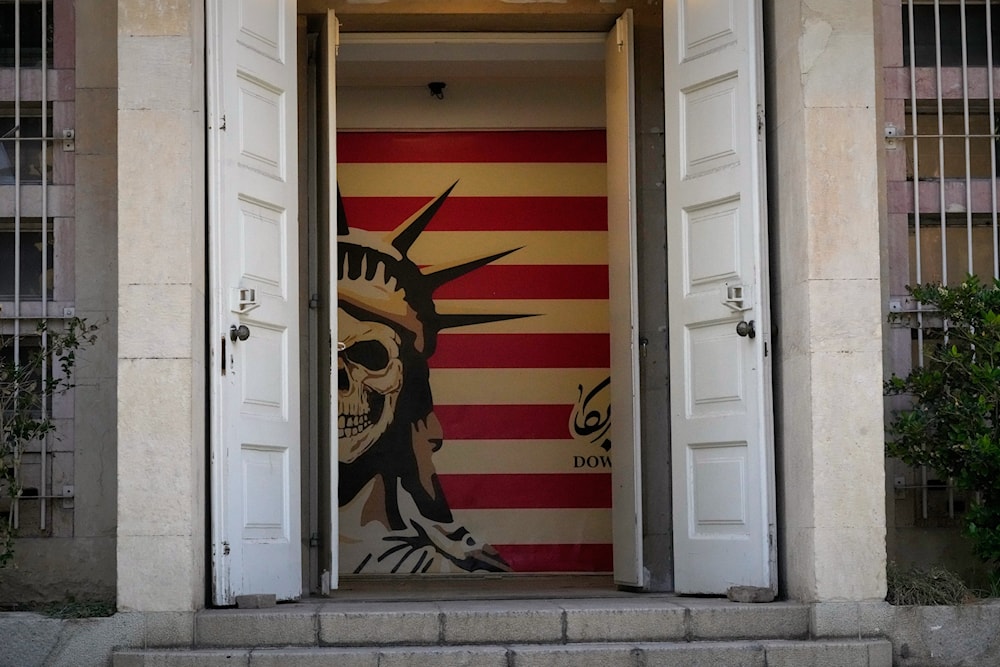
A satirized image of the Statue of Liberty and the US flag decorate the entrance to the former US Embassy, which has been turned into an anti-American museum, in Tehran, Iran, June 12, 2026 (AP)
An Iranian negotiating delegation has departed for Zurich, Switzerland, to participate in follow-up talks regarding the implementation of commitments by the opposing party, according to Iranian state television.
The delegation, identified as "Minab 168", left Tehran earlier today and is headed to the Swiss city of Zurich. It is led by high-ranking officials including:
- Mohammad Bagher Ghalibaf, Speaker of the Iranian Parliament
- Abbas Araghchi, Minister of Foreign Affairs
- Ali Bagheri, Deputy Secretary for International Affairs of the Supreme National Security Council
- Abdolnasser Hemmati, Governor of the Central Bank of Iran
- Hamid Boud, Deputy Oil Minister and Head of the National Iranian Oil Company
- Kazem Gharibabadi and Esmaeil Baghaei, Deputy Foreign Minister
- Esmaeil Baghaei, Spokesperson for the Foreign Ministry and Iranian delegation; in addition to other officials
According to Iranian Foreign Ministry spokesperson Esmaeil Baghaei, the visit is aimed at following up on the other side’s commitments. He underscored that "any agreement or understanding is truly tested and scrutinized when the time comes for its implementation."
Baghaei further stressed Iran’s cautious stance, stating, "Given our past experience with the other party's breach of its pledges, we must seriously demand the fulfillment of their obligations."
Meanwhile, Pakistan’s Ministry of Foreign Affairs has announced that technical-level talks will be held in Bürgenstock, Switzerland, on June 21. The discussions are a follow-up to the signing of the Islamabad Memorandum of Understanding.
Representatives from the United States and Iran, alongside mediators from Pakistan and Qatar, are expected to attend the session. Pakistan’s Ministry reiterated that Islamabad will continue its facilitation role as part of its ongoing mediation efforts.
'Israel' must halt its aggression on Lebanon: Iran
Earlier, the Iranian Foreign Ministry announced that Tehran sent a delegation to Switzerland, issuing a sharp warning to the US that it should rein in "Israel" and halt its attacks on Lebanon.
The Ministry asserted that Tehran has fully upheld its own obligations under the MoU and now expects the United States to deliver on its side, specifically, by compelling "Israel" to cease its ongoing aggression and occupation of Lebanese territory.
"We did not sign the memorandum so that it isn't applied and abided by," the Ministry spokesperson said. "Our philosophy is adherence in return for adherence."
The warning came with a clear ultimatum: if Washington fails to meet its commitments, Iran will respond with "the necessary measures." The Ministry further cautioned that "if the other party does not perform its full commitments and does not take the necessary measures as soon as possible, the entire memorandum is at stake."
Strait of Hormuz closed
In the same vein, the Khatam al-Anbiya Headquarters announced the closure of the Strait of Hormuz, in response to the continuous Israeli aggressions on Lebanon, which are a violation of the memorandum of understanding reached between Tehran and Washington.
In a statement carried by Iranian state television, the Khatam HQ accused the US of violating its MoU commitments on ending the war, citing continued Israeli ceasefire breaches, killings, forced displacement in southern Lebanon, and failure to withdraw. It said the measure is a response to worsening compliance and ongoing hostilities.
"In light of the United States’ blatant violation of its commitments and breach of the provisions of Article One of the memorandum of understanding to end the war and in response to the ongoing and continuous violation of the ceasefire by the Israeli entity in southern Lebanon, the continued brutal killing and forcible displacement of the Lebanese people, and its failure to withdraw from southern Lebanon, it is hereby announced that the Strait of Hormuz will be closed to maritime navigation," the statement read.
Israeli aggression on Lebanon continues, kills 37
Israeli occupation forces launched a new wave of attacks across southern Lebanon and western Bekaa on Saturday morning, killing at least 37 people despite a ceasefire nominally in place since April 17. The heaviest toll came in the Nabatieh area, where 25 people were martyred and 35 others wounded, according to the Islamic Health Authority's Civil Defense Operations Room.
Rescue teams are still clearing rubble and searching for missing persons, with a Lebanese Army soldier among those killed in a drone strike on Kfaroumman.
In the Saida district, an Israeli strike on a residential building in Qennarit killed seven people and injured 13 others, including five children and five women, the Lebanese Ministry of Public Health reported. Separately, in western Bekaa, attacks on the town of Sohmor claimed five lives, four in a house bombardment and one in an earlier drone strike on a motorcycle, with a child still trapped under rubble as rescue crews worked to save him.
Local media reported that the IOF conducted at least 80 attacks since early morning, comprising 65 airstrikes and 15 drone strikes, in addition to artillery shelling and sweeping fire. Al-Nabatieh al-Fawqa and the al-Rihan heights were the most frequently targeted, struck eight and six times respectively, while Kfar Tebnit, Jabal al-Rafi', Shoukin, and Nabatieh city each endured four bombings.
Kfaroumman, Aramta, al-Aroush quarry, Harouf, and Habboush were each hit three times, while Sojod, the Toul-Kfour area, Kfar Joz, Zebdine, and Shhour were attacked twice. Single strikes targeted Nmairiyeh, Arab Salim, al-Mahmoudiyeh, Borj Qalaouiyeh, Qabrikha, Barish, al-Qatrani, and Qennarit.
Israeli drones specifically struck Nabatieh city four times and Arab Salim twice, with single drone attacks hitting Deir al-Zahrani, Doueir, Deir Qanoun Ras al-Ain, Kawthariyet al-Riz, Sohmor, Harouf, Jibchit, and al-Nafakhiyeh. Artillery shelling targeted Majdal Zoun, Habboush, Harouf, and Ali al-Taher, while sweeping-fire operations were carried out in Buyout al-Sayyad.


