
House Democrats told by leadership not to go to Minnesota: Axios
 4 Min Read
House Democratic leaders have privately advised members to avoid traveling to Minnesota amid anti-ICE protests, citing security risks and concerns over straining local resources, Axios reports.
-
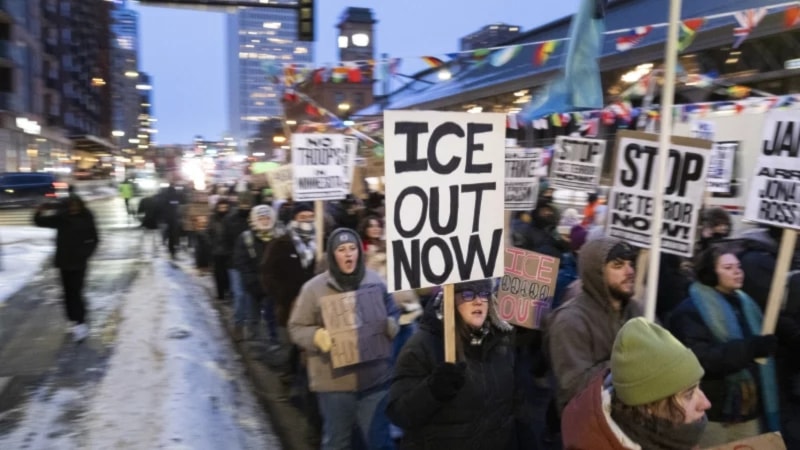
Demonstrators march during the nationwide "Stop ICE Terror" rally through downtown Minneapolis, Minnesota, on January 20, 2026. (AFP)
House Democratic leadership has privately advised members of Congress to avoid traveling to Minnesota in support of anti-ICE protests, Axios reported in an exclusive article, citing internal communications and security concerns.
The advisory comes after several Democratic politicians, including Senator Raphael Warnock (D-Ga.) and New York congressional candidates Brad Lander and Micah Lasher, visited the state to show solidarity with demonstrators following recent fatal incidents involving US immigration agents in Minneapolis.
In an email dated Monday and obtained by Axios, a senior aide to House Minority Leader Hakeem Jeffries (D-N.Y.) urged members to remain in their districts and participate in “Days of Action” from home. The message, confirmed by two staffers, emphasized that visiting Minnesota at this time could place additional burdens on local authorities.
"Visiting the state right now, although well intentioned, puts a burden on local resources and does not support our colleagues, the city and state government, local law enforcement, and most importantly, the people of Minneapolis," the staffer wrote.
One House Democrat, speaking anonymously to Axios, noted that Minnesota officials, including members of the state’s congressional delegation and the governor’s office, recommended against visits due to concerns about overwhelming law enforcement and emergency services. The guidance also reflects broader security concerns amid what officials describe as a heightened threat landscape for members of Congress. Recent incidents have included attacks targeting Representatives Ilhan Omar (D-Minn.) and Maxwell Frost (D-Fla.).
The situation in Minneapolis has drawn national attention, with scrutiny over the Department of Homeland Security’s immigration enforcement practices intensifying. The protests, which have focused on Immigration and Customs Enforcement (ICE) operations, have triggered political fallout and sparked debate over federal deportation policies and civil liberties.
Support grows for abolishing ICE as US public opinion shifts
A majority of Americans supported Trump’s pledge to carry out mass deportations of undocumented immigrants during the 2024 election. However, new polling on Tuesday showed a marked shift in public sentiment, with more Americans now favoring the abolition of ICE, the agency responsible for carrying out deportation raids.
Trump campaigned on what he described as the largest deportation effort in US history, a policy his administration has pursued over the past year through large-scale enforcement operations in major cities led by the Department of Homeland Security (DHS). A CBS News/YouGov poll conducted in June 2024 found that 62% of Americans supported deporting all undocumented immigrants.
Since the expansion of ICE raids, however, public opinion has increasingly soured.
Polls show growing support for abolishing ICE
A new YouGov poll found that 46% of Americans somewhat or strongly support abolishing ICE, compared with 41% who somewhat or strongly oppose dismantling the agency. An additional 12% of respondents said they were unsure. The results reveal sharp partisan divides, as 76% of Democrats supported abolishing ICE, while 73% of Republicans opposed doing so. Independents leaned toward abolition, with 47% in favor and 35% opposed.
Public disapproval of ICE’s conduct was also pronounced. According to the poll, 48% of Americans said they strongly disapprove of how ICE is handling its work, while another 9% said they somewhat disapprove. When asked to characterize the agency’s tactics, 58% described them as “too forceful.”
The poll was conducted after a second US citizen was fatally shot by DHS agents in Minneapolis within a single month, further intensifying scrutiny of federal immigration enforcement.


