
ICE: Expanding mass incarceration in the 'Land of the Free'
-
 Timo Al-Farooq
- 27 Jan 2026 12:03
- 6 Shares
 5 Min Read
ICE has become the spearhead of a new phase of mass incarceration in the US, fusing immigration enforcement with criminal law to expand detention, repression, and political control.
-
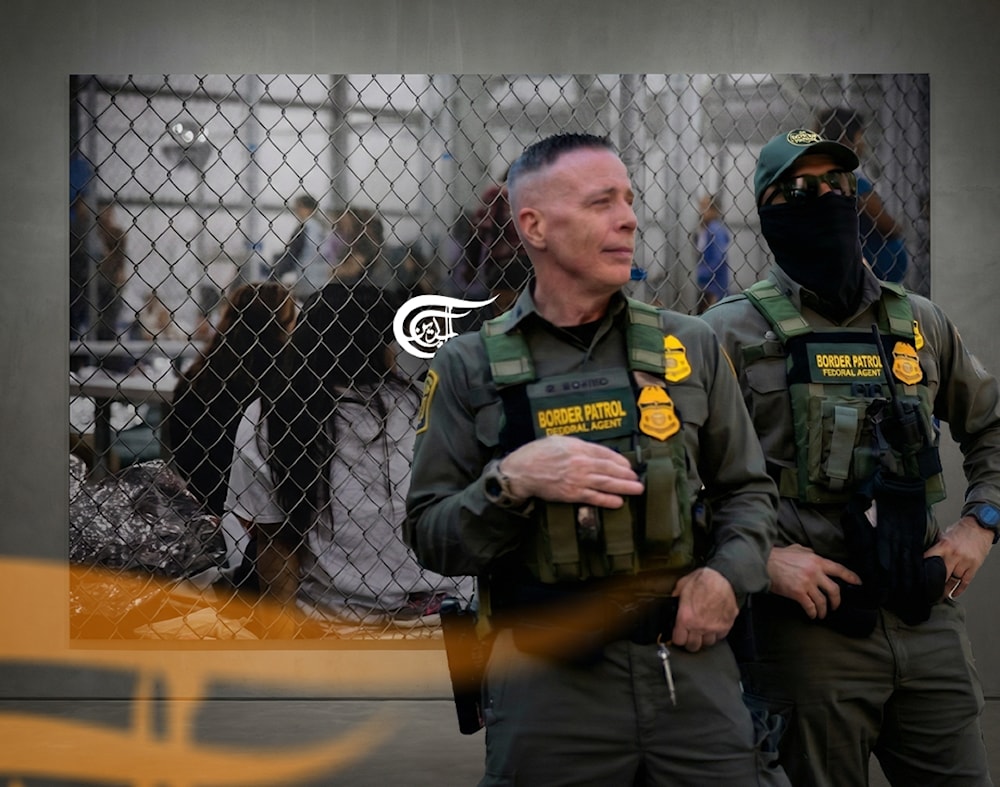
ICE, which alongside Border Patrol operates under the post-9/11 Department of Homeland Security, has taken a leading role in crushing any opposition to the Trump regime’s fascist governance. (Al Mayadeen English; Illustrated by Ali Al-Hadi Shmeiss)
It is no secret that the US has the highest incarceration rate in the world.
Since the mid-1960s, “prisons, jails and law-enforcement institutions have functioned as a central engine of American inequality,” writes Elizabeth Hinton in her 2016 book From the War on Poverty to the War on Crime: The Making of Mass Incarceration in America.
A 2024 report by the Sentencing Project found that between 1973 and 2009, incarceration rates saw a seven-fold increase.
The racial disparities are egregious. Black people account for 13% of the total US population, yet they represent 37% of the national prison population.
Native people are incarcerated at a rate of 763 per 100,000 people, which is double the national rate and four times higher than the incarceration rate of white people, according to the Prison Policy Initiative.
Carceral expansionism
The second Trump administration's war on immigrants is exacerbating the US’ already notorious over-reliance on penal control, with Immigration and Customs Enforcement (ICE) taking on a leading role in expanding mass incarceration even further in the self-professed “Land of the Free.”
A new report published by the American Immigration Council found that the number of people in ICE detention increased by 75% to 66,000 prisoners during Trump’s first eleven months back in office.
ICE’s detention system is reportedly capable of holding 70,000 people on any given day, the highest number in history, and is “on track to rival the entire federal criminal prison system by the end of President Trump’s second term in office.”
“Changes in arrest practices,” such as predatory “roving patrols” and “collateral arrests,” have resulted in a staggering “2,450 percent increase in the number of people with no criminal record held in ICE detention.”
The report laments that this unprecedented carceral expansion is “trapping hundreds of thousands of noncitizens in an increasingly opaque world of remote jails and private prisons.”
Analogous to this historic increase of prison facilities, prison conditions are worsening to the point that 2025 saw the number of deaths in ICE detention at its “highest ever for a non-COVID year.”


All of this is made possible by Congress’s exorbitant funding for ICE. In July 2025, lawmakers authorised $45 billion for ICE detention to be spent through the end of the fiscal year 2029.
This makes ICE’s detention budget larger than that of the entire federal prison system, the Council’s senior fellow told independent broadcaster Democracy Now! on the day the report was released.
'Crimmigration'
But the situation is even worse than already described.
A July 2025 report by the Prison Policy Initiative found that ICE statistics grossly understate the true extent of immigration detention by not factoring in that one-third of the people detained for immigration reasons are held in local jails or are part of U.S. Marshals and Bureau of Federal Prisons custody populations.
While ICE’s own official data puts the number of people in immigration detention in June 2025 at 57,200, 26,200 were held for ICE by the U.S. Marshals Service and in federal and local prisons.
With public scrutiny focusing predominantly on ICE, the report sheds light on the underreported collaboration between local jails and federal agencies in the service of what it calls Trump’s “mass arrest and deportation agenda.”
Local law enforcement plays a crucial, supportive role in Trump’s “crimmigration” agenda, a portmanteau coined in a 2006 paper by US law scholar Juliet Stumpf, which describes the convergence of immigration and criminal law.
Analysis conducted by the Prison Policy Initiative of ICE’s own arrest data shows that almost half of all ICE arrests were transfers from local jails.
Empowered by federal laws which “essentially deputize local law enforcement to enforce immigration laws for ICE,” local jails “act as jailers on the behalf of immigration authorities” by, for example, providing ICE with contractually rented detention space, the report said.
Shadow intelligence agency
Rarely has a law-enforcement agency invited so many unflattering comparisons as ICE has.
It has been described as Trump’s personal army, a white supremacist militia, a Gestapo-like secret police, a paramilitary force, modern-day slave catchers and even domestic terrorists.
Yet even the aggregate total of each of these ascriptions does not do justice to what investigative journalist Ken Klippenstein on his Substack called the “dizzying scope of ICE’s operations” which goes far beyond racist immigration enforcement in the service of making America white again.
Referencing an unnamed military source, Klippenstein writes that ICE’s crackdowns are also about intelligence-gathering “in support of Trump’s war on cartels — as well as on Antifa, on the radical left, and those who are ‘anti-American,’ and anyone else they consider terrorists.”
In short: ICE, which alongside Border Patrol operates under the post-9/11 Department of Homeland Security, has taken a leading role in crushing any opposition to the Trump regime’s fascist governance, with mass incarceration and deportation having evolved as the tools of choice to achieve that.


