
House tilts Democratic, but Senate control remains up for grabs: Polls
 5 Min Read
Democrats are favored to capture the House and remain competitive for Senate control ahead of the November 3 US midterms.
-
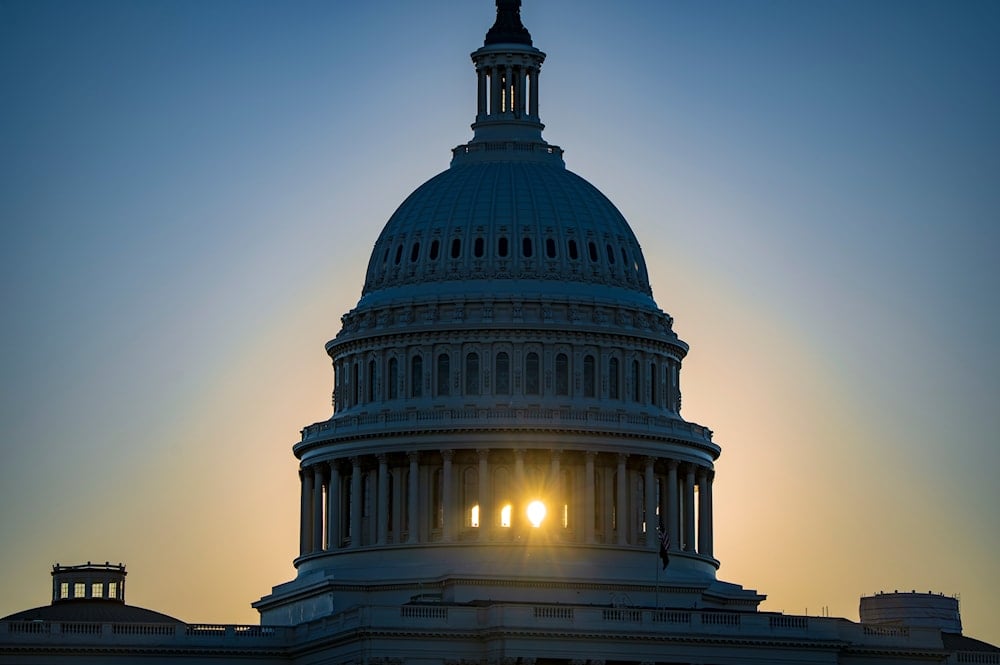
The sun rises behind the Capitol Dome in Washington, Tuesday, Oct. 20, 2026, two weeks before the midterm elections that will determine political control of Congress (AP)
Republicans face the prospect of losing their congressional majorities in the November 3 elections, with forecasts pointing toward a Democratic takeover of the House of Representatives and a potential shift in Senate control, Newsweek reported Saturday.
Such an outcome would significantly constrain President Donald Trump’s legislative agenda during his remaining two years in office, while allowing Democrats to direct congressional committees and intensify scrutiny of his administration.
The Senate currently has a 53–47 Republican majority, meaning Democrats need a net gain of four seats to secure control. Their opportunities extend into several states traditionally favorable to Republicans, although narrow polling margins leave the outcome uncertain.
Forecasts differ over strength of Democratic advantage
The figures reviewed by Newsweek, checked at 7 am Eastern Time on October 23, show agreement among major forecasters that Democrats have an advantage, but substantial differences over how likely they are to capture the Senate.
Silver Bulletin’s October 22 forecast assigned Democrats a 95 percent probability of taking the House and a 76.4 percent probability of winning the Senate. Its average projected Senate outcome was 52 Democratic seats against 48 Republican seats.
VoteHub also projected a 52–48 Senate, but placed the likelihood of Democratic control at 60 percent. Decision Desk HQ was more cautious, giving Democrats a 57 percent chance and projecting 51 seats after conducting one million simulations.
These probabilities measure the likelihood of securing a majority, rather than the share of votes either party is expected to receive.
Republican strongholds become competitive
Texas is among the states offering Democrats a possible breakthrough. James Talarico, a state representative and former public-school teacher, led Republican Attorney General Ken Paxton by 2.4 percentage points in Silver Bulletin’s polling average.
Paxton secured the Republican nomination after defeating incumbent Senator John Cornyn in a runoff. Despite Talarico’s polling advantage, Decision Desk HQ classified the contest as a toss-up, assigning the Democrat a 57 percent probability of victory.
In Kansas, Democrat Adam Hamilton held a 1.1-point lead over Republican Senator Roger Marshall in Silver Bulletin’s average. However, Decision Desk HQ still favored Marshall’s party, giving Republicans a 65 percent chance of retaining the seat.
A similarly divided picture emerged in Iowa. Democrat Josh Turek led Republican Representative Ashley Hinson by 1.2 points in Silver Bulletin’s average, while VoteHub measured his advantage at just 0.3 points. Decision Desk HQ projected a one-point Hinson victory but continued to classify the race as a toss-up.
Republicans retained a narrow polling advantage in South Carolina, where Senator Darline Graham led Democrat Annie Andrews by 1.7 points in Silver Bulletin’s average. Graham was appointed to succeed her late brother, Senator Lindsey Graham.
Decision Desk HQ gave Republicans a 70 percent probability of winning South Carolina. The smaller volume of public polling there adds uncertainty to assessments of the race.
Ohio, Alaska, and Maine offer further openings
Democrats are also challenging Republican incumbents in Ohio, Alaska, and Maine, while seeking to retain Michigan’s open Senate seat.
Former Ohio Senator Sherrod Brown led Republican Senator Jon Husted by 3.7 points in Silver Bulletin’s average and 4.3 points in VoteHub’s. Husted, appointed to the seat previously held by JD Vance, is running in a special election to complete the term. Decision Desk HQ gave Brown a 57 percent chance of returning to the Senate.
In Alaska, former Democratic Representative Mary Peltola held a 3.5-point advantage over incumbent Republican Senator Dan Sullivan in Silver Bulletin’s average. RealClearPolling put her lead at a narrower 1.2 points.
The ranked-choice election also includes another Republican named Dan Sullivan, a situation Trump said he was “very concerned” about in a Truth Social post.
Maine’s Republican Senator Susan Collins, seeking a sixth term, trailed Democrat Troy Jackson by 2.8 points in Silver Bulletin’s average. RealClearPolling measured Jackson’s lead at 1.4 points, while Decision Desk HQ gave Democrats a 56 percent chance of winning.
In Michigan, Democrat Abdul El-Sayed led Republican Mike Rogers by three points in Silver Bulletin’s average. Decision Desk HQ assigned Democrats a 68 percent probability of retaining the seat.
The differences between polling averages and election forecasts reflect their distinct purposes. Averages combine surveys of voter preferences, while forecasts incorporate additional information and assumptions about electoral uncertainty.
With several Senate contests separated by only a few points, turnout, late shifts in support, or polling errors affecting multiple states could still preserve Republican control despite the Democratic advantage.
Read more: 7 in 10 doubt Trump would accept midterm defeat: Poll


