
In first letter, Sayyed Mojtaba Khamenei vows continued retaliation
 5 Min Read
The third leader of the Islamic Republic of Iran, Sayyed Mojtaba Khamenei, addresses the nation for the first time following his election, vowing continued operations and justice against the enemies.
-
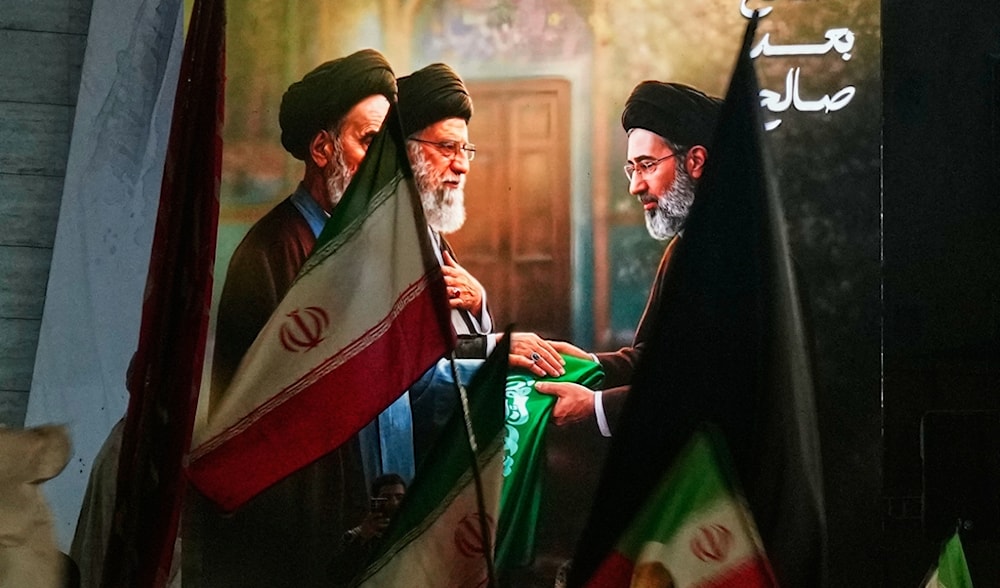
Protesters wave Iranian flags and hold a portrait of Iran's martyred Leader Sayyed Ali Khamenei and his son Sayyed Mojtaba Khamenei to support his selection in Baghdad, March 9, 2026. (AP)
Sayyed Mojtaba Khamenei, the third leader of Iran's Revolution and the Islamic Republic of Iran, pledged that Iran will continue its retaliation against US and Israeli military targets while maintaining the closure of the Strait of Hormuz.
In his first public message after assuming leadership, Sayyed Mojtaba Khamenei began by mourning his father, the martyred leader of the Islamic Revolution, Sayyed Ali Khamenei, eulogizing his martyrdom as a profound loss for Iran and the wider resistance front.
"Sitting in the place once occupied by the two great leaders of this nation, the great Khomeini and the martyred Khamenei, is an immense responsibility. This platform was once held by a man who, after more than sixty years of struggle in the path of God and renouncing worldly comforts, became a shining jewel and a distinguished figure not only in our time but in the history of those who governed this country."
He extended condolences to the Iranian nation and the Muslim world, praising the martyred leader’s decades of struggle and leadership while vowing to continue the path of resistance and national sovereignty.
Sayyed Khamenei also addressed families affected by the US-Israeli war, expressing condolences to those who lost relatives or whose homes and livelihoods were damaged. For the injured, he pledged free medical treatment and additional benefits.
Speaking on his personal loss, he noted that he not only lost his father, but he also lost his dear wife and his devoted sister.
Iran will avenge its martyrs
Vowing justice, Sayyed Mojtaba Khamenei said his country would not retreat from confronting those responsible for the martyrdom of Iranian citizens and leaders.
“We will not retreat from avenging the blood of our martyrs,” he stated, adding that “the closure of the Strait of Hormuz must continue.”
Sayyed Mojtaba Khamenei emphasized that Iranian strikes would remain focused on military installations rather than civilian targets, particularly bases used by US forces in the region.
“We believe in maintaining friendly relations with neighboring states, and target only military bases, but we will be forced to continue these strikes,” he said.
Call for mass mobilization and unity
In his letter, Sayyed Mojtaba urged the Iranian public to maintain a visible presence on the streets, particularly during the upcoming Quds Day commemorations.
“Public presence on the streets, especially during the Quds Day ceremonies, must be strong and prominent,” he said, emphasizing that public mobilization is a critical element of national resilience during wartime.
He praised Iranian fighters for their role in blocking attempts by adversaries to weaken the country, adding that Iranian forces had delivered “crushing blows” against those attempting to impose dominance over the nation.
Hormuz closure is strategic leverage
Sayyed Khamenei also stressed the continued closure of the Strait of Hormuz as an essential strategic tool in Iran’s response to the ongoing conflict.
“The use of the lever of closing the Strait of Hormuz must certainly continue,” he said, arguing that the measure remains a key instrument in Iran’s confrontation with its adversaries.
The Strait is one of the world’s most critical maritime chokepoints for global energy shipments, and any prolonged closure could have major implications for international oil markets.
Message to regional governments
Addressing governments across West Asia with whom he stressed Iran wishes good relations, Sayyed Mojtaba Khamenei warned that Iran would continue targeting military facilities used by its adversaries if those bases were employed in attacks against Iran.
“We targeted only those bases without attacking the countries themselves,” he said, adding, “If they continue to be used, we will be forced to continue targeting them.”
He also urged regional governments to reconsider allowing foreign military infrastructure on their territory, emphasizing that Washington’s promises of security in the region had proven unreliable.
Praise for the resistance front
Sayyed Mojtaba Khamenei also praised the Resistance, thanking allied movements and governments across the region for supporting Iran during the war.
“We consider the countries of the resistance front to be among the friendliest to Iran,” he affirmed, praising Ansar Allah, Hezbollah, and the Iraqi Resistance for their continued support for Gaza and Iran.
They are inseparable from the Islamic Republic of Iran, he said, hailing their efforts and stressing that continued cooperation cuts the enemy's lifeline shorter.
Promise of continued retaliation
Concluding his letter, Sayyed Mojataba Khamenei pledged that Iran’s response to attacks on its territory and citizens would continue.
“A limited amount of this revenge has already been carried out,” he said. “But this process will continue until it is fully realized.”
The full text of Sayyed Mojtaba Khamenei's letter can be read below:
In the name of God, the Most Compassionate, the Most Merciful
“Whenever We abrogate a sign or cause it to be forgotten, We bring forth one better than it or similar to it.”
Peace be upon you, O caller to God and interpreter of His signs. Peace be upon you, O gate of God and guardian of His faith. Peace be upon you, O vicegerent of God and defender of His truth. Peace be upon you, O proof of God and guide of His will. Peace be upon you, O awaited and hoped-for leader. Peace be upon you in every expression of peace. Peace be upon you, my master, the Lord of Time.
At the outset of this message, I extend my deepest condolences to the Lord of the Age, may God hasten his reappearance, on the martyrdom of the great, beloved, and wise leader of the Islamic Revolution, Sayyed Ali Khamenei. I pray that blessings and mercy be granted to the great Iranian nation, to all Muslims across the world, to the servants of Islam and the revolution, to the fighters who sacrifice for their homeland, and to the families of the martyrs of the Islamic movement, especially those who have fallen in the present war. I also ask for prayers for this humble servant.
The second part of my remarks is addressed to the great Iranian nation.
First, I must briefly clarify my position regarding the decision of the respected Assembly of Experts. Like many of you, I learned of the outcome of its vote through the broadcast of the Islamic Republic’s national television. For this servant of yours, Sayyed Mojtaba Hosseini Khamenei, to assume the position once held by two towering figures, the great Khomeini and the martyred Khamenei, is an immense and daunting responsibility.
This seat was previously occupied by a man who devoted more than six decades of his life to struggle in the path of God. He renounced comfort and worldly pleasures and emerged as a figure of rare distinction, not only in our own era but in the long history of those who have governed this country. Both his life and the manner of his martyrdom were marked by dignity and greatness born from steadfast faith.
I was granted the honor of seeing his body after his martyrdom. What I witnessed was a mountain of resolve and strength. I was told that even in death his uninjured hand remained clenched in a firm fist. Those who truly understood the many dimensions of his character will speak of him for years to come. Here, I will confine myself to these brief words and leave the fuller account for another time.
It is precisely for this reason that assuming leadership after such a figure is so difficult. Bridging the gap left by his absence will only be possible through reliance on God and through the steadfast support of the Iranian people.
One essential truth must be emphasized: one of the defining achievements of the martyred leader, and of his great predecessor, was to bring the people into every arena of national life. They awakened public awareness, cultivated insight, and placed their trust in the strength of the nation itself. In doing so, they gave real meaning to the idea of a republic and to the sovereignty of the people.
The results of this approach became clear during the brief days in which the country was left without a leader and without a commander-in-chief. The awareness, courage, and steadfast presence of the Iranian nation during those days astonished the enemy and inspired admiration among friends. It was you, the people, who safeguarded the strength and authority of this country.
The verse with which I began these remarks reminds us that when a divine sign is taken away, God replaces it with one that is equal or greater. The purpose of invoking this verse is not to claim that this servant stands at the level of the martyred leader, far from it, but to highlight the decisive role of the Iranian people themselves. If that great blessing has been taken from us, another has been granted in its place: the renewed presence and determination of the Iranian nation.
Know this clearly: if the strength of the people is absent from the public arena, neither leadership nor the institutions of the state, whose true mission is to serve the people, can function effectively.
For this strength to flourish, several principles must be upheld.
First, remembrance of God, trust in Him, and devotion to the sacred legacy of the righteous must remain the foundation of our struggle. These are the sources of resilience and the keys to ultimate victory over the enemy.
Second, unity among the various segments of the Iranian nation must be preserved, especially in times of hardship. Differences must not be allowed to weaken the solidarity that binds our people together.
Third, the people must maintain an active and meaningful presence in the public arena, as they have done throughout these days and nights of war. This presence can take many forms: social, political, cultural, educational, and even security-related. What matters most is that each person understands their role and fulfills it without undermining the unity of the nation.
In this regard, I emphasize the importance of mass participation in the upcoming Quds Day commemorations of the year 1447 AH. These gatherings must embody the spirit of resistance and demonstrate the determination of our people to confront the enemy.
Fourth, mutual solidarity must remain a defining feature of Iranian society. Our people have always stood by one another in times of difficulty, and this spirit must shine even more brightly in these challenging days. I also call on state institutions and public service bodies to provide every possible form of assistance to those who have suffered losses and to support community relief efforts.
If these principles are upheld, the path toward renewed greatness and dignity will open before our nation. The closest example of this, God willing, will be victory over the enemy in the war that is now being waged against us.
Message to the fighters and the resistance front
The third part of my remarks is a message of sincere gratitude to our brave fighters. At a time when our beloved homeland has come under unjust aggression from the leaders of the arrogant front, you have stood firm. Through your powerful strikes, you have blocked the enemy’s path and shattered their illusion that they could dominate our country or even divide it.
Dear brothers in arms, the will of the Iranian people is clear: the defense of the nation must continue in a way that is effective, decisive, and deterrent.
The strategic leverage of closing the Strait of Hormuz must continue to be used.
At the same time, studies have been conducted on opening additional fronts where the enemy has little experience and would be highly vulnerable. Should the war continue, and if circumstances require it, these options will be activated in accordance with the interests of the nation.
I also extend my sincere thanks to the fighters of the resistance front. We regard the nations and movements of the resistance front as among our closest friends. The cause of resistance itself is inseparable from the values of the Islamic Revolution.
Without doubt, the cooperation and solidarity of the forces of this front will shorten the path toward overcoming the Zionist threat. We have seen how courageous and faithful Yemen has refused to abandon the defense of the oppressed people of Gaza. We have seen how Hezbollah, despite immense obstacles, has stood by the Islamic Republic. And we have seen how the resistance in Iraq has bravely followed the same path.
Address to the victims of the war
The fourth part of my remarks is directed to those who have suffered during these difficult days, those who have lost loved ones to martyrdom, those who have been wounded, and those whose homes and livelihoods have been damaged.
First, I express my deepest sympathy to the families of the noble martyrs. My empathy for them comes from personal experience. In addition to my father, whose martyrdom became a loss shared by the entire nation, I have also lost my beloved and loyal wife, my devoted sister who dedicated her life to caring for our parents and ultimately received her reward, her young child, and the husband of another sister, a learned and honorable man. They too have joined the caravan of martyrs.
What makes patience in the face of such hardships possible, even bearable, is trust in God’s certain promise of great reward for those who endure suffering with faith. Therefore, patience must prevail, and our reliance must remain firmly placed in God’s mercy and justice.
Second, I assure the nation that we will not abandon the pursuit of justice for the blood of your martyrs. This pursuit does not concern only the martyrdom of the leader of the revolution. Every member of our nation who falls at the hands of the enemy represents a separate case in the ongoing account of retribution.
A limited portion of that retribution has already been carried out. Yet the matter will remain open until justice is fully realized, especially with regard to the blood of our children. The crime committed deliberately by the enemy against the Shajarah Tayyebeh school in Minab, and other similar atrocities, occupies a special place in this pursuit.
Third, those wounded in these attacks must receive proper medical treatment free of charge and be granted the support and benefits they deserve.
Fourth, as far as the current conditions allow, sufficient measures must be taken to compensate citizens for the financial losses inflicted upon their homes and property. These responsibilities are binding obligations upon officials, who must implement them and report their progress accordingly.
Let it also be clearly understood that we will demand compensation from the enemy for these crimes. If they refuse, we will take from their assets what we deem appropriate. And if that is not possible, we will destroy an equivalent portion of their resources.
Message to regional governments
The fifth part of my remarks is addressed to the leaders and decision-makers in several countries of our region.
Iran shares land or maritime borders with fifteen countries, and we have always sought warm and constructive relations with all of them. However, over the years, our enemies have established military and financial bases in some of these countries in order to consolidate their domination over the region.
During the recent aggression against Iran, some of these bases were used. As we had previously warned, we targeted only those bases, without directing any aggression toward the countries themselves.
If these bases continue to be used for attacks against our nation, we will be compelled to continue targeting them.
At the same time, we remain firmly committed to maintaining friendly relations with our neighbors. For this reason, I advise these countries to move quickly to close those bases. By now it should be clear that the promises of security and peace offered by the United States were nothing more than deception.
The Islamic Republic seeks neither domination nor colonial influence in the region. On the contrary, we remain fully prepared to build sincere, cooperative relations with all our neighbors based on mutual respect.
In these blessed days, I pray that God’s special grace and mercy encompass the Iranian nation, as well as all Muslims and all oppressed people throughout the world.
Finally, I ask our master, the Lord of the Age, may God hasten his reappearance, to pray during the remaining nights and days of Qadr in this sacred month that our nation may achieve decisive victory over its enemies, and that our people may be granted dignity, prosperity, and well-being.
May our martyrs be granted the highest ranks in the hereafter, and may peace and divine mercy be upon you all.


