
No ship crossed Hormuz Strait under US military protection: Exclusive
 4 Min Read
Iran says not a single vessel has crossed the Strait of Hormuz under US military protection, dismissing Washington's claims as psychological warfare.
-
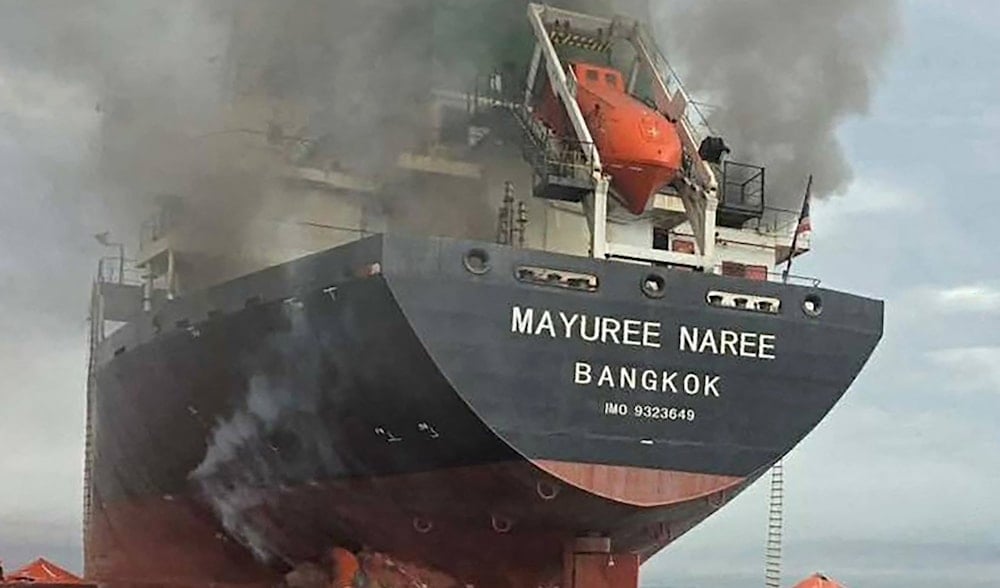
This handout photo taken on March 11, 2026, and released by the Royal Thai Navy shows smoke rising from the Thai bulk carrier Mayuree Naree near the Strait of Hormuz after an attack. (Photo by Royal Thai Navy via AFP)
A senior Iranian security source told Al Mayadeen on Wednesday that Washington has been waging psychological warfare for the second consecutive night over the Strait of Hormuz, seeking to manipulate energy markets. The source affirmed that not a single vessel has transited the strait under US military protection.
"Either there is full and comprehensive security in the Strait of Hormuz, or the strait will face permanent instability," the source said. He added that ensuring such security is a shared responsibility for all parties, affirming Iran's readiness to achieve it, while warning of equal readiness to push the regional war into a broader and more dangerous phase if necessary.
View this post on Instagram
These remarks were reinforced by the spokesperson for Iran's Khatam al-Anbiya Central Headquarters, who confirmed on Wednesday that Iranian armed forces currently hold full operational initiative in the strait, noting that closing it remains an option of last resort rather than an opening move. He attributed the current state of affairs to the ongoing US-Israeli aggression on Iran.
Oil exports halted for hostile parties as US
Another senior Iranian military official told Al Mayadeen that not "a single liter of oil" destined for hostile parties or their partners would be permitted to leave the region until further notice, stressing that wartime management of the strait would be governed by strict security and military regulations.
This comes as Reuters reported, citing sources, that the US Navy has been rejecting near-daily requests from the shipping sector for military escorts through the strait since the war on Iran began, deeming the risk of attack too high.
On Tuesday, Ali Larijani, secretary of Iran's Supreme National Security Council, remarked that the Strait of Hormuz must either remain a passage of relief for all, or it will become a chokepoint for those who dream of war.
Iran asserts full intelligence coverage
On Wednesday evening, Major General Yahya Rahim Safavi, advisor to the commander-in-chief of Iran's armed forces, stated that Iranian forces maintain robust intelligence oversight over adversary systems and movements, backed by cooperation with foreign states whose satellites are also tracking developments.
Safavi told Iranian television that Iran has real-time awareness of US naval fleet movements across theaters, from the Sixth Fleet in the Mediterranean to the Fifth Fleet in the Indian Ocean and the Sea of Oman.
He went further, asserting that US aircraft departing from the US mainland, Diego Garcia, or European bases are tracked continuously. "We know exactly where they are. Sometimes we even have their precise coordinates," he asserted.
He also dismissed the effectiveness of strikes on Iranian military infrastructure, explaining that no missiles remain at the bases being targeted, as all assets have been relocated and dispersed across multiple sites. "This time we will impose our demands on them," Safavi concluded, declaring that the war is moving toward Iran's inevitable victory and that the United States has been humiliated.
IRGC warns of underwater missiles
Brigadier General Ali Fadavi, deputy commander-in-chief of the Islamic Revolutionary Guard Corps, disclosed that Iran possesses underwater-launched missiles capable of traveling at 100 meters per second, suggesting their deployment could come within days.
He noted that Iran and Russia are the only two countries in the world to possess this technology, and warned that Americans should brace for further surprises.
In a direct address to President Donald Trump, Brigadier General Majid Mousavi, commander of the IRGC Aerospace Force, called on him to instruct US Central Command to release before-and-after imagery of strikes on Iranian military installations, stressing that the footage is "worth seeing."
Iran has continued striking US bases and Israeli-occupied territories in response to the joint US-Israeli aggression that has deliberately targeted residential areas, civilian infrastructure, and natural resources since 28 February.


