
India takes BRICS helm for 2026, pledges Global South focus
 3 Min Read
India has assumed the 2026 BRICS presidency, committing to a Global South-focused agenda while carefully balancing its ties with major global powers.
-
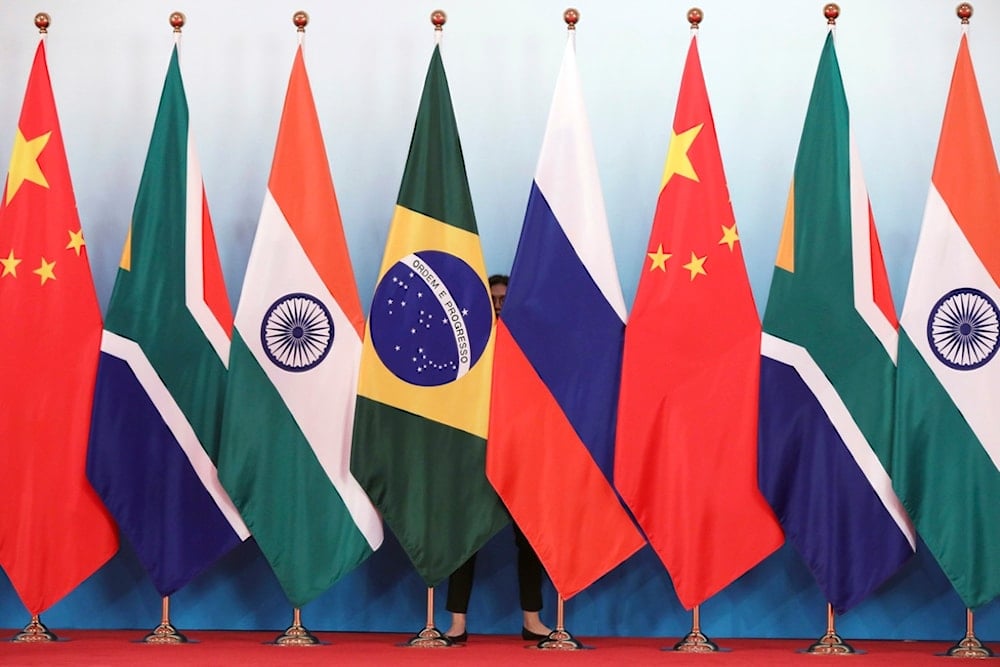
Staff worker stands behinds national flags of Brazil, Russia, China, South Africa and India to tidy the flags ahead of a group photo during the BRICS Summit at the Xiamen International Conference and Exhibition Center in Xiamen, southeastern China's Fujian Province, Monday, Sept. 4, 2017. (Wu Hong/Pool Photo via AP, File)
Ria Novosti reported that India officially took over the rotating presidency of BRICS for 2026 on January 1, pledging to advance the interests of the Global South amid increasingly strained international relations.
The transition followed a handover ceremony at the BRICS Sherpa meeting in Brasilia on December 12, where the Indian delegation received the ceremonial gavel from Brazil. New Delhi is now set to steer the grouping’s agenda and host the bloc’s 18th summit later this year.
Indian authorities have outlined a development-focused presidency, echoing priorities raised during India’s G20 leadership in 2023. Prime Minister Narendra Modi has promoted a “people first” vision grounded in sustainability, innovation, collaboration and a green transition.
Tensions shape presidency
India’s tenure begins as internal differences among BRICS members persist, particularly between New Delhi and Beijing. The two Asian powers remain locked in a prolonged military standoff along their disputed Himalayan border, following deadly clashes in 2020 that severely strained ties. Despite continued economic exchanges and engagement within multilateral forums, political trust between India and China remains fragile, with repeated rounds of military and diplomatic talks failing to fully resolve the crisis.
Read more: China accuses US of undermining improving ties with India
Beyond the border dispute, Indian officials have grown increasingly cautious over China’s expanding influence within BRICS. New Delhi has pushed back against efforts to position the bloc as a vehicle for geopolitical confrontation with the West, favouring instead a narrower focus on development, finance and South-South cooperation. India has also expressed reservations about rapid BRICS expansion, which it fears could dilute decision-making and consolidate Chinese leadership within the grouping.
Analysts say these frictions are shaping India’s careful approach as president of the bloc.
“New Delhi will have to defend the interests of the Global South while carefully avoiding steps that could run counter to the interests of international players. During its presidency, India is likely to prioritize development and cooperation rather than raising contentious issues that may harm its relations with Washington,” Indian foreign policy expert Balaji Radhakrishnan told RIA Novosti.
India navigates BRICS
While maintaining close strategic ties with Russia, New Delhi has avoided fully endorsing Moscow’s positions on Ukraine, opting instead for diplomatic neutrality. Relations with Brazil and South Africa remain largely cooperative, though differences exist over how assertively BRICS should challenge Western-led institutions.
Radhakrishnan noted that India’s expanding engagement with the United States in defence, space and scientific cooperation adds another layer of complexity. He pointed to tensions following claims by US President Donald Trump that he had facilitated a ceasefire between India and Pakistan, an assertion New Delhi has repeatedly rejected.
As India assumes leadership of BRICS, officials are expected to steer the bloc away from internal rivalries, focusing instead on consensus-building and economic cooperation as a means of reinforcing its role as a representative platform for the Global South.
Read more: Nigeria eyeing full BRICS membership in coming years, FM says


