
Indonesia receives first aircraft carrier amid cost debate
 5 Min Read
Jakarta receives Italy’s retired Giuseppe Garibaldi as defense spending rises, while analysts question the carrier’s costs, military role, and long-term utility.
-
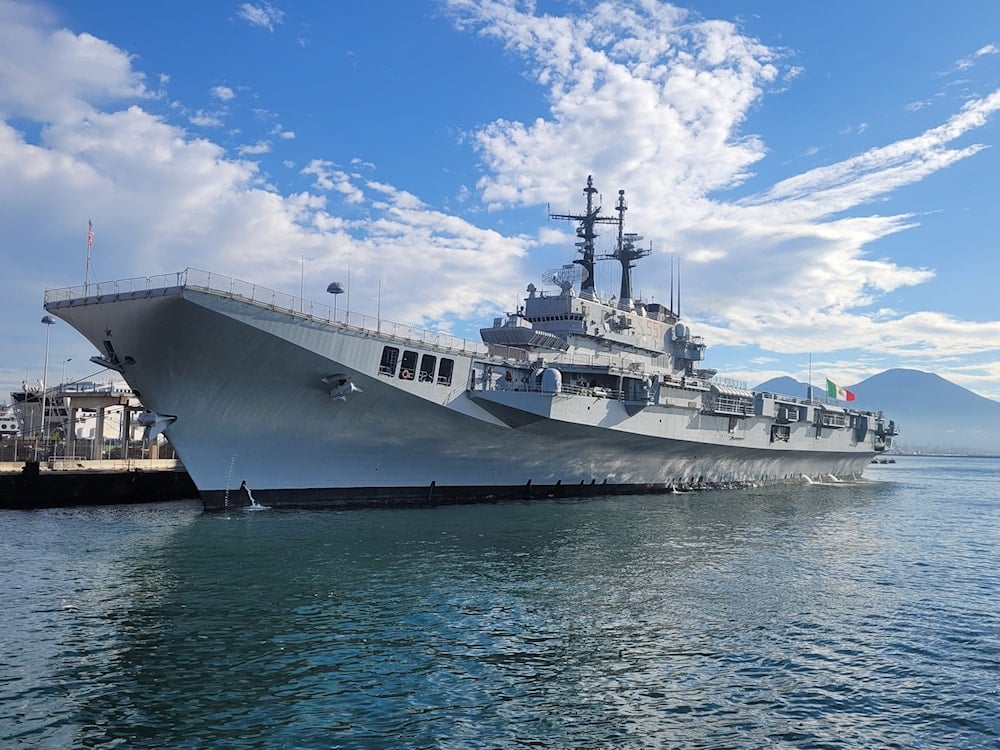
The ITS Giuseppe Garibaldi aircraft carrier anchored in Naples, Italy, on October 25, 2024. (Benzekre/Wikimedia)
Indonesia has received its first aircraft carrier, with the former Italian warship arriving in North Jakarta as President Prabowo Subianto’s government expands the country’s military capabilities.
The 41-year-old former ITS Giuseppe Garibaldi arrived Friday at Tanjung Priok port, where it was welcomed with a military ceremony. The vessel, which can operate short-takeoff and vertical-landing aircraft and helicopters, is scheduled to be formally commissioned into the Indonesian Navy next week as the KRI Gajah Mada.
The acquisition comes amid debate in Indonesia over the cost of refurbishing and operating the aging vessel and whether an aircraft carrier should be a priority for the country’s defense strategy.
Read more: China, Indonesia expand military cooperation, technology ties
Indonesia takes delivery of first carrier
Italy agreed in March to transfer the carrier to Indonesia after the ship was retired from Italian service in 2024.
The transfer forms part of broader Italy-Indonesia defense cooperation as Rome seeks to expand its defense relationship with Jakarta, including potential deals involving submarines and aircraft. Giving away the retired carrier also allows Italy to avoid the cost of decommissioning the vessel.
The ship’s arrival makes Indonesia the second Southeast Asian country to operate an aircraft carrier. Thailand became the first when its HTMS Chakri Naruebet entered service in 1997 after being procured from Spain alongside carrier-capable AV-8S Matador jump-jets.
Indonesia has named the incoming carrier after Gajah Mada, the prominent 14th-century Majapahit-era military leader associated with campaigns aimed at consolidating the archipelago.
Cost concerns cloud carrier program
The carrier has become a point of contention as Jakarta increases defense spending while facing mounting fiscal pressures.
Indonesia’s Finance Ministry approved $450 million in financing for the aircraft carrier program in 2025. However, some lawmakers have warned that the final cost could be considerably higher.
TB Hasanuddin, a member of parliament’s Commission I, said the cost of retrofitting the vessel alone could reach 16 trillion rupiah, or about $900 million.
The broader financial burden extends beyond the transfer and modernization of the ship. Operating an aircraft carrier requires sustained spending on personnel, maintenance, fuel, weapons systems, and supporting infrastructure.
Muhammad Fauzan Malufti of the Center for Strategic and International Studies said the acquisition should be driven by operational requirements rather than considerations of national prestige.
“The plan to acquire the Garibaldi must be based on genuine operational needs and our ability to operate it, rather than being driven by pride or other considerations,” Fauzan said.
He also called for greater transparency over the vessel’s long-term costs, citing Thailand’s carrier as a cautionary example because it has spent much of its service life in port due to operational and budget constraints.
Jakarta outlines maritime and disaster roles
Indonesia is not presenting the carrier primarily as a platform for projecting fighter power far from its shores.
Instead, Jakarta views the vessel as a mobile command center and support hub for helicopters, drones and maritime operations across the country’s thousands of islands.
Speaking at a disaster management meeting earlier this month, Prabowo said the ship could support efforts to combat forest and peatland fires that periodically spread hazardous haze across parts of Southeast Asia.
According to Prabowo, the carrier could accommodate up to 10 medium-sized helicopters, including aircraft with capabilities comparable to the Black Hawk and Mi-17. He said it could also carry large quantities of water and be deployed to areas with numerous fire hotspots.
The government also plans to operate drones from the vessel and use it as a mobile platform for rapid disaster-response operations. Indonesia is highly exposed to natural disasters because of its location along the Pacific “Ring of Fire.”
Analysts question Indonesia’s naval priorities
The carrier’s military utility remains contested among Indonesian defense analysts.
Fauzan said Jakarta must assess whether it can sustain the ship’s operations before proceeding with the program.
“The bottom line is that this should not be forced. Otherwise, the benefits could be outweighed by the costs,” Fauzan said. “The money might be better spent on other priorities, such as increasing the number of frigates in the fleet.”
Military analyst Khairul Fahmi of the Institute for Security and Strategic Studies similarly argued that aircraft carriers are not currently a priority for Indonesia.
“Indonesia has a greater need for submarines, frigates and asymmetric weapons systems to protect its maritime sovereignty,” he said.
Fahmi nevertheless said the vessel could serve a broader role if Jakarta seeks to strengthen its position as a major maritime power.
“An aircraft carrier can be both a symbol of national power and a multifunctional platform capable of supporting a wide range of military and non-military missions,” he said.


