
IOF to impose West Bank lockdown on election day
 4 Min Read
The Israeli occupation forces will impose a West Bank lockdown on Israeli election day and bar Palestinian workers from settlements and industrial zones.
-
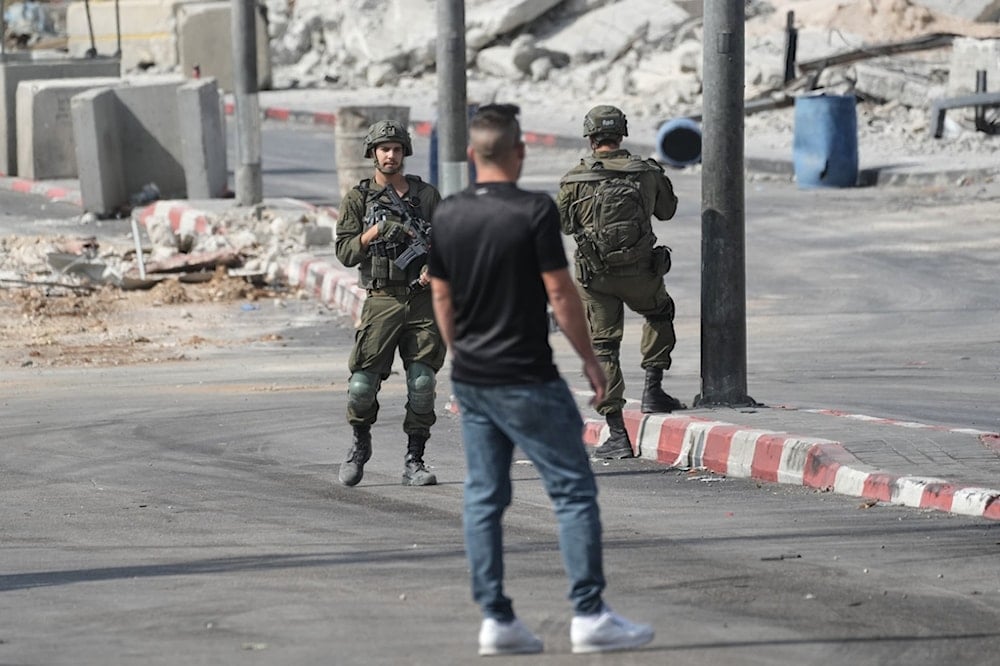
A Palestinian man stands next to Israeli occupation forces during an 'operation' in the West Bank city of al-Khalil, Saturday, Oct. 24, 2026. (AP Photo/Mahmoud Illean)
The Israeli occupation military will impose a lockdown across the occupied West Bank on Tuesday, October 27, during the Israeli elections, while further restricting Palestinian workers from entering settlements in the West Bank and Jordan Valley on Sunday and Monday.
According to the Times of Israel, as per the IOF, following a fresh assessment, Palestinians holding work permits will be barred from entering Israeli settlements across the West Bank and Jordan Valley from Sunday through Monday, with exceptions for industrial zones and a “limited number of other approved areas.”
Data from last year showed that around 9,000 Palestinians held permits to work in settlements or nearby industrial zones.
The Israeli political leadership has also approved a recommendation from the security establishment to prohibit Palestinian workers from entering or leaving the entire West Bank and Jordan Valley on election day, including industrial zones. All land crossings with the occupied West Bank will also be closed to Palestinians throughout Tuesday.
The restrictions are expected to remain in place throughout election day, with the crossings set to reopen and the ban on Palestinian workers lifted afterward, as reported by the Times of Israel.
Election lockdown follows intensified IOF aggression in al-Khalil
The restrictions come as the Israeli occupation military continues an escalating aggression in al-Khalil, where the IOF has imposed a siege on the city and neighboring villages, demolished homes and commercial and industrial facilities, and forced thousands of Palestinians to evacuate their homes.
On Saturday, the IOF levelled a neighborhood in al-Khalil and drove out hundreds of families, according to local Palestinian authorities. Al-Khalil Municipality estimated that 35 hectares (86 acres) had been destroyed.
Israeli occupation forces continued a military raid in occupied al-Khalil on Saturday, forcing more than 250 Palestinian families out of their homes, sealing off roads and city entrances, and carrying out widespread raids and detentions across the occupied West Bank. Al Mayadeen’s correspondent reported a heavy military deployment in neighborhoods including Jallada and Ain Deirbaha, as residents feared they would be prevented from returning. Al-Khalil Municipality declared a state of emergency and opened shelters for displaced families. The raids extended to Nablus, Jenin, Tubas, Ramallah, Beit Lahm, Tulkarm, Qalqilya, and areas around occupied al-Quds, with reports of home raids, detentions, road closures, and the conversion of a residential building in Nablus into a field interrogation center. Palestinian sources also reported settler attacks that injured farmers west of Dura. The Israeli military and Shin Bet said the "military operation" in al-Khalil could last several days, focused on the area from which the Palestinians who carried out a Resistance operation that killed two Israeli soldiers had set out.
— Al Mayadeen English (@MayadeenEnglish) October 25, 2026
The head of the municipality said the occupation forces had demolished a house as well as several commercial and industrial facilities, while forcing more than 2,000 Palestinians to leave their homes. He added that al-Khalil and several surrounding villages were under a complete siege.
The IOF also raided several neighborhoods in Dura, focusing on the Krisa area, where forces searched homes, including the residence of the father of Palestinian detainee Ibrahim al-Rajoub.
Mass detentions and displacement
In a separate assault, the IOF detained Thaer Tayseer after Israeli settlers assaulted him in the village of Sama, west of Dura. The occupation forces also continued closing entrances to al-Khalil, its refugee camps, and surrounding towns, pursuing residents and their vehicles and assaulting Palestinians.
Several Palestinians suffered suffocation after inhaling toxic tear gas fired by the IOF near Khubab Roundabout and the Sadda al-Fahs area south of the city.
The IOF also continued sealing off the al-Jaladah and Ain Deir Bahha areas and raiding homes after forcing residents to leave.
Local sources said the occupation forces had forced around 1,500 Palestinians to evacuate their homes in Deir Bahha and al-Jaladah since Friday, while planning to displace another 2,500 in the following hours. The ongoing aggression had already displaced more than 200 families, leaving them without shelter.
IOF launch multi-day aggression on al-Khalil
The IOF began evacuating Palestinians from the al-Jalda area of al-Khalil early Saturday after the Israeli occupation military and Shin Bet announced a new aggression in the city under the guise of a “military operation” that they said would last several days.
Large numbers of occupation troops stormed al-Khalil and fired flares over the city, while other forces raided Nablus and other West Bank cities, including Tubas, Aqaba, and Qalqilya, carrying out detentions, according to local reports.
Palestinian media also reported confrontations between Resistance fighters and occupation forces in Balata refugee camp, east of Nablus.
In a joint statement on Friday night, the Israeli military and Shin Bet said the operation, led by the so-called Judea Regional Brigade alongside Border Police and the Civil Administration, was “focused and limited to the area from which the terrorists operated.”
The statement said residents could leave only through three exits after being subjected to questioning and security checks by occupation forces, with anyone who raised “suspicion” taken for interrogation.
As "Israel" heads toward its upcoming elections, the dispute over military conscription for ultra-Orthodox Haredi Jews is emerging as a major challenge to Benjamin Netanyahu's political alliances. For decades, Haredi religious students benefited from military exemptions, but a 2024 Supreme Court ruling challenged the legal basis for the practice, triggering tensions within Netanyahu's coalition. With Haredi parties historically playing a crucial role in forming governing majorities, the dispute could influence coalition negotiations and determine who holds power after the elections. (1/2)
— Al Mayadeen English (@MayadeenEnglish) October 25, 2026


