
Iran, Russia ties strategic, on path to multipolar world: Araghchi
 4 Min Read
Iran and Russia deepen their strategic partnership, emphasizing regional cooperation, multipolarity, and infrastructure development like the North-South Corridor.
-
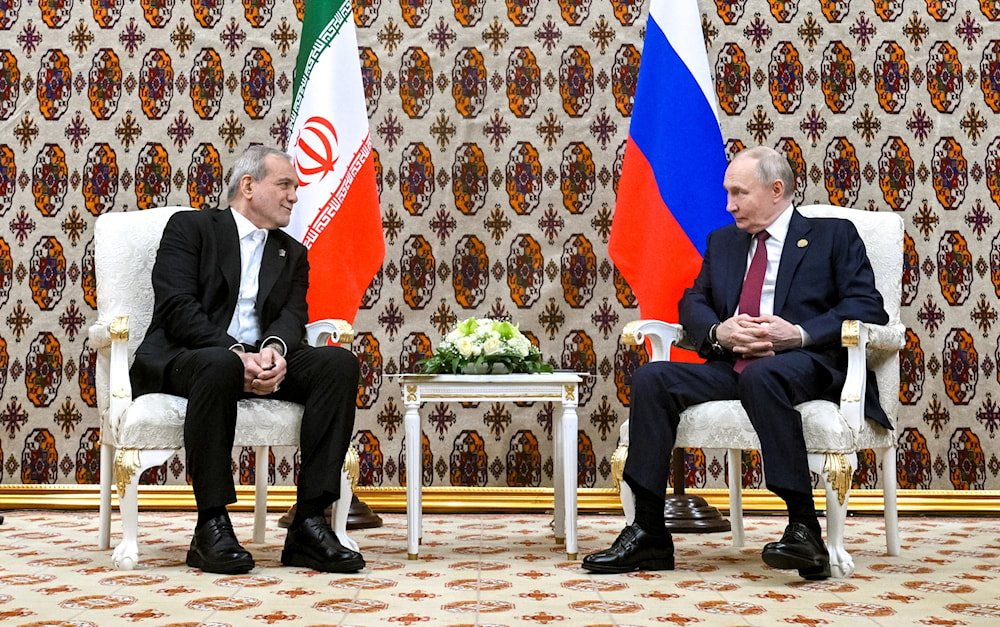
Russian President Vladimir Putin and Iranian President Masoud Pezeshkian talk during their meeting on the sidelines of an international forum in Ashgabat, Turkmenistan, Friday, Dec. 12, 2025 (AP)
Tehran’s relationship with Moscow is multi-layered and based on a shared understanding of the profound changes taking place in the international system, Iranian Foreign Minister Abbas Araghchi stated on Tuesday.
In an article for the Russian newspaper Kommersant titled “Tehran and Moscow: A Strategic Partnership on the Path to a New Multipolar World Order,” Araghchi noted that regional security, stability, and sustainable development “can only be achieved through cooperation among neighboring countries and the region, without interference from external actors.”
He added that political and security coordination between Iran and Russia “holds a distinguished position,” stressing that both countries advocate for an international system that “returns to true, fair, and equitable multipolarity.”
Araghchi also stated that “Iran and Russia are moving forward on the basis of a strategic partnership to build a system where cooperation replaces domination, dialogue replaces pressure, and respect replaces dictates.”
Echoing Araghchi's statements, Russian Foreign Minister Sergey Lavrov, in a Monday interview with Iranian television from Moscow, expressed Moscow’s “confidence in the Iranian leadership and support for the path Iran has chosen,” highlighting that the comprehensive cooperation agreement between the two countries “has an effective framework and includes concrete commercial and economic measures.”
Larijani, Savelyev meet in Tehran
Meanwhile, Iran’s top security official, Ali Larijani, met with Russian Deputy Prime Minister Vitaly Savelyev in Tehran as part of ongoing high-level coordination to strengthen bilateral cooperation. The meeting took place Monday night at the Secretariat of Iran’s Supreme National Security Council, where the two sides discussed key issues shaping the Iran-Russia partnership.
The talks followed understandings reached between the presidents of Iran and Russia, focusing on removing existing obstacles to move bilateral cooperation into an operational phase. A central topic of discussion was the North-South Transport Corridor, which both sides identified as a strategic factor in the region’s geopolitical landscape.
Larijani emphasized that Iran is committed to operationalizing the corridor, promising that all executive and institutional hurdles would be resolved swiftly. He added that necessary agreements would be finalized to ensure the legal and operational consolidation of the project.
Referring to a commitment by Iran’s president, Larijani stated that all land along the corridor’s route would be acquired by the end of the year, allowing the project to proceed uninterrupted and in full coordination. Savelyev welcomed Iran’s decisive approach and affirmed Moscow’s readiness to accelerate the project and initiate its operational phases.
Iran-Russia relations reach news heights in 2025
In January 2025, Iran and Russia elevated their ties with the Comprehensive Strategic Partnership Treaty signed in Moscow on January 17, setting a 20‑year framework to expand cooperation in trade, energy, transport, and security.
By October 2, the treaty came into force after ratification by both countries, and leaders from Tehran and Moscow reaffirmed in December their commitment to fully implementing its provisions, including boosting economic and infrastructure projects.
Trade and economic cooperation have been emphasized throughout 2025, with senior Russian officials noting that bilateral trade, currently around $5 billion, is expected to grow significantly through collaboration in the Shanghai Cooperation Organization and other blocs.
Beyond economics, Tehran and Moscow have intensified political and diplomatic engagement, with frequent consultations on regional security, nuclear cooperation, and alignment in international forums, signaling a broader strategic alignment amid Western sanctions and geopolitical tensions.
Military cooperation also saw notable advances, with joint naval drills held in the Gulf of Oman in March 2025, and discussions on defense technology transfers continuing throughout the year, underscoring the growing depth of Iran-Russia strategic coordination.


