
Iran announces 40-day memorial ceremonies for Sayyed Ali Khamenei
 4 Min Read
Memorial ceremonies for martyred Leader Sayyed Ali Khamenei will be held in Tehran, Qom, and Mashhad as Iran marks the 40th day since his funeral.
-
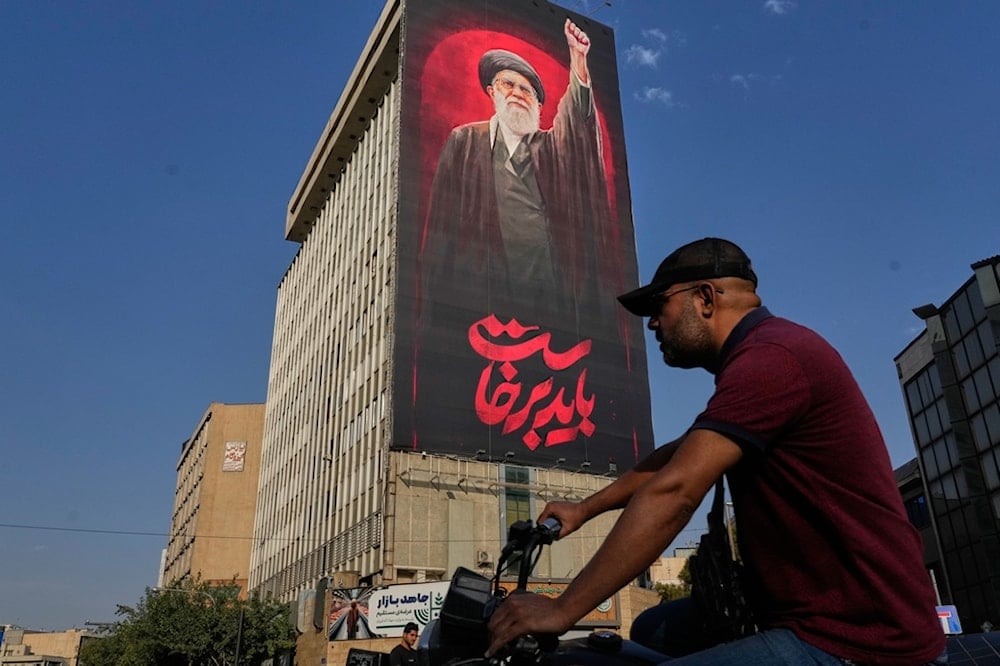
A man rides on his motorbike past a billboard with a message that reads in Farsi: " We must rise up" and an image of the martyred Iranian Leader Ayatollah Sayyed Ali Khamenei, in Tehran, Iran, Saturday, Aug. 15, 2026 (AP)
The office of the Leader of the Islamic Revolution has announced plans for memorial ceremonies marking the 40th day since the funeral of the martyred Leader of the Islamic Revolution, Sayyed Ali Khamenei, with events scheduled to take place in Tehran, Qom, and Mashhad.
The office called for broad public participation in the ceremonies, which will be held over three consecutive days in the three Iranian cities.
The first ceremony will take place in Tehran on Tuesday, August 18, from 5 pm to 7 pm at the Imam Khomeini Mosque's prayer hall.
A second memorial ceremony will be held in Qom on Wednesday, August 19, following the Maghrib and Isha prayers at the Fatima Masumeh Shrine.
The ceremonies will conclude in Mashhad on Thursday, August 20, coinciding with the eve of the martyrdom anniversary of Imam Hassan al-Askari. The ceremony will be held following the Maghrib and Isha prayers at the Imam Reza Shrine.
Millions to attend funeral ceremonies
The office of the Leader of the Islamic Revolution called on the Iranian people to attend the ceremonies, stressing that "the massive and widespread participation of the Iranian people and devotees will constitute a renewed pledge of allegiance to the leadership of the Islamic Revolution and a renewed affirmation of treading the path of the martyred Leader of the Revolution."
Following his martyrdom in a joint US-Israeli aggression on Iran on February 28, the Islamic world witnessed an unprecedented outpouring of grief as millions participated in funeral and mourning ceremonies spanning multiple cities and two nations over the course of a week.
Public farewell events commenced in Tehran on July 4, drawing millions to the capital's streets. Iranian media reported that mourners arrived from across all provinces of the country, alongside representatives and visitors from nearly 100 nations, to pay their final respects. The Financial Times described the gatherings as "the largest in the modern history of the world," with estimates suggesting between 12 and 15 million people participated across the various ceremonies.
On Tuesday, July 7, millions of mourners packed the streets of the holy city of Qom, home to Iran's foremost religious seminaries and shrines, with a population of approximately 1.5 million, to perform funeral prayers for the martyred leader and members of his family who were also killed in the February 28 bombing. The ceremonies at Jamkaran Mosque drew vast crowds that analysts described as a massive reaffirmation of allegiance to the principles of the Islamic Revolution.
July 7 and 8 saw Iraq hold its own monumental funeral rites in the holy cities of Najaf and Karbala. A sea of mourners, estimated at over 2.3 million, flooded the sacred city in what officials described as one of the largest processions in modern regional history. Following the Najaf ceremonies, the body of the martyred leader arrived in Iraq's Karbala province, where millions of mourners were awaiting the start of the funeral ceremony.
The burial ceremony concluded in Sayyed Khamenei's hometown of Mashhad on July 9, where millions gathered to bid their final farewell. Iran's state broadcaster confirmed that the martyred leader was laid to rest at the Dar al-Dhikr portico within the Imam Reza Shrine, one of the most revered religious sites in Shia Islam.
Throughout the week of mourning, the ceremonies continued to draw crowds of a scale rarely witnessed in contemporary times, standing as a testament to the profound impact of the martyred leader across the region and beyond.
Read more: Religious Popular Sovereignty: A pillar of Sayyed Khamenei’s legacy


