Religious Popular Sovereignty: A pillar of Sayyed Khamenei’s legacy
 11 Min Read
Sayyed Ali Khamenei’s concept of religious popular sovereignty presented an Islamic model in which divine guidance sets the moral limits of power, while the people choose, supervise, and sustain government.
-
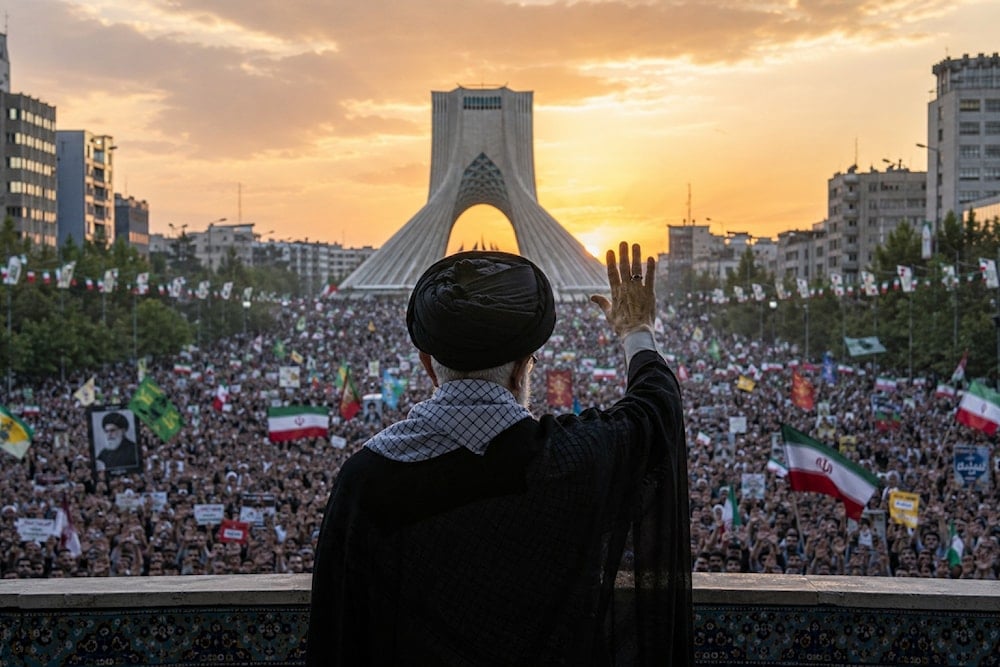
Part of Sayyed Ali Khamenei’s legacy lies in presenting an Islamic political model rooted in its own history and values, one that brings together revelation and the people’s political role (Al Mayadeen English; AI-designed image)
Looking at the days-long funeral of Sayyed Ali Khamenei and the millions upon millions who took part, one cannot help but ask what brought such vast crowds into the streets.
One message came up repeatedly among the people we spoke with in Iran: “This is the first time I have come to one of these marches,” or, “I did not like Sayyed Khamenei before, but after the 12-Day War, my entire outlook changed.”
This was far removed from the usual Western media drivel and far-right claims that people had somehow been forced to attend. Anyone who has actually visited Iran or lived there knows how openly people discuss politics and criticize officials. Still, even for those who know the country, the question remains: What brought these millions into the streets? Is Iran a theocracy? A republic? Or, as Western media would love you to believe, a dictatorship playing democracy for funsies?
Much of modern Western political thought has treated religious authority and popular sovereignty as incompatible. The question is usually framed like this: If political legitimacy belongs to God, what meaningful authority remains for the people? And if the people are sovereign, can their will be limited by truths they did not create?
Sayyed Ali Khamenei rejected this either-or choice. His theory of Religious Popular Sovereignty was neither secular democracy wrapped in religious language nor a religious state merely tolerated by its population.
As he explained, “Religious Popular Sovereignty is not two things; it is not that we take democracy from the West and attach it to religion.” In his view, popular government arises from religion itself.
Islam does not simply permit people to participate in government. It provides the basis for their political rights and freedom of choice. “The foundation of the people’s right to choose is Islam itself,” Sayyed Khamenei argued.
Divine guidance sets the moral goals and limits of power. The people, meanwhile, choose officials, support institutions, and turn those principles into political reality.
Sayyed Ali Khamenei’s legacy therefore lies in presenting an Islamic political model rooted in its own history and values, one that brings together revelation and the people’s political role, justice and participation, and national sovereignty and independence.
Political choice and moral truth
Religious Popular Sovereignty begins by separating political choice from moral truth.
People are essential to government, but numbers alone do not make an action just or an idea true. A majority may choose officials, shape public policy, and set political priorities. But injustice does not become justice simply because enough people vote for it. Making murder legal, for example, would not suddenly make murder just.
Popular sovereignty therefore works within a moral framework shaped by divine guidance. This does not make public choice meaningless. It simply means that neither rulers nor majorities can decide for themselves what is right and wrong.
At the same time, this framework does not reduce society to blind obedience.
According to the Quran, God’s messengers were sent with scripture “so that the people may uphold justice.” Justice is therefore not something simply imposed from above. The people themselves are charged with defending and upholding it.
Revelation provides the framework, but people must recognize justice, protect it, and build it into laws and institutions. Religious government therefore requires both divine guidance and active public participation.
This relationship creates rights and duties on both sides. Drawing on a statement by Imam Ali, Sayyed Ali Khamenei stressed that rulers and people have obligations toward one another: “You have a right over me similar to the right I have over you.”
For Sayyed Khamenei, this was central to the popular character of the Islamic system. Divine sovereignty does not free political authority from accountability. On the contrary, it establishes the rights through which rulers are held accountable. Neither rulers nor the people stand above all limits.
People and elections
The people’s role does not end with accepting an authority already formed without them. They help bring government into political existence, choose officials, supervise their conduct, and sustain the state’s institutions.
Sayyed Ali Khamenei described elections as one of the system’s two central pillars and insisted that the Islamic system “rests upon elections.” Through them, the people choose legislative and executive authorities.
But elections are not the whole of popular sovereignty.
The people’s role also extends into social organization, economic production, scientific progress, cultural life, and national defense. Sayyed Khamenei rejected the idea that popular sovereignty exists only “at the ballot box.” Under an Islamic order, he argued, “the people themselves are the masters of the life of society.”
In this view, society does not hand all political responsibility to a professional political class and then go home. The people remain active partners in building the country’s strength and must monitor the government's actions.
Sayyed Khamenei also argued that this understanding of government is rooted in Islam rather than borrowed from Western democracy, which, incidentally, does not come in a single one-size-fits-all form agreed upon by the West itself.
Islamic concepts such as bayʿah (pledging allegiance), consultation, public covenant, and mutual obligation created a political jargon through which the relationship between ruler and society could be understood. In Sayyed Khamenei’s reading, Imam Ali’s rule offered one of the clearest examples of political authority remaining answerable to the people.
That does not mean the political institutions of seventh-century Arabia were identical to those of the modern state. It means that the same basic principles (participation, accountability, public acceptance, and limits on power) could take new forms in different periods.
Iran’s Constitutional Revolution in the early 20th century was one such moment. Muslim jurists and political thinkers confronted the question of how to limit arbitrary rule through law, representation, and constitutional government.
The Islamic Republic later built these principles into a modern system of institutions. Referenda, presidential and parliamentary elections, local councils, the Assembly of Experts, and constitutional procedures all became ways for public choice to operate within an Islamic framework.
Sayyed Khamenei summed up the logic of the Assembly of Experts (the popularly elected body which chooses and monitors the performance of the Iranian Leader, and may also remove him) in a simple formula: “The criteria are Islamic, and the selection is popular.”
The Assembly is elected by the people. It then chooses and monitors the Leader according to religious and constitutional qualifications and has the authority to remove him if he no longer meets them.
The same framework appears in Sayyed Khamenei’s description of parliament. It is both a consultative assembly and an Islamic institution, “both the choice of the people and Islamic orientation.”
The political culture of Religious Popular Sovereignty
Institutions alone cannot sustain Religious Popular Sovereignty. The model also requires a political culture based on responsibility, honesty, restraint, and service.
Elections may give someone authority, but they cannot guarantee that the authority will be used justly. Religious ethics must therefore shape political behavior, as well as the design of the political system. This is where taqwa (God-consciousness and fear of God) takes on a political meaning. It is not merely private piety or ritual observance. It is a discipline through which officials resist ego, privilege, deception, and domination.
Political competition does not suspend moral responsibility. Lying does not become acceptable because it wins votes. Slander does not become legitimate because it damages an opponent. Public office does not become private property simply because someone won an election (Compare a serious discussion of electoral programs in Iranian elections with the night of popcorn, theatrics, gotcha moments, and all-round Reality TV-like vibes of elections elsewhere).
Sayyed Khamenei described Religious Popular Sovereignty as “a system of sincere and unostentatious service,” carried out as a duty and accompanied by moral integrity. In simple terms, being in power means being responsible. It means accepting obligations and working to improve people’s lives.
Religious Popular Sovereignty also depends on law, oversight, criticism, and public advice. Imam Ali’s instruction, repeatedly cited by Sayyed Khamenei, was clear: “Do not refrain from speaking a truth or offering counsel in justice.”
Sayyed Khamenei understood this as a command not to remain silent when officials need to hear an honest criticism or sound advice. His annual meetings with university students and public figures, in which participants often speak directly and critically, reflected this principle in practice.
The political culture required by this model is therefore neither obedience without thought nor opposition without responsibility. It calls for having citizens who participate, advise, criticize, produce, and defend. It also calls for having rulers who listen, serve, and understand that religious standing does not place anyone beyond correction.
Beyond theocracy and liberal democracy
Sayyed Khamenei presented Religious Popular Sovereignty as an alternative to two forms of political domination.
The first is theocracy: religious rule without meaningful public participation, where authority speaks in the name of God while the people have little real role in choosing or supervising those who govern them.
The second is liberal democracy: a system where the majority is formally sovereign, but public choice can be heavily shaped by money, media power, corporations, political machines, and organized interests.
Sayyed Khamenei’s criticism of liberal democracy was not a rejection of elections, constitutions, or representative institutions. The Islamic Republic uses all three.
His objection concerned the values and power structures surrounding those institutions. Formal equality at the ballot box can still exist alongside real control by wealthy corporations, concentrated media ownership, political elites, or military power.
In his view, democracy becomes hollow when people are formally free to vote, but the range of acceptable choices is shaped by forces far more powerful than the average citizen.
Religious Popular Sovereignty seeks to place public choice within a moral framework and to prevent both rulers and majorities from treating power as its own justification.
Independence
For Sayyed Khamenei, popular sovereignty also had an international dimension.
A nation cannot fully determine its own future if its major political decisions are controlled by foreign powers. Domestic participation and national independence are therefore inseparable. A state may hold elections, but if its strategic choices are dictated from abroad, its people are not fully sovereign.
Religious Popular Sovereignty was therefore part of a wider struggle against domination. It sought to restore confidence to a society that had lived through monarchy, foreign interference, and political dependence.
Sayyed Khamenei described the Islamic Republic’s political model as a new form of democracy placed before the world, one in which the Iranian people had the confidence to build an Islamic system rather than copy a model prescribed from outside.
His central claim was not simply that Islam could coexist with democracy. It was that Islamic government itself requires the political presence of the people.
“Our popular sovereignty emerged from the heart of Islam,” he declared. It was not an extra democratic feature attached to an otherwise religious state.
In this model, revelation sets the moral direction of political life, but the people remain essential to making it real. They choose, participate, advise, supervise, produce, and defend.
Sayyed Khamenei's political legacy is vast, to be sure, but his model of governance sheds light on the philosopher who led the Islamic Republic for decades. Religious Popular Sovereignty is just one of his many contributions in the realm of political theory, a model that connects faith with public participation, justice with political responsibility, and national sovereignty with independence.