
Iran delayed retaliation as US pushed 'Israel' on Lebanon: Khatibzadeh
 4 Min Read
Iran has delayed a planned retaliation after US-mediated messages sought to rein in "Israel’s" aggression on Lebanon.
-
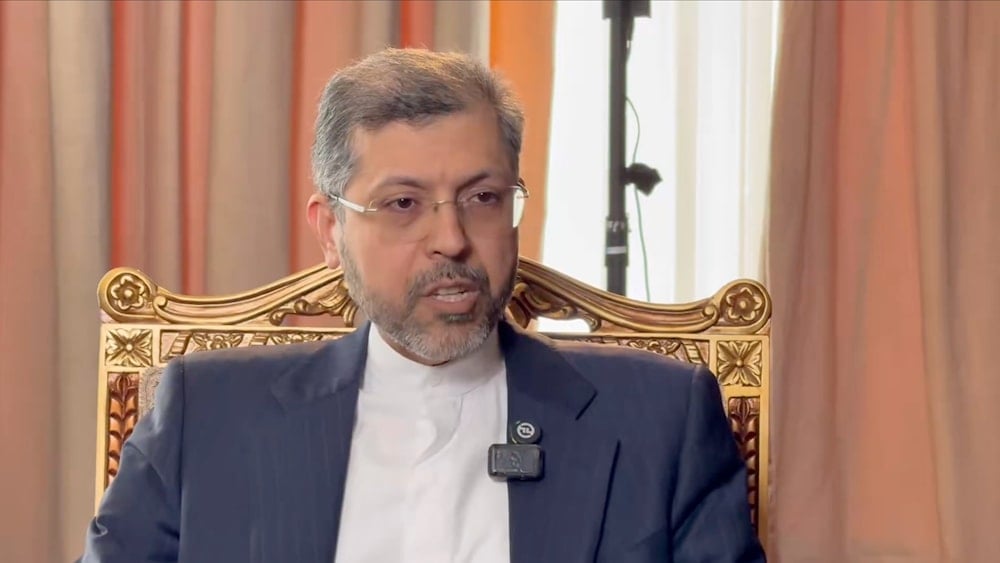
Iran’s Deputy Foreign Minister Saeed Khatibzadeh speaks during an interview with Emma Murphy in Tehran, warning that the coming hours are critical and stressing that any ceasefire must include Lebanon (screengrab, X/@emmamurphyitv)
Tehran came close to launching retaliatory action overnight in response to ongoing Israeli aggression on Lebanon, but deliberately held back following diplomatic exchanges involving the United States, Iran’s Deputy Foreign Minister Saeed Khatibzadeh stated on Thursday.
Speaking to ITV News in an interview with international editor Emma Murphy in Tehran, Khatibzadeh described the situation as “very critical", stressing that Iran had been left with “no option” but to respond to new “atrocities” carried out by the Israeli occupation before last-minute messages temporarily shifted the trajectory.
“Last night was a very critical night because we had no option just to respond to these new atrocities,” he said, adding that “a few back and forth” communications were relayed through Pakistani intermediaries as regional actors sought to contain the fallout of the aggression.
Khatibzadeh said Tehran chose to pause its response after receiving indications that Washington was pressing "Israel" to halt its attacks on Lebanon. “We hope that America could control its ally and this time honor their words,” he said, signaling cautious expectations that US assurances would translate into tangible restraint on the ground.
He noted that both Iran and the US are working toward a potential meeting in Pakistan, part of an ongoing diplomatic track aimed at reaching a broader settlement. “We hope that we can meet soon in Pakistan to wishfully reach a settlement and agreement for permanent peace in the whole Middle East,” he said.
Lebanon central to ceasefire
The Iranian official stressed that Lebanon remains at the core of any meaningful ceasefire, warning that excluding it would effectively legitimize continued Israeli aggression and render any agreement unsustainable.
“Lebanon is included in the ceasefire,” Khatibzadeh said, reaffirming that peace cannot be selectively applied while attacks persist against one front.
He framed Iran’s position as principled and consistent, arguing that Tehran does not enter negotiations lightly but remains committed once agreements are reached. “Iran has shown to everybody that [it] hardly negotiates, but when [it does] negotiate, [it] honor[s] its words,” he said.
Khatibzadeh also pointed to decades of destabilization driven by Israeli policies, arguing that the root cause of recurring crises in the region lies in the occupation’s conduct.
“Nobody can think of a peace in the Middle East, lasting peace in the Middle East, unless there is an inclusive agreement for everyone involved,” he said, adding that ensuring Lebanon’s inclusion is a “responsibility for everybody” engaged in the current diplomatic efforts.
In an interview for ITV News, Saeed Khatibzadeh affirmed that #Lebanon is included in the ceasefire between #Iran and the United States.
— Al Mayadeen English (@MayadeenEnglish) April 9, 2026
When asked, "How committed is Iran to Lebanon? If the attacks on Lebanon continue, will the ceasefire and your agreement be withdrawn?" the… pic.twitter.com/ez4ihKz4Il
Lebanon under fire
The remarks come as Israeli aggression against Lebanon continues unabated despite emerging ceasefire efforts.
Just hours after the ceasefire was announced between Tehran and Washington, "Israel" launched its largest wave of airstrikes since the start of the war, striking more than 100 locations across Beirut, the Bekaa, South Lebanon, and Mount Lebanon, killing over 250 people and wounding more than 1,000.
Earlier today, Iran’s Foreign Minister Abbas Araghchi reinforced this position in diplomatic contacts, stressing that any path toward de-escalation hinges on full adherence to the ceasefire across all fronts, warning that selective implementation would only prolong instability.
He further signaled that maritime transit through the Strait of Hormuz remains conditional and coordinated, stating that “no vessel can simply pass without coordination” and that safe passage is tied to compliance with ceasefire commitments.
Araghchi also described recent US-led actions as “wholly unprovoked, illegal, and illegitimate,” while reiterating in parallel discussions with regional counterparts that Lebanon must be included in any comprehensive settlement to prevent further escalation.
Read more: Qaani warns of punishment for perpetrators of brutality in Lebanon


