
Iran rejects any US-aligned military presence in Hormuz: Gharibabadi
 4 Min Read
Kazem Gharibabadi warns that French and British naval deployments to the region will escalate tensions, stressing Iran’s sovereignty and rejecting foreign military presence under the pretext of securing navigation.
-
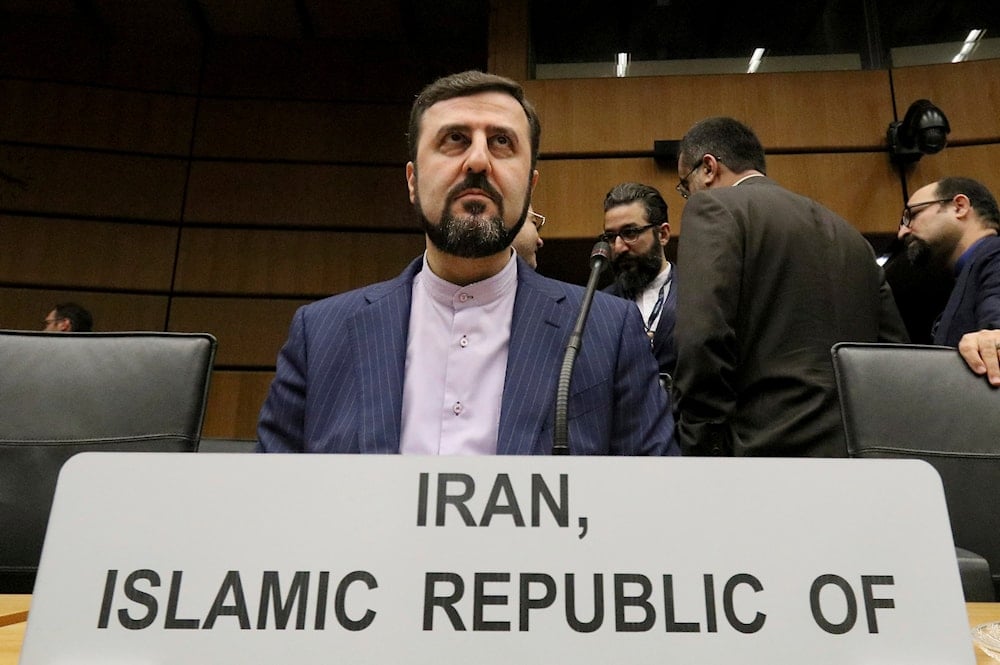
In this Thursday, Nov. 21, 2019 photo, Iran's assistant foreign minsiter, Kazem Gharibabadi, waits for the start of the IAEA board of governors meeting at the International Center in Vienna, Austria (AP)
Kazem Gharibabadi, Iranian Deputy Foreign Minister for Legal and International Affairs, warned that recent French and British naval movements toward the Red Sea and the vicinity of the Strait of Hormuz represent an escalation of tensions and the further militarization of a strategically sensitive waterway.
In remarks shared on X, Gharibabadi criticized attempts to justify military deployments under the pretext of protecting maritime navigation, stressing that such actions do not contribute to stability in the region.
Maritime security cannot be achieved through displays of military force, he added, stressing that the roots of instability in the region lie in the unlawful use of power, ongoing threats against coastal states, naval blockades, and disregard for the principles of the UN Charter.
He emphasized that the Strait of Hormuz is not a shared domain for external powers but a sensitive maritime passage adjacent to coastal states, affirming Iran’s right to exercise sovereignty over its territorial waters.
France and Britain’s military plans in the region
According to Gharibabadi, France has announced the deployment of its aircraft carrier Charles de Gaulle toward the Red Sea and the Gulf of Aden, as part of preparations for a joint mission with Britain aimed at enhancing so-called freedom of navigation in the Strait of Hormuz area.
He also noted that the British government has separately confirmed the dispatch of a warship to the same region. The United Kingdom said on Saturday it was deploying HMS Dragon to West Asia, Reuters reported.
These developments, he argued, reflect a broader pattern of increased Western military presence in maritime corridors that are already highly sensitive due to ongoing regional tensions and competing strategic interests.
Iran alone capable of ensuring maritime security
Reaffirming Iran’s stance, Gharibabadi said that the country alone is capable of ensuring security in the Strait of Hormuz and surrounding waters, and stressed that external interference under any pretext would not be accepted, warning that Iran would not allow foreign forces to impose themselves on regional maritime affairs.
The deputy foreign minister also underlined that Iran views the presence of foreign naval forces, particularly when aligned with unlawful US measures, as a destabilizing factor.
Gharibabadi linked regional insecurity to continued violations of international law, including the use of force against coastal states and the imposition of naval restrictions, noting that such practices undermine the principles of international maritime order and contribute to escalating tensions in already volatile waterways.
He further warned that any presence of French, British, or other foreign military forces accompanying these policies in the Strait of Hormuz would be met with a firm response from Iran’s armed forces.
Paris-London meeting
His comments also follow a recent meeting co-chaired by France and Britain in Paris, attended by representatives from around 40 countries, which reportedly focused on coordinating international efforts to “re-secure freedom of navigation” in the Strait of Hormuz once conditions allow.
According to the discussions, several US allies expressed readiness to take part in maritime security initiatives in the region, reflecting growing coordination among Western states on Gulf maritime policy.
In response, the commander of the Iranian Navy, Admiral Shahram Irani, stated on Sunday that Iranian submarines are "ready for operation, deployed and settled on the seabed".
Irani explained that keeping submarines positioned on the seabed "is a means of strengthening power in the Strait of Hormuz over extended periods and countering maritime vessels", adding that Iran’s domestically produced light submarines "are suited to the types of threats present in the strait".
Read more: Iran warns supporters of US sanctions against crossing Hormuz


