
Iran warns supporters of US sanctions against crossing Hormuz
 4 Min Read
The spokesperson of Iran's Army warns that countries supporting US sanctions will not be able to cross the Strait of Hormuz.
-
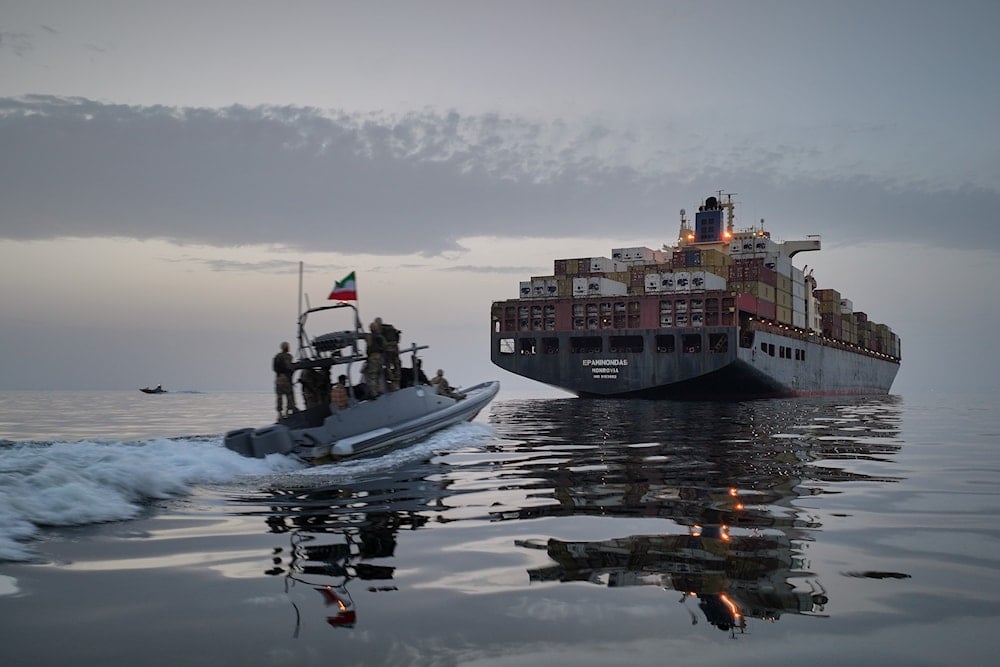
In this photo released by Tasnim News Agency, a Revolution Guard Navy (IRGC) speedboat approaches the cargo ship Epaminondas during the seizure of one of two vessels accused of violations in the Strait of Hormuz, on April 21, 2026. (Meysam Mirzadeh/Tasnim News Agency via AP)
Iranian Army spokesperson Brigadier General Mohammad Akrami Nia asserted on Sunday the enhancement of Iran's operational military capabilities and the refinement of its strategic target bank, while warning countries participating in US sanctions that they may face complications when transiting the Strait of Hormuz.
Brigadier General Akrami Nia issued a strong warning to international powers taking part in the blockade on Iran, stressing that countries imposing sanctions on Iran alongside the US will face difficulties when transiting the Strait of Hormuz.
He explained that Iran has demonstrated its military capabilities and has managed to withstand and carry out both offensive and defensive operations, noting that "the enemy was eventually forced to cease fire after realizing its inability to break the resilience of the Iranian armed forces".
He emphasized that Tehran "does not trust the enemy at all regarding a ceasefire", affirming the continued efforts to strengthen forces and military capabilities and to update the strategic "target bank".
Iran's military expansion and regional operations
In detailing air operations, the army spokesperson stated that the Iranian Air Force conducted several sorties at the outset of the war, during which fighter jets reached US bases in Kuwait, Qatar, and Erbil, successfully executed their missions, and returned safely to base.
On the naval front, Akrami Nia stated that claims of a blockade on Iran are intended to undermine Tehran’s management of the Strait of Hormuz through psychological and propaganda efforts, affirming that Iranian maritime trade continues to operate smoothly, with only a limited number of vessels reportedly detained according to international reports.
He also referred to the success of Iranian forces in preventing the passage and activity of vessels affiliated with the Israeli entity, as well as detaining them.
Brigadier General Akrami Nia concluded by asserting the failure of hostile objectives to destabilize the political balance of the system, stressing that the pressure has only led to greater internal unity and cohesion in the face of challenges.
Iranian unmanned speed boats pose challenge to US Navy in Hormuz
On a related note, Western military officials and experts have said that Iran’s fleet of small, fast attack boats remains a stubborn military challenge for the US Navy, capable of confronting US warships and targeting commercial shipping despite US and Israeli airstrikes that allegedly destroyed many of Tehran’s larger vessels.
While US airstrikes destroyed many of Iran’s larger warships early in the US-Israeli aggression, Iran retains a significant number of smaller craft, according to military officials. Those vessels can be armed with shoulder-fired missiles and machine guns or used to deploy naval mines.
Iran deployed such craft in its recent retaliatory attack on US guided-missile destroyers in the Strait of Hormuz, US Central Command said. At least one frigate was hit by fire from a speedboat, officials said. On Monday, US military helicopters destroyed six Iranian boats during an operation in the Strait, Central Command added.
Military experts estimated that Iran possessed hundreds of speedboats before the war. As of April, roughly 60% of those boats remained intact, according to one military analyst.
Like Iran’s one-way attack drones, the small boats are central to Tehran’s doctrine of asymmetric warfare, which relies on cheaper, more expendable systems to challenge a technologically superior adversary.


