
Iran rejects US CENTCOM claim over Minab school strike
 3 Min Read
Iranian Foreign Ministry spokesperson Esmail Baghaei rejected US CENTCOM claims over the Minab school strike that killed more than 170 students and teachers.
-
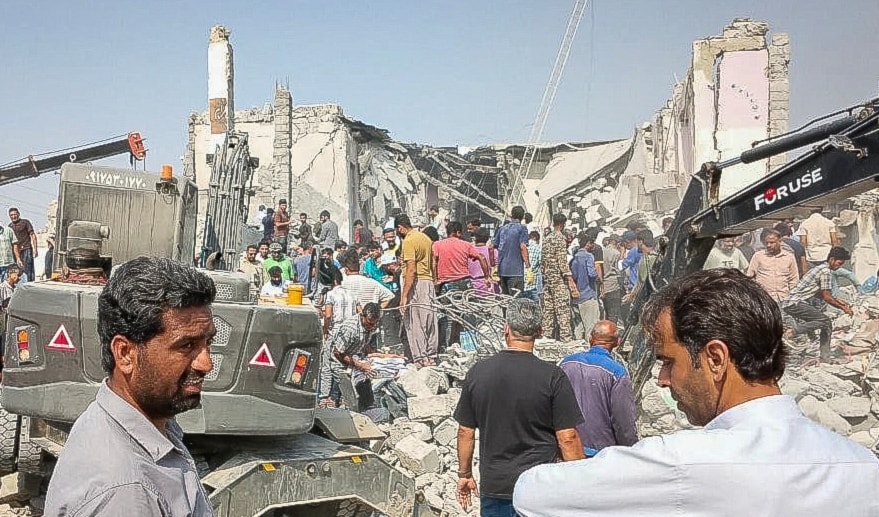
The site of the US-Israeli strike on a girls' elementary school in Minab, in Iran's southern Hormozgan province, on February 28, 2026. (Photo by ALI NAJAFI / ISNA / AFP)
Iranian Foreign Ministry spokesperson Esmail Baghaei has strongly rejected claims attributed to the United States Central Command (CENTCOM) regarding the strike on the Shajarah Tayibah School in Minab, which killed more than 170 students and teachers.
In a post on the platform X, Baghaei dismissed the CENTCOM assertion that the girls’ primary school was located within the perimeter of a missile facility, describing it as “a baseless fabrication and an appalling lie.”
The claim by U.S. Central Command (CENTCOM) that the targeted #Shajareh_Tayyebeh Elementary School in #Minab was located within a "missile launch facility" is a baseless fabrication and an appalling lie.
— Esmaeil Baqaei (@IRIMFA_SPOX) May 19, 2026
This shameless distortion is a clear attempt to obscure the severe…
Clear violation of international humanitarian law
Baghaei stressed that the targeting of an active educational center during school hours “constitutes a grave violation of international humanitarian law and is a clear war crime.”
He added that the civilian nature of the site cannot be obscured through “technical misrepresentations.”
The spokesperson further called for the prosecution of US military commanders and officials responsible for ordering and executing the attack, urging full accountability under international law.
US strike on Iranian school caused by human error, not AI: Semafor
Earlier in March, an investigation by Semafor revealed that the US bombing in Minab was the result of human error, not artificial intelligence.
While public debate has increasingly focused on the role of AI in modern warfare, those with insight into the bombing campaign say the failure lies squarely with the human systems used to identify and approve targets.
According to Semafor, US military targeting relies on extensive databases compiled well in advance of conflict, built by thousands of analysts who process satellite imagery and intelligence inputs. In this case, officials failed to detect subtle but critical changes on the ground, while intelligence analysts either missed or failed to incorporate publicly available information indicating that a functioning school was located within the supposed IRGC compound.
The oversight proved catastrophic. Analysts did not update or flag the site as civilian, leaving it on target lists despite evidence that could have prevented the strike.
Those familiar with the process say the error reflects a broader limitation of human-led intelligence systems, which can struggle to keep pace with evolving conditions and large volumes of data. By contrast, AI systems, despite their own well-documented flaws, are capable of processing far greater amounts of information and cross-referencing sources in ways that might have identified the school before the strike.
“Finding the right balance between humans and machines will be a crucial component of future training,” Jack Shanahan, a former senior US military official and founding director of the Pentagon’s Project Maven AI program, told Semafor.
Read more: Over 230 students martyred as US-"Israel" destroy 600 schools in Iran


